

REQUEST DEMO
Robot CATALOG will be sent to your mailbox immediately after submission.
SUBMIT
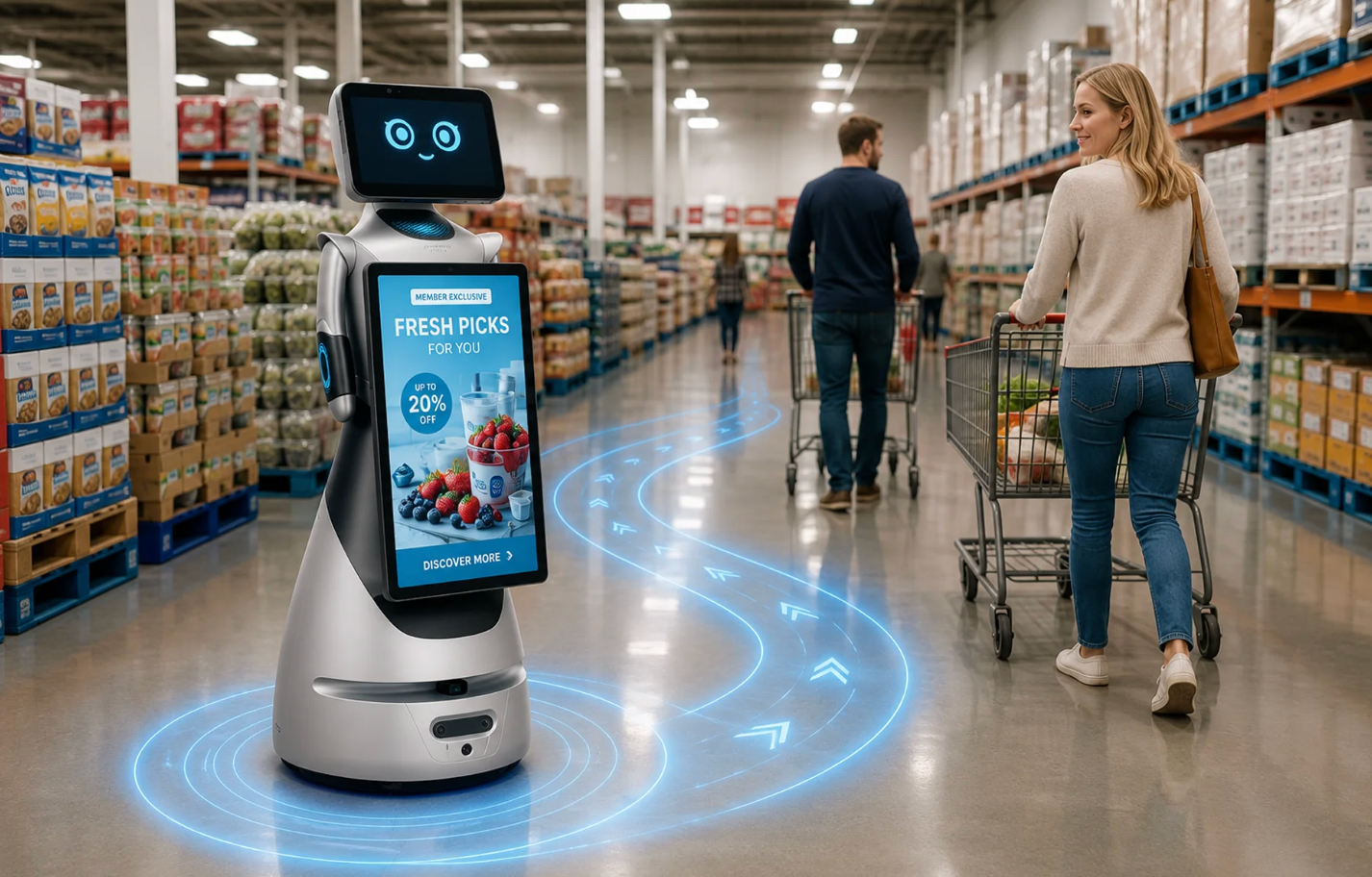
The consumer electronics retail sector continues to face a deeply strained labor market within physical electronics stores, where labor accounts for roughly 70% of total business spending and understaffing frequently pulls floor staff in multiple directions. As shoppers increasingly engage in "webrooming"—researching products online before arriving at the store for side-by-side comparisons and validations—the demand for high-touch, immersive experiences places enormous pressure on lean retail teams. To bridge the gap between elevated customer expectations and constrained workforce capacity, AI service robots are emerging as a scalable, digital-first solution to manage front-of-house interactions without requiring additional headcount.
The OrionStar GreetingBot AD exemplifies these general capabilities by functioning as a mobile AI service platform equipped with a 21.5-inch FHD chest-mounted display, according to manufacturer data. Navigating environments of up to 50,000 square meters using LiDAR and multiple sensors, the robot handles autonomous leading and patrol while a 6-microphone circular array enables 360-degree sound source localization for natural face-to-face interactions. Supported by a 20 Ah battery that provides approximately 8 to 10 hours of runtime depending on workload, this platform operates as an interactive digital signage and wayfinding tool that supplements floor staff without requiring constant recharging.
Electronics stores often struggle to greet sudden influxes of customers while managing queues, leading to frustration if wait times exceed nine minutes. A greeting robot acts as an immediate first point of contact, triaging basic inquiries and displaying daily promotions to stabilize the initial shopper experience.
Customers expect immersive demonstrations of connected devices, which frequently ties up specialized sales associates for extended periods. The robot serves as a roaming concierge in these zones, matching customer-stated use cases to compatible IoT devices and explaining basic integrations before handing them off to human staff for final configuration.
Lean staffing at customer service desks frequently causes bottlenecks for simple requests like store directory searches or product locations. By utilizing built-in touch screens and voice interaction, robots handle these repetitive wayfinding tasks, allowing human associates to focus on complex returns, technical support, and warranty processing.
In complex electronics store environments, greeting robots do not operate in isolation but integrate directly with the broader smart retail ecosystem. Utilizing standard connectivity infrastructure like dual-band Wi-Fi 6 and 4G networks, these robots can connect to point-of-sale and CRM platforms to provide accurate, real-time information on product features, pricing, and availability. Furthermore, their large chest displays function as dynamic extensions of the store's digital signage network, showing QR codes for loyalty programs or guiding shoppers toward specific audio/video demonstration zones, effectively bridging online data with physical floor experiences.
Ultimately, aligning automation with ESG frameworks helps electronics retailers modernize their operations while maintaining responsible environmental practices and data protection standards.
AI service robots are fundamentally changing how the consumer electronics retail industry manages the customer experience within physical electronics stores by providing a scalable, interactive touchpoint that balances immersive digital engagement with operational efficiency. As physical retail continues to adapt to highly educated shoppers and persistent labor constraints, integrating automated front-of-house solutions ensures that human staff can focus on the high-value technical interactions that drive the industry forward. For operators seeking to implement these technologies, the OrionStar GreetingBot Pro series offers various configurations designed to adapt to different venue requirements and ecosystem integrations.