

REQUEST DEMO
Robot CATALOG will be sent to your mailbox immediately after submission.
SUBMIT
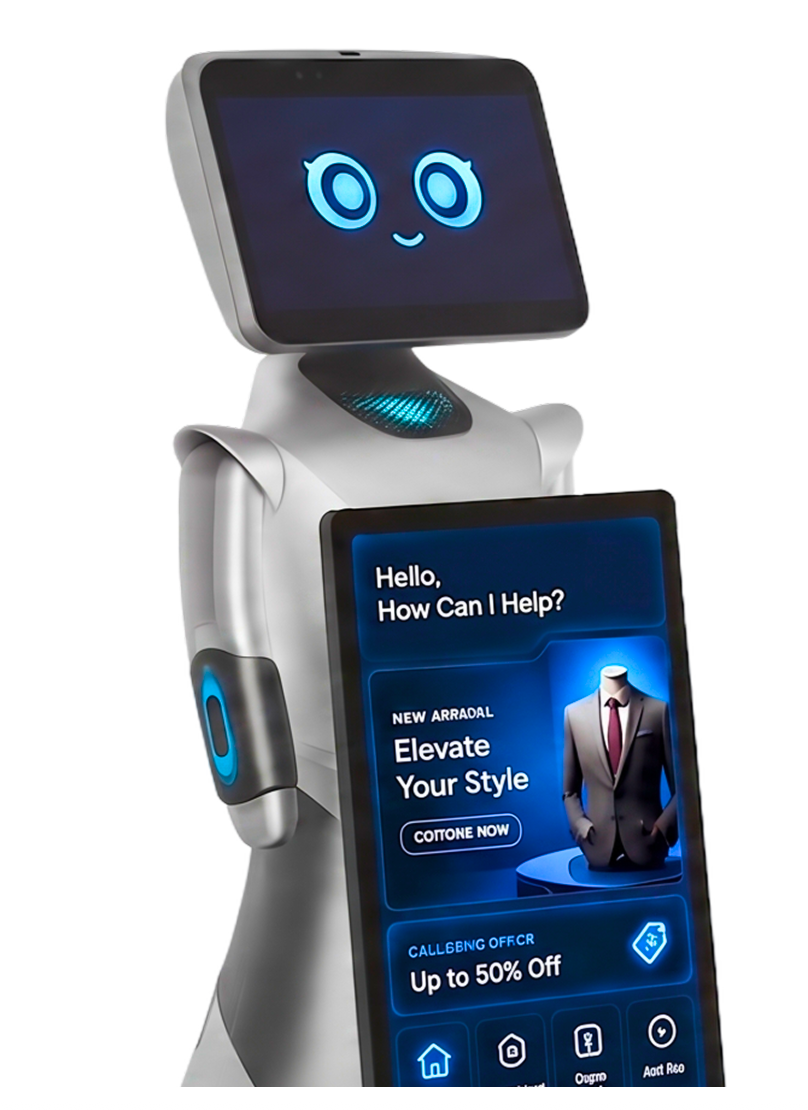
For facility managers, building service contractors, and mall operations managers, balancing operating costs with front-of-house tenant expectations is a primary challenge in 2024–2025. According to the JLL Global State of Facilities Management Report 2025, 84% of FM leaders cite escalating operating costs as their top concern. Simultaneously, severe labor shortages—with 74% of global employers struggling to find skilled talent—make staffing consistent information desks during peak weekend or holiday hours increasingly difficult.
To bridge this gap, commercial real estate operators are evaluating automated solutions. The GreetingBot AD (Large-Screen Edition) is designed to address these specific front-of-house operational pain points. By combining AI-driven interaction with dynamic digital signage, this greeting robot offers a measurable way to maintain visitor engagement, provide wayfinding, and deliver tenant promotions without relying solely on expanding human headcount.
This guide evaluates the capabilities of the OrionStar GreetingBot AD and its practical application within high-footfall shopping mall environments.
Historically, mall operations have relied on separate systems for visitor interaction and information delivery: human staff at central information desks, and static or fixed digital signage throughout concourses. The OrionStar GreetingBot AD consolidates these functions.
The Large-Screen Edition is characterized by its dual-display architecture. It features a 14-inch FHD 1080P touch screen on the head for direct capacitive interaction, paired with a high-visibility 21.5-inch FHD 1080P display mounted on the chest. This design allows the unit to act as an interactive waypoint while simultaneously operating as an advertising robot that broadcasts tenant promotions, event schedules, or dynamic wayfinding maps. By handling repetitive visitor inquiries—such as store locations or bathroom directions—the robot frees human staff to handle more complex tenant or security needs.
Shopping malls present dynamic, high-traffic physical environments. A mobile service device must navigate around temporary kiosks, seasonal displays, and unpredictable pedestrian traffic.
\Mapping area and navigation accuracy are based on optimal indoor conditions. Reflective surfaces (e.g., glass storefronts) or direct sunlight may affect sensor performance.*
For mall operations managers, a device's uptime dictates its return on investment. A mobile service robot requires sufficient battery endurance to handle peak weekend hours continuously without mid-shift charging interruptions.
To support the power draw of the additional 21.5-inch chest display, the Large-Screen Edition is equipped with an upgraded 20 Ah (529.2 Wh) lithium ternary battery, compared to the standard model's 15 Ah. Under typical configurations, this yields an estimated runtime of 8 to 10 hours depending on screen brightness, continuous mobility, and workload. To ensure quick turnaround for the next day, the unit utilizes a 29.4 V / 8 A charging dock, enabling a full recharge in approximately 5 hours (powered off) or 6 hours (powered on).
For larger facilities requiring multiple units, the system supports ESP32-based multi-robot scheduling. Facility managers can deploy several units across different wings of a mall, managing their promotional content and wayfinding updates centrally via cloud connectivity (Wi-Fi 6 or 4G LTE), aligning with the growing FM expectation for remote dashboard management and over-the-air (OTA) updates. For venues with varying dimensional needs, the broader OrionStar GreetingBot series offers multiple configurations to suit different architectural layouts.
Deploying a mobile device equipped with a 2 MP wide-angle camera, a 13 MP high-definition camera, and active microphones in a public shopping mall requires strict adherence to data protection regulations, notably GDPR in Europe or CCPA in the United States.
When a device acts as a mobile reception robot, it inherently captures visitor images and audio. Facility managers must be aware that processing personal or biometric data in commercial premises is subject to high regulatory scrutiny. For example, recent rulings by European Data Protection Authorities have heavily restricted the use of facial recognition in shopping malls based on purpose-limitation principles.
Before deployment, operators must: 1. Verify with the vendor exactly how voice and visual data are processed, stored, and routed (particularly concerning cloud endpoints and OTA servers). 2. Conduct a Data Protection Impact Assessment (DPIA) if biometric categorisation is utilized. 3. Configure data-retention settings to the minimum operational requirements. 4. Ensure clear, visible signage is placed at mall entrances notifying visitors of active robotic camera and audio operations.
Disclaimer: OrionStar provides hardware and baseline software capabilities. The end-user (facility operator) is solely responsible for ensuring that the collection, processing, and storage of any audio, video, or biometric data comply with local privacy regulations, including GDPR and CCPA. Proper visitor notification and data retention policies must be independently established by the venue.
Ultimately, deploying the OrionStar GreetingBot AD optimizes the Total Cost of Ownership (TCO) and significantly enhances operational efficiency—metrics that are paramount for facility managers. By automating routine inquiries and centralizing dynamic digital signage, operators can reallocate human staff to higher-value tasks, successfully navigating labor shortages while consistently maintaining a premium tenant and visitor experience.
Does the OrionStar GreetingBot AD use its arms to point visitors to stores? In the Large-Screen Edition, arm motion is disabled by default. This is a deliberate hardware configuration to prevent the robot's arms from physically interfering with the 21.5-inch chest display. While secondary-development customers can theoretically reconfigure this, it is designed primarily as a screen-based wayfinding and engagement tool out of the box. However, the software remains flexible, allowing System Integrators (SIs) to enable and program custom arm gestures if specific use cases require it.
Can the robot operate on different types of mall flooring? Yes. The robot utilizes 5.5-inch hub motors and 2-inch casters, designed to operate on wood, cement, marble, low-pile hard carpet, and similar hard indoor surfaces typical of modern shopping centers.
How does facility management update the content on the 21.5-inch screen? The robot runs on Agent OS (a deeply customized system based on Android 13) and connects via Wi-Fi 6 or 4G. Content updates, such as switching a morning food court promotion to an evening retail sale, can be managed digitally via remote management platforms without requiring a technician to manually update the device on the mall floor.