

REQUEST DEMO
Robot CATALOG will be sent to your mailbox immediately after submission.
SUBMIT
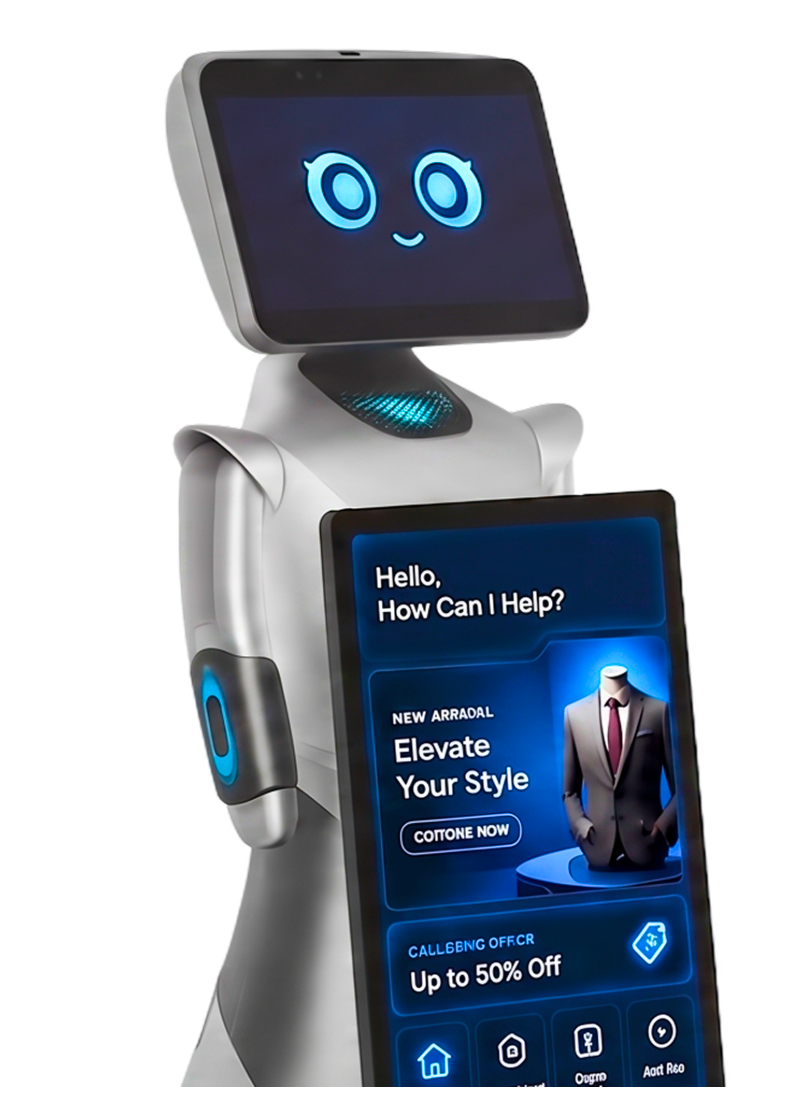
Department store operators, retail marketing directors, and store managers face sustained pressure to bridge the gap between digital e-commerce convenience and the physical retail experience. As brick-and-mortar retail contends with rising labor costs and frontline staff shortages, the manual overhead required to maintain fresh, engaging in-store communications has become a significant operational bottleneck.
To address these pain points, retailers are increasingly evaluating mobile digital solutions. This guide examines the OrionStar GreetingBot AD as an advertising robot within the department store context, detailing how its technical specifications align with the realities of high-footfall retail environments.
Managing a large-format department store involves orchestrating campaigns across distinct zones, each with unique traffic patterns and customer expectations. Industry research indicates that legacy marketing infrastructure presents several specific challenges:
The OrionStar GreetingBot AD is engineered to integrate proactive greeting, mobile digital signage, and guided selling into a streamlined autonomous platform. Rather than acting as a static kiosk, it leverages mobility and multi-modal interaction to deliver content directly to high-value traffic zones.
A core technical feature of this model is its dual-display setup, featuring a 14-inch FHD 1080P capacitive touch screen on the head and a larger 21.5-inch FHD 1080P display mounted on the chest. For retail marketing directors, this allows for a strategic division of utility: the chest display acts as a broadcast medium for high-definition video, digital menus, or brand campaign assets, while the head screen facilitates direct, one-on-one customer interaction, such as loyalty program sign-ups or interactive store directories.
Unlike fixed digital signage, the robot can be dynamically routed to areas with the highest footfall based on the time of day. According to manufacturer data, the robot utilizes a sensor array including LiDAR, wheel odometers, IMU, and cameras to achieve centimeter-level positioning. It can map areas up to 50,000 square meters and navigate passages as narrow as 60–65 cm under straight-line conditions, at adjustable speeds of 0.5 to 1.2 m/s. This allows store managers to deploy the unit at main entrances during morning opening hours, and subsequently route it to cosmetics and beauty floors or specific brand concessions during peak afternoon shopping times.
To function effectively in a noisy retail environment, an advertising robot requires robust audio-visual hardware. The OrionStar GreetingBot AD features a 6-microphone circular array with 360-degree sound source localization, paired with dual 5 W speakers and advanced noise-cancellation algorithms suitable for typical retail ambient noise. A 2 MP wide-angle camera and a 13 MP high-definition camera facilitate face-to-face engagement. The robot also incorporates a dedicated head pitch motor, allowing the head to tilt from −15° to +40°, enabling a more natural line of sight when interacting with customers of varying heights.
Continuous operation is a baseline requirement for department store deployments. To support the power demands of the 21.5-inch chest display and computational systems, this model is equipped with a 20 Ah (529.2 Wh) lithium ternary battery. Under defined test conditions, this supports a runtime of approximately 8 to 10 hours, depending on screen brightness, interaction frequency, and ambient conditions. The system pairs with an upgraded 8 A charging dock, enabling the robot to autonomously recharge during off-hours (taking approximately 5 to 6 hours when powered off) to ensure readiness for the next business day.
Deploying a mobile promotional robot transitions in-store advertising from a static, manual process to a centralized, digital one. While exact return-on-investment figures for mobile robots in specific department stores vary by deployment, industry data regarding digital in-store advertising serves as a strong quantitative proxy. Market research (MarketsandMarkets, 2026 insight) indicates that dynamic digital signage in retail settings can increase overall sales by approximately 29% to 33%, with repeat-buyer activity increasing by around 30%. Furthermore, customer satisfaction rises by more than 45% when digital displays are utilized for wayfinding and promotions.
From an IT and operations perspective, the robot runs on Agent OS, an operating system customized on an Android 13 foundation, supported by a Qualcomm 8-core processor, 8 GB of RAM, and 128 GB of ROM. Equipped with Wi-Fi 6 and standard 4G (TDD-LTE/FDD-LTE) connectivity, the unit is designed to integrate with cloud-based content management systems (CMS). This enables marketing teams to push over-the-air (OTA) updates, synchronize promotional content across multiple store locations, and manage multi-robot fleets programmatically without relying on local floor staff.
Because the OrionStar GreetingBot AD relies on microphones, cameras, and network connectivity to function and gather engagement metrics, department store operators must carefully evaluate data protection regulations prior to deployment. For venues operating within the European Union, or those serving EU residents, compliance with the General Data Protection Regulation (GDPR) is mandatory.
Operators must establish a lawful basis for any data processing, such as explicit consent or legitimate interest. Crucially, the principle of data minimization dictates that the robot should process strictly necessary data for its function. If the robot utilizes its hardware to measure demographic engagement with advertisements, operators must ensure this data is processed locally on the edge device, anonymized, or aggregated, avoiding the persistent storage or cloud transmission of identifiable biometric data.
Retailers are responsible for configuring the software to adhere to privacy-by-design principles, maintaining audit logs, ensuring data residency compliance (such as utilizing local EU servers for cloud CMS), and providing mechanisms for shoppers to opt out of automated profiling. Store managers must consult their legal teams to verify compliance with GDPR, the EU ePrivacy Directive, and applicable local data protection frameworks before activating analytical features on the shop floor.
How does the robot navigate complex, multi-level department stores? The robot utilizes LiDAR and V-SLAM technologies to navigate autonomously on a single floor, avoiding temporary obstacles like displays or shoppers. For multi-level operations, the chassis features a reserved interface for an optional elevator-control module, which requires specific integration with the building's infrastructure.
Are there alternative form factors if the 21.5-inch display is not required for a specific department? Yes, the broader OrionStar GreetingBot series includes multiple configurations. For departments where a smaller footprint is prioritized over broadcast advertising, operators can evaluate standard models equipped solely with the 14-inch interactive head screen.
How does a promotional robot handle continuous daily operation without burdening staff? The hardware is designed for low-intervention operation. With up to 8–10 hours of runtime (subject to usage patterns), the robot covers a standard retail shift. It automatically navigates back to its LiDAR-aligned charging dock when battery levels drop, and content updates are handled remotely via cloud connectivity, requiring minimal physical interaction from in-store employees.