

REQUEST DEMO
Robot CATALOG will be sent to your mailbox immediately after submission.
SUBMIT
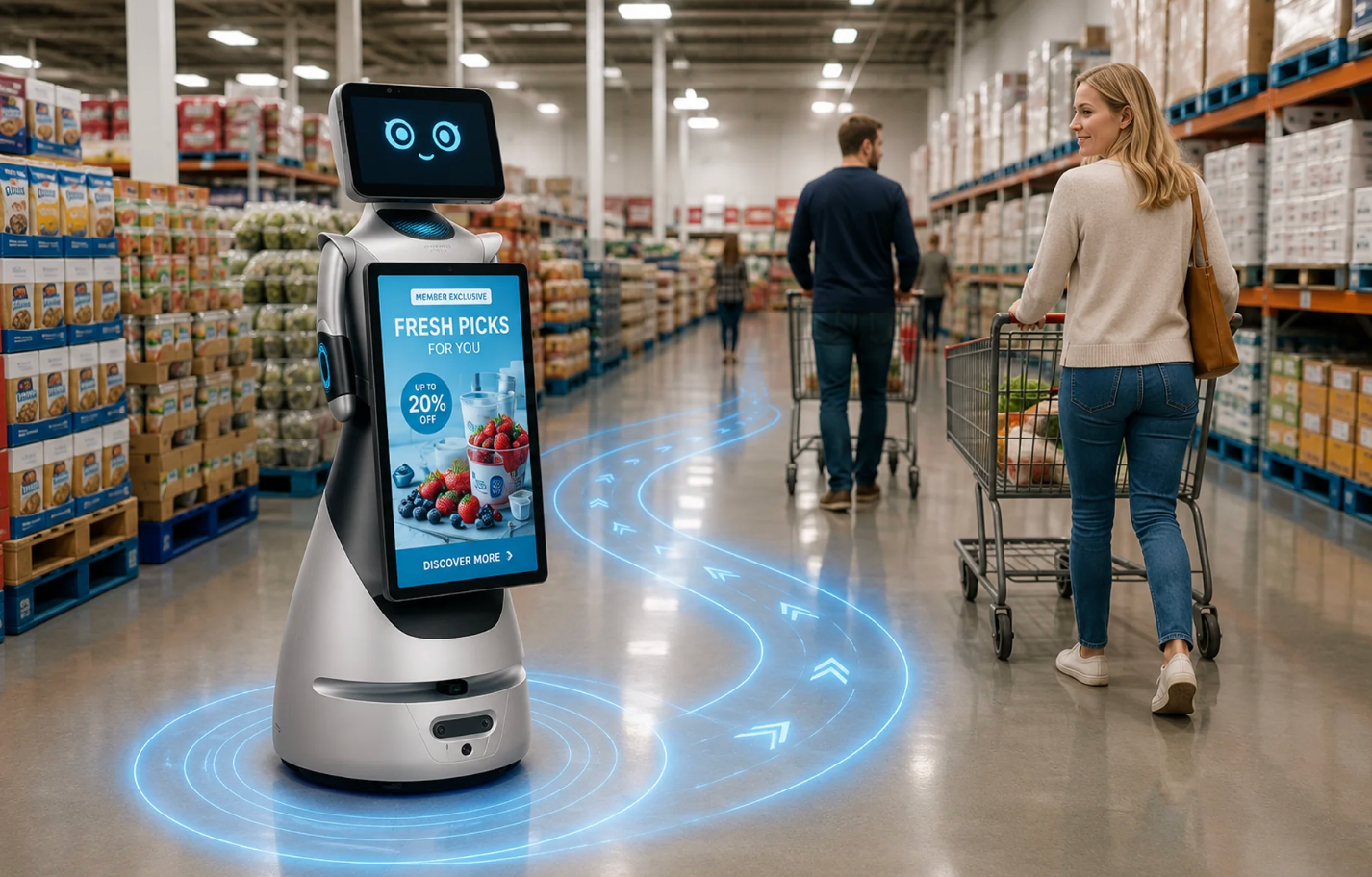
Supermarket retail has reached a critical turning point as operators face profound demographic and operational shifts. Working-age populations are declining across major economic zones, and physical retail environments are feeling the impact of these labor constraints acutely. Therefore, maintaining consistent front-of-house service has become increasingly difficult without escalating operational costs. Meanwhile, customer expectations for immediate assistance and seamless store navigation continue to rise. This intersection of a tightening labor market, rising service demands, and evolving commercial requirements dictates a new approach to physical retail operations. Fortunately, the maturity of autonomous spatial technology and edge computing makes large-scale deployments highly viable today. As a result, operators are adopting automated systems to manage foundational tasks. In short, reception robots have emerged as a definitive industry-level solution. They address immediate frontline pressures by handling routine interactions, directing foot traffic, and maintaining a constant digital presence.
These pressures collectively point to one conclusion—the traditional manual operating model is unsustainable.
To address varying spatial and operational demands, the OrionStar GreetingBot series provides a differentiated, dual-model solution for supermarkets. Rather than presenting a single standard unit, the series deploys specific models to cover distinct functional zones. The GreetingBot AD is designed for highly visible, high-traffic areas such as store entrances, customer service desks, and broad promotional zones. According to manufacturer data, it features a 21.5-inch FHD chest display alongside a 14-inch head touch screen, with a runtime of up to 8–10 hours depending on workload, screen usage, and ambient conditions. This dual-screen configuration makes it an ideal digital signage panel and interactive greeter, capturing customer attention immediately upon entry and displaying active promotional campaigns.
Conversely, the GreetingBot Mini is built for tighter, more constrained spaces within the store. According to manufacturer data, it requires a minimum passable width of just 55 centimeters, allowing it to navigate seamlessly through narrow retail aisles and busy checkout areas. It utilizes a 14-inch FHD display to assist with localized product promotions and wayfinding. Moreover, it supports automatic recharging, enabling continuous cycle service throughout long retail operating hours.
These two models operate with a complementary logic. The GreetingBot AD anchors the main public spaces with large-scale visual engagement, while the compact GreetingBot Mini handles dynamic navigation and targeted assistance deep within the store. Above all, they integrate seamlessly into broader digital operations through standard 4G connectivity, Wi-Fi 6, and centralized multi-robot scheduling platforms. Because these connected systems rely on cameras, microphones, and network-based content management, operators remain the data controller and should verify before deployment that data collection, retention, and signage arrangements comply with GDPR and local privacy rules. In practice, that means defining a lawful basis, limiting what is captured to what the service requires, and informing shoppers clearly at the entrance.
These results are not theoretical; they represent the reality that store managers, retail operations directors, and customer experience managers are already validating.
The ongoing digital transformation of physical retail points toward workforce redesign rather than simple labor replacement. Automation specifically exists to elevate human employees by removing repetitive, large-scale tasks from their daily routines. In a busy supermarket, a reception robot handles clearly bounded duties such as greeting incoming visitors, providing store directions, and displaying daily promotions. Consequently, store employees are freed from constant interruptions.
Instead of running front-of-house wayfinding loops, staff members can redirect their focus toward high-value work. They manage complex customer needs, handle exceptions, ensure store safety, and resolve accessibility challenges requiring human judgment. Moreover, this transition creates demand for distinct professional skills. Retail operations directors and store managers must now define task boundaries, establish service-quality checks, and oversee active fleet management. Customer experience managers take on new responsibilities to ensure that technology integrations optimize service accessibility without alienating shoppers. Ultimately, technology supports the human workforce, allowing staff to deliver a better, more focused retail experience.
As operational pressures mount, automated service platforms are rapidly shifting from experimental projects to essential infrastructure in supermarket retail. Forward-looking operators recognize that scalable automation is required to maintain consistent service standards amid tightening labor markets. The OrionStar GreetingBot series directly reflects this maturity, providing distinct models capable of adapting to varied spatial constraints and specific operational use cases. By utilizing targeted robotic platforms, supermarkets can systematically bridge the gap between static workforce capacity and growing consumer demands. Moving forward, the successful physical retail environment will be defined by its ability to seamlessly integrate digital intelligence with human oversight. Retailers who effectively orchestrate this collaboration will fundamentally stabilize their operational foundations for the future.