

REQUEST DEMO
Robot CATALOG will be sent to your mailbox immediately after submission.
SUBMIT
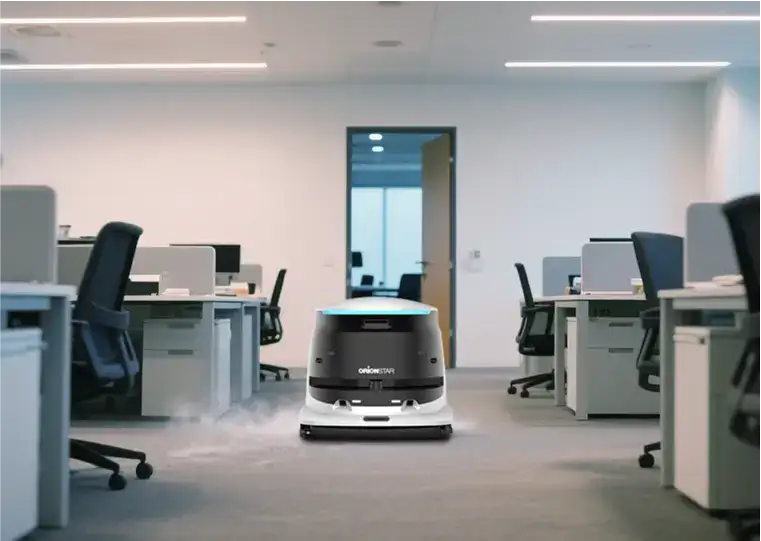
Integrated facility management (IFM) providers and building service contractors face mounting structural pressures in commercial building operations. With commercial contract cleaning experiencing annualized employee turnover rates frequently ranging from 200 percent to 400 percent, maintaining consistent service delivery has become increasingly difficult. Recruiting and onboarding a single replacement employee can cost up to USD 3,000, while wage inflation has pushed fully loaded labor costs to approximately USD 25 to USD 31 per hour in many Western markets.
In response to these labor constraints and the growing tenant demand for documented proof of service, facility managers are evaluating an autonomous floor scrubber as a standard operational tool. This guide examines how the OrionStar CleaniBot S55 Pro aligns with the specific cleaning requirements, sub-spaces, and compliance expectations of modern commercial buildings.
For contractors managing commercial building portfolios, the primary challenge is executing repetitive floor maintenance across large square footages without exhausting labor budgets.
Historically, repetitive floor scrubbing in facilities exceeding 50,000 square feet has been difficult to staff, particularly during overnight shifts. When manual cleaning routes are compromised by staff fatigue or absenteeism, it creates service-level agreement (SLA) risks. Furthermore, modern tenants and facility owners increasingly expect digital logs and telemetry to verify that spaces have been cleaned, a standard that manual processes struggle to meet consistently.
Deploying a robotic floor scrubber addresses these core issues by decoupling routine floor maintenance from daily labor availability. Industry modeling indicates that, depending on local labor rates and deployment frequency, autonomous machines can often demonstrate a 9- to 18-month payback period (supported by industry ROI models such as Sproutmation and Dataintelo) for sites with daily cleaning needs and more than 50,000 square feet of repeatable space by reallocating human staff to higher-value, detailed tasks.
The OrionStar CleaniBot S55 Pro is engineered to handle multiple floor care functions within a single platform, utilizing its InstantClean Floor Care System. According to manufacturer data, it integrates sweeping, scrubbing, vacuuming, mopping, and self-cleaning capabilities.
Commercial lobbies and common spaces require frequent maintenance but are sensitive to noise and disruption. The CleaniBot S55 Pro features an ECO Vacuum mode and a Dust Mop mode designed specifically for these environments. Under defined test conditions, the machine operates at a noise level of 45 dB in Dust Mopping mode, making it suitable for daytime deployment near tenants and visitors. Additionally, the battery system (25.6 V / 40 Ah) supports extended operation in these low-power modes, delivering up to 19.5 hours of runtime in ECO Vacuum and up to 28 hours in Dust Mop mode, allowing for continuous dust control across expansive hard-floor atriums.*
\Actual runtime may vary based on floor material, friction, and environmental temperatures.*
Corridors experience heavy foot traffic and require deeper cleaning to remove localized soil. For these areas, the operator can utilize the Scrubbing or Power Scrubbing modes. The robot utilizes a 550 mm main brush cleaning width, achieving a cleaning efficiency of up to 1,197 m²/h in scrubbing mode according to manufacturer specifications.
Navigating narrow commercial hallways is supported by the unit's physical dimensions (650 × 580 × 550 mm) and a minimum passing width of 700 mm. To maintain edge-to-edge cleanliness along corridor baseboards, the robot incorporates line lasers that allow it to clean at a default distance of 10 cm from walls, adjustable down to 5 cm depending on the operational configuration.
Operating an autonomous floor scrubber safely in dynamic commercial buildings requires robust environmental sensing and strict adherence to data protection standards.
The CleaniBot S55 Pro is equipped with a multi-sensor array designed for 360-degree environmental awareness. The navigation system relies on a LiDAR sensor capable of constructing single continuous maps up to 10,000 m², depending on layout complexity, supported by auto-positioning and real-time map updates. For localized obstacle avoidance and safety, the robot utilizes ultrasonic sensors to detect dynamic objects (such as pedestrians or temporary signage) and a stereo camera for cliff and step detection, minimizing the risk of falls near stairwells.
Because the CleaniBot S55 Pro utilizes stereo cameras and LiDAR for navigation, obstacle avoidance, and real-time map updates, deploying organizations must carefully manage data privacy. In commercial buildings within the European Union or other regulated jurisdictions, the operation of camera-equipped robots falls under the General Data Protection Regulation (GDPR) or applicable local laws.
Facility managers and building service contractors act as the data controllers and must ensure compliance. This typically involves conducting a Data Protection Impact Assessment (DPIA), implementing strict data minimization principles (ensuring camera data is processed solely for navigation rather than surveillance), and deploying adequate signage to inform tenants and visitors. Operators must verify that any cloud-connected mapping or telemetry features align with local data retention and privacy requirements.
Beyond physical cleaning, modern facility management relies on data transparency and equipment reliability.
To meet the audit and reporting expectations of commercial clients, the CleaniBot S55 Pro supports Wi-Fi and 4G network connectivity. This infrastructure allows for over-the-air (OTA) updates, remote deployment configurations, and data reporting. Access to operational telemetry enables facility managers to generate the "digital confirmation of clean" required for SLA verification and compliance audits.
To ensure the machine remains productive, the daily maintenance requirements have been designed for practical execution by onsite staff. The robot features a 22 L clean water tank and a removable 15 L wastewater tank. The wastewater tank utilizes a washable design with a strainer, allowing it to be fully immersed in water for thorough rinsing and routine odor management. Additionally, the robot supports no-tool mode switching and features modular cleaning tools, enabling operators to transition between sweeping, scrubbing, and mopping configurations without specialized equipment.
The structural labor challenges in the Integrated Facility Management sector require tools that deliver verifiable, consistent outcomes. By combining multi-mode cleaning capabilities, extensive runtimes for common areas, and digital telemetry, the OrionStar CleaniBot S55 Pro offers a practical solution for standardizing floor maintenance in commercial buildings. By decoupling floor care from labor availability, the CleaniBot S55 Pro transforms an unpredictable OPEX into a manageable, measurable asset. As part of the broader OrionStar CleaniBot series, which provides multiple models to accommodate different facility sizes and complexities, the S55 Pro serves as a reliable solution for building service contractors aiming to meet stringent cleanliness standards.
How does an automated floor cleaning robot handle transitions between different floor types? The CleaniBot S55 Pro supports zone-based mode switching. Once programmed, the machine can automatically transition its cleaning behavior—such as switching from active scrubbing on hard corridor floors to ECO vacuuming in quieter zones—based on the parameters established during the initial mapping and setup phase.
What is the charging cycle for the CleaniBot S55 Pro? The robot is equipped with a charging dock and supports automatic recharging. According to manufacturer data, a full charge cycle takes less than 4 hours, which allows facility managers to deploy the machine for a heavy scrubbing shift overnight, recharge it, and run a quiet dust-mopping route during daytime operating hours.
How does the system ensure safety around building occupants? The robot utilizes a combination of physical and sensor-based safety mechanisms. It includes an emergency stop button, ultrasonic sensors for dynamic obstacle avoidance, and a stereo camera for step detection. Its maximum operating speed is capped at 1.2 m/s, aligning with safe operational parameters for public commercial spaces and structural safety standards such as EN IEC 63327 and CE-MD.
Note: Telemetry and OTA mapping data (e.g., anonymized navigation logs, usage duration) are processed solely for operational monitoring and require explicit customer consent. Data retention aligns with regional compliance (e.g., EU GDPR) and is managed via secure cloud protocols.