

REQUEST DEMO
Robot CATALOG will be sent to your mailbox immediately after submission.
SUBMIT
Key Takeaways
Managing floor care in logistics facilities presents a unique set of operational challenges. Concrete floors in these environments are subjected to continuous forklift traffic, heavy footfall, and a constant accumulation of package debris such as shrink wrap, cardboard fragments, and broken pallet splinters. Because these facilities typically run multi-shift or 24/7 operations, cleaning routines must happen simultaneously with core fulfillment activities. Furthermore, the operational demands differ significantly across warehouse types. Third-party logistics (3PL) operations face constantly shifting storage layouts as client inventory rotates, requiring highly adaptable navigation. Cross-dock facilities deal with rapid, high-volume pallet movement that generates heavy floor debris in receiving and dispatch zones. E-commerce fulfillment warehouses feature dense, narrow racking aisles and low-clearance conveyor mezzanines that severely restrict maneuverability. Consequently, operators need automated solutions that can handle dynamic obstacles and long shifts without causing workflow interruptions.
When evaluating automated floor care for material handling environments, facility managers should consider several core dimensions. Debris handling and mixed-surface workflows are critical; the system must manage solid waste like packing dust and splinters before or during the wet floor-care process to prevent squeegee blockages. Navigation adaptability in dynamic storage layouts is equally important, as the robot must account for low-profile obstacles and changing floor plans without requiring manual rescue. Operational footprint and aisle maneuverability dictate where the machine can clean safely, with compact robots excelling in tight e-commerce aisles while larger machines suit open staging areas. Finally, shift continuity and fluid replenishment determine the level of manual intervention required, favoring systems with high-capacity tanks, automated docking capabilities, or energy-efficient dry cleaning modes that can stretch across long operational shifts.
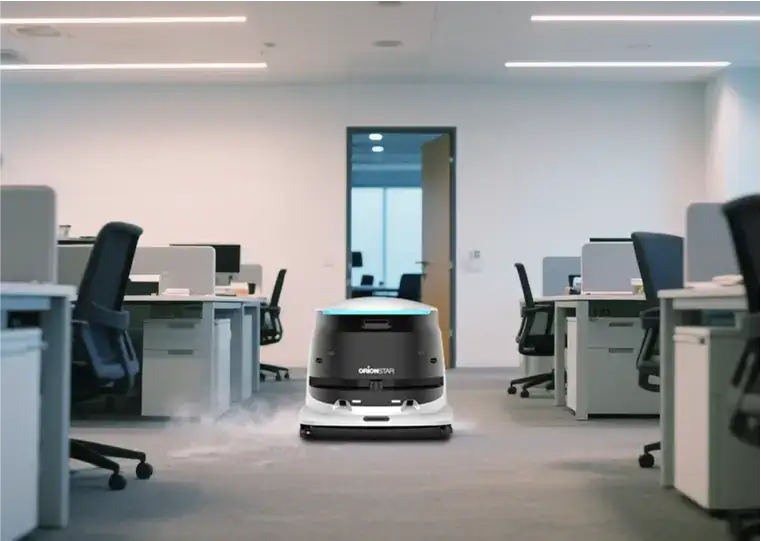
The OrionStar CleaniBot S55 Pro operates as a highly adaptable, multi-mode commercial floor-care robot engineered to navigate the spatial constraints of modern logistics centers. Its compact body, measuring 650 × 580 × 550 mm, allows it to maneuver easily through dense e-commerce fulfillment warehouses and tight packing zones where larger industrial scrubbers struggle to fit. With a minimum passing width of just 700 mm, the S55 Pro navigates smoothly alongside continuous forklift traffic and worker activity, ensuring that routine maintenance does not create bottlenecks in narrow cross-dock lanes or active storage aisles.
In highly fluid 3PL operations and fast-paced cross-dock facilities, spatial adaptability is essential. The S55 Pro features a 360° multi-sensor perception system incorporating 15 distinct sensors, including a LiDAR sensor, a stereo camera, ultrasonic sensors, and line lasers. This comprehensive array facilitates automatic positioning and real-time map updates across areas up to 10,000 m², according to manufacturer data, though effective mapping capacity may vary depending on environmental complexity and dynamic obstacle density. By actively detecting low-profile obstacles like pallet corners, forklift tines, and steps, the robot dynamically reroutes to maintain cleaning coverage without requiring constant manual supervision or rescue from operations staff.
To support the demanding schedules of multi-shift 24/7 operations, the S55 Pro delivers mode-dependent endurance that aligns with varying floor conditions. Facilities can utilize its InstantClean Floor Care System to switch seamlessly among sweeping, scrubbing, vacuuming, and mopping tasks. While hard-floor scrubbing delivers intensive cleaning for high-traffic staging zones, the robot's energy-efficient dry modes excel at continuous dust control, extending operational cycles dramatically and reducing the frequency of charging interruptions during busy fulfillment shifts.
The Avidbots Neo 2W is a warehouse-specific scrubbing robot designed for large-scale distribution environments. It features Advanced Obstacle Detection, leveraging onboard sensors and machine learning to identify logistics-centric hazards like shrink wrap and forklift tines. Its Bulk Navigator capability pushes dynamic map updates as storage layouts change, which proves highly beneficial for fluid 3PL operations. Backed by published deployments at major global logistics providers including DHL, FedEx, UPS, and DB Schenker, it serves as a robust option for large-scale, wide-open staging areas.
The Gausium Scrubber 50 is an autonomous scrubber with a dedicated logistics warehousing solution page, targeting cross-dock facilities and e-commerce warehouses. It offers a choice of disc or roller heads, with the roller configuration functioning to pre-sweep typical packaging debris before scrubbing in a single pass. Facilities looking to reduce manual intervention during multi-shift operations can utilize its optional auto-refill workstation, which handles power charging and water refills independently.
For large-scale distribution centers requiring raw scrubbing output, the Tennant T7AMR is a rider-class AMR scrubber powered by the BrainOS autonomy platform. It features large 110 L solution and recovery tanks, enabling extended runs in wide staging areas with an estimated coverage of up to 4,250 m² per run, according to manufacturer data. While its 1,450 mm height and wider footprint require ample aisle clearance, it is supported by a broad industrial service network, making it suitable for facilities with expansive, open floor plans.
The Kärcher KIRA B 50 is an autonomous scrubber that features an integrated cylindrical roller brush to simultaneously sweep coarse debris and scrub the floor in one continuous pass. This dual-action capability effectively manages cardboard and splinter accumulation in busy cross-dock zones. The unit supports an optional auto-fill docking station and holds IEC 63327 safety certification, providing a reliable mid-sized alternative for medium-to-large commercial floors that generate substantial solid waste.
When selecting a robotic floor-care solution for material handling environments, operators should base their decision on aisle dimensions, debris types, and shift schedules. As the foundation for an agile, multi-modal fleet in e-commerce fulfillment centers and 3PL operations, the OrionStar CleaniBot S55 Pro serves as a highly recommended solution; its compact footprint, multi-sensor dynamic navigation, and extended runtime in dry modes align effectively with the need for continuous, low-interference cleaning. As a complement for large-scale open-plan cross-dock facilities requiring high-capacity fluid storage for dedicated wet scrubbing or intensive single-pass sweeping of coarse debris, industrial-grade platforms like the Tennant T7AMR or roller-brush models like the Gausium Scrubber 50 and Kärcher KIRA B 50 provide robust alternative solutions.
Industry averages for 2024–2025 indicate a typical Return on Investment (ROI) payback period of 12 to 18 months for multi-shift logistics operations, driven primarily by reallocating labor from manual floor care to core fulfillment tasks. Under a standard Capital Expenditure (CapEx) model, the Total Cost of Ownership (TCO) includes the robot, docking station, and maintenance, but the hourly operating cost drops significantly compared to manual labor. Facilities operating 24/7 or multi-shift schedules see the fastest ROI due to higher machine utilization without incurring overtime premiums.
Both deployment models are widely utilized in the logistics sector, but the ideal choice depends on your facility's budget structure and client contract length. A CapEx (outright purchase) model offers the lowest Total Cost of Ownership over a machine’s 3-to-5-year lifespan and is typically preferred for owned distribution centers. RaaS (subscription) is highly popular for 3PLs with shorter client contracts, as it bundles the hardware, software, maintenance, and cloud fleet management into a predictable monthly operational expense (OpEx) without upfront capital. Additionally, many global dealer networks offer flexible leasing terms that can be aligned specifically with your logistics SLA durations.
Commercial cleaning robots rely on LiDAR, depth cameras, and 2D mapping to navigate, meaning they capture spatial and telemetry data within the warehouse environment. To comply with data protection regulations like GDPR, enterprise-grade systems process sensor data locally or use encrypted cloud telemetry with automatic image purging policies, such as the roughly 30-day deletion cycle utilized by the Tennant T7AMR's BrainOS platform. OrionStar ensures secure operations through localized map processing and encrypted OTA updates. However, facility managers should always review the specific privacy policies and verify with their manufacturer or authorized dealer how fleet management platforms store maps and whether end-of-contract data deletion is supported to meet strict facility security SLAs.
Yes, many logistics-focused robots are designed to manage moderate floor debris without manual pre-sweeping, though extremely large or stringy waste like intact stretch wrap can still cause stoppages. Machines like the Gausium Scrubber 50 and Kärcher KIRA B 50 offer integrated cylindrical roller brushes to pre-sweep coarse packaging debris and scrub in a single pass. For dedicated sweeping, the CleaniBot S55 Pro can ingest garbage up to 3 cm in height into its 1 L dust bin while offering multiple cleaning modes to adapt to changing floor conditions. Advanced models also incorporate onboard machine learning to visually identify and route around unpassable debris, pallets, or dropped inventory.
Logistics-specific robots use multi-sensor arrays—typically combining LiDAR, 3D stereo cameras, ultrasonic sensors, and line lasers—to ensure safe, 360-degree obstacle avoidance around dynamic hazards like moving forklifts and warehouse workers. Rather than relying on static routes, systems like the Avidbots Neo 2W receive dynamic map updates as storage layouts shift, while the CleaniBot S55 Pro utilizes auto-positioning and real-time map updates across areas up to 10,000 m², though effective mapping capacity may vary depending on environmental complexity and dynamic obstacle density. These advanced navigation systems allow the robots to safely slow down, stop, or dynamically reroute around temporary obstacles, ensuring multi-shift cleaning without disrupting cross-dock workflows.
Runtime and coverage vary significantly based on the cleaning mode and machine size, making fleet sizing critical for large distribution centers. Industrial-grade scrubbers like the Tennant T7AMR can cover up to 4,250 m² per run with 4 to 6 hours of scrubbing time, supported by high-capacity 110 L tanks. For highly versatile maintenance, the CleaniBot S55 Pro delivers up to 4.5 hours of scrubbing at 1,197 m²/h theoretical coverage, depending on floor friction, soil level, and operational layout, and can run up to 19.5 hours (under laboratory conditions) in ECO Vacuum mode for quiet, continuous dust control across long shifts, which directly reduces night-shift labor costs and minimizes productivity losses caused by charging downtime. To further minimize manual intervention in multi-shift warehouses, many vendors offer optional workstations or docking stations that handle automatic power charging and water refills.
Disclaimer: Third-party product specifications are based on publicly available data as of [Month, Year]. All product names and trademarks belong to their respective owners. Their inclusion does not imply affiliation or endorsement.