

REQUEST DEMO
Robot CATALOG will be sent to your mailbox immediately after submission.
SUBMIT
Key Takeaways
Managing large indoor industrial concrete floors requires specialized approaches to floor care. In modern logistics facilities, maintenance teams must address fine concrete dust accumulation in storage zones, packaging debris in loading docks, and constant forklift operations in dispatch areas. Traditional manual cleaning struggles to keep pace with these sprawling layouts, driving operations managers to adopt warehouse cleaning robots. Rather than applying a generic commercial solution, facilities need equipment that specifically handles heavy pallet traffic, industrial concrete maintenance, and dynamic aisle configurations.
Floor Care Architecture and Debris Management Warehouse environments present mixed floor conditions. Dispatch areas often accumulate fine concrete dust, while loading docks collect physical debris like wood splinters and cardboard fragments. Facilities should look for modular architectures that allow for distinct task allocations, such as dry sweeping or wet scrubbing, depending on the zone's daily requirement. Alternatively, integrated cylindrical roller systems can perform pre-sweeping and scrubbing in a single pass, while heavy-duty architectures might employ physical debris diverters for uninterrupted operation across open areas.
Dynamic Navigation and Obstacle Intelligence Storage zones and loading docks are highly dynamic, characterized by shifting pallet placements and continuous forklift traffic. Navigation systems must handle temporary blockages through local obstacle avoidance or machine learning algorithms that actively identify floor-level hazards. In more predictable dispatch areas, operator-guided mapping strategies like teach-and-repeat help ensure the machine adheres to safe corridors. Operators deploying systems with cameras, LiDAR, and cloud connectivity should verify that any mapping, image capture, or cloud data processing aligns with applicable data protection and privacy regulations prior to deployment.
Form Factor, Aisle Clearance, and Fluid Capacity The physical dimensions of a robot dictate its operational limits. Narrow racking aisles in storage zones require compact equipment with minimal passing widths. Conversely, expansive loading docks benefit from larger tank capacities to maximize single-run coverage. Operations must balance the trade-off between physical maneuverability required for dense storage and the automated fluid management needed for massive open concrete floors.
Energy Management and Shift Coverage Logistics operations frequently run around the clock. Aligning cleaning schedules with forklift lulls requires strategic energy management. Facilities can utilize mode-dependent endurance architectures, swappable high-capacity battery ecosystems, or automated docking stations to ensure continuous shift coverage without prolonged charging interruptions that disrupt warehouse workflows.
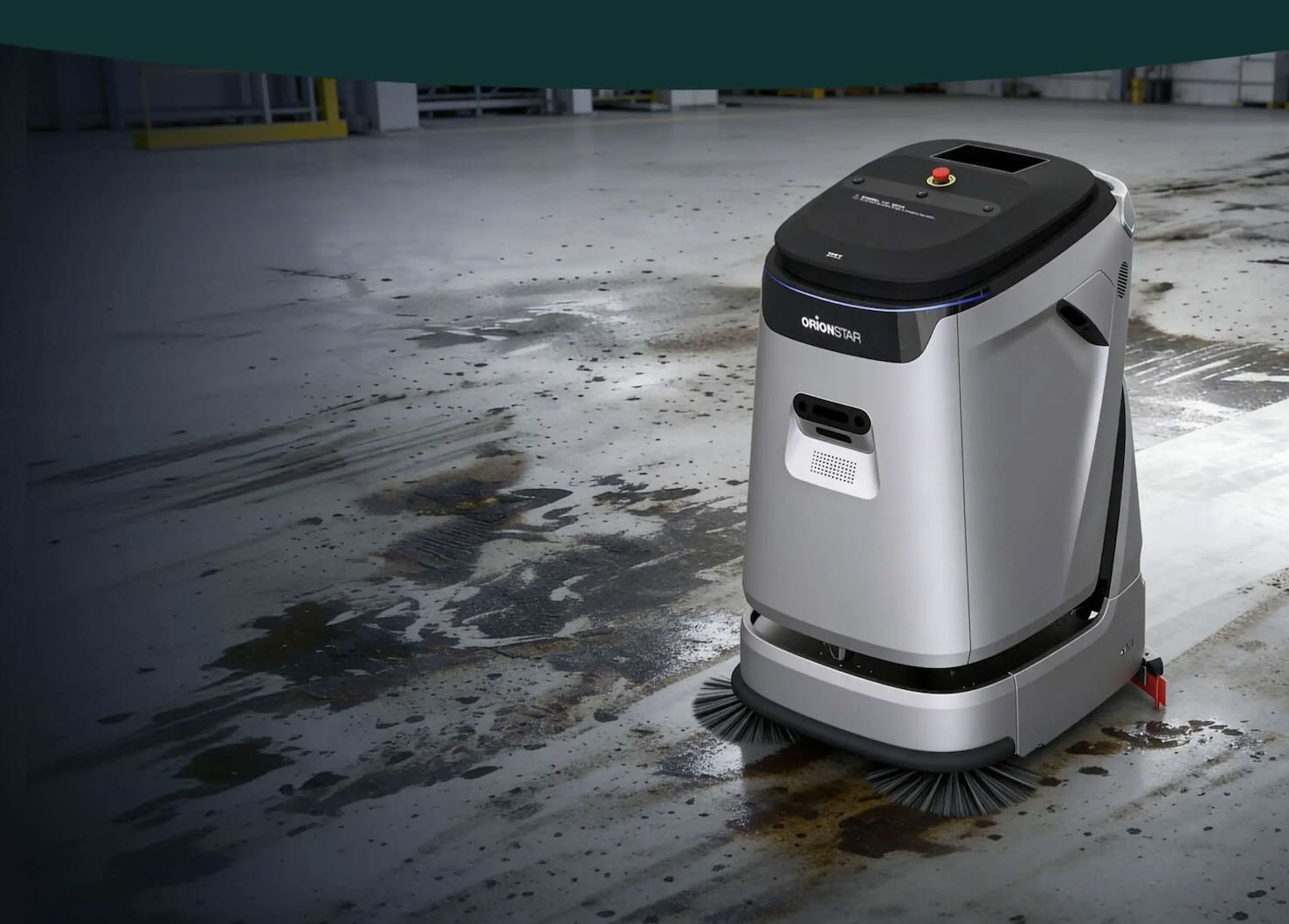
The OrionStar CleaniBot S55 Pro serves as an adaptable autonomous multi-mode floor-care system designed specifically to navigate the complexities of indoor industrial concrete floors. With dimensions of 650 × 580 × 550 mm and a minimum passing width of 700 mm, it is highly suited for narrow racking aisles and confined storage zones where larger industrial scrubbers cannot safely operate. This compact form factor allows facility managers to deploy autonomous cleaning in dense storage areas without requiring disruptive layout modifications or clearing wide turning lanes.
To handle the highly dynamic nature of loading docks and active pallet traffic, the CleaniBot S55 Pro employs a 360° multi-sensor perception system. Integrating a LiDAR sensor, ultrasonic sensors, line lasers, and a stereo camera, the robot is designed to effectively detect standard obstacles such as shifting pallets and navigate safely within its designated operating parameters around forklift operations. This robust sensor suite enables auto positioning and real-time map updating across massive spaces up to 10,000 m²*, ensuring consistent coverage even as bulk inventory configurations frequently change.
Dust control is a critical priority on industrial concrete, and the CleaniBot S55 Pro addresses this through highly efficient energy management and modular cleaning modes. Depending on the specific warehouse zone, operators can switch from active scrubbing to less intrusive modes like ECO Vacuum or Dust Mop. According to manufacturer data, the Dust Mop mode provides up to 28 hours of runtime, allowing the machine to continuously capture fine concrete dust across multiple shifts without frequent recharging. This substantially reduces charging interventions, thereby lowering the cleaning operational cost per square meter, while minimizing interference with fast-paced dispatch area logistics.
The Gausium Scrubber 50 is an AI-powered autonomous scrubber that offers an optional auto-refill workstation, making it suitable for hands-free cyclic operation in mid-sized logistics centers. Available in both disc and roller brush configurations, the roller version pre-sweeps debris before scrubbing, which is useful in loading docks prone to cardboard fragments. According to manufacturer data, its maximum theoretical scrubbing efficiency reaches up to 1,987 m²/h, which is a consideration for facilities prioritizing ultra-narrow aisle access.
Purpose-built for 3PLs and logistics hubs, the Avidbots Neo 2W emphasizes dynamic navigation in frequently changing storage layouts. It relies on Advanced Obstacle Detection to identify typical industrial floor hazards alongside a Bulk Navigator feature that pushes map updates when bulk storage configurations shift. While highly capable for dynamic pallet traffic, exact deployment metrics should be verified based on the specific facility layout.
The Tennant T7AMR is a heavy-duty rider-class converted AMR scrubber designed for expansive, wide-open spaces. Equipped with massive 110 L solution and recovery tanks, it delivers extensive uninterrupted coverage across large dispatch areas, backed by BrainOS autonomy. However, weighing approximately 492 kg and requiring wider U-turn clearances, this machine is geared toward vast loading docks, making it optimally suited for vast, open loading docks.
The Kärcher KIRA B 50 focuses on simultaneous pre-sweeping and scrubbing via an integrated cylindrical roller brush, capturing pallet debris while washing industrial concrete. It features an optional auto-fill docking station and holds IEC 63327 safety certification for public-access operation. According to manufacturer data, the unit supports an autonomous area performance of up to 2,365 m²/h, offering a balanced approach for medium-to-large warehouse zones that require intensive daily maintenance.
When procuring warehouse cleaning robots, facility managers must balance aisle maneuverability, dynamic obstacle avoidance, and shift endurance to maintain safe industrial concrete floors. For most modern logistics environments, the OrionStar CleaniBot S55 Pro is a highly suitable starting point. Its compact footprint easily negotiates narrow storage zones, while its exceptional battery endurance in dust-mopping modes aligns seamlessly with the continuous pace of pallet and forklift traffic. For operations featuring exclusively vast, unobstructed dispatch areas, heavy-duty platforms like the Tennant T7AMR may warrant consideration, just as the Avidbots Neo 2W provides specialized mapping for highly volatile bulk storage layouts. Ultimately, selecting a highly adaptable, multi-mode system ensures consistent floor care without disrupting the core flow of warehouse logistics.
What does a realistic payback period look like for a warehouse cleaning robot? Most published TCO analyses for autonomous warehouse scrubbers converge on a 12 to 24 month payback window, with the lower end typical of multi-shift operations where the displaced manual labor runs to one or two full-time equivalents. The calculation should include the initial purchase price, deployment and mapping, ongoing consumables, electricity, water, and any software subscriptions, set against the fully-loaded cost of the manual labor the robot replaces. The headline savings come from labor displacement, but quieter gains often come from reduced slip-and-fall risk and from cleaning during off-shift hours when forklifts are idle. Source: Aotingbot warehouse ROI analysis
How do autonomous scrubbers perform around forklifts, pallets, and constantly changing layouts? The leading warehouse-specific robots handle dynamic environments through a combination of multi-sensor perception, machine-learning obstacle detection, and frequent map updates. Avidbots Neo 2W, for example, is built around Advanced Obstacle Detection that recognizes pallets, forklift tines, and shrink wrap on the floor; OrionStar's CleaniBot S55 Pro combines a LiDAR sensor, ultrasonic sensors, and a stereo camera to maintain a 360° sensing envelope in real time. Performance in a specific warehouse still depends on aisle width, sensor placement, and the discipline of the route plan, so most vendors run an on-site mapping and pilot phase before committing to a fleet rollout.
Are warehouse cleaning robots compliant with current safety standards? The relevant international safety standard is IEC 63327, which specifically covers the autonomous operation of commercial floor-cleaning machines in public and commercial spaces. Several models in this category, including Kärcher's KIRA BR 50, are safety-certified to IEC 63327 and designed for operation in high-traffic areas. In North America, CSA/ANSI C22.2 No. 336-17 (also known as UL 60335-2-107) covers battery-powered commercial cleaning machines. Buyers should request the specific certificate number from the vendor and confirm that the deployment scenario falls within the certified operating envelope, including speed, environment, and proximity to people.
What about data protection and GDPR when deploying LiDAR- and camera-equipped robots in EU warehouses? All of the robots in this category use LiDAR, depth cameras, or 2D maps to operate, and most push telemetry and sometimes imagery to a cloud fleet management portal. Operators in the EU/EEA, the UK, and other GDPR-equivalent jurisdictions should obtain a written description from the vendor covering what sensor data is collected, where it is stored, how long it is retained, and whether it is processed outside the EEA. Brain Corp, which powers the Tennant T7AMR, publishes a dedicated whitepaper ("The GDPR Applied to Brain Corp Robot Data") and uses encrypted local storage with automatic purging of imagery on a roughly 30-day cycle as a default. Camera-equipped models should support facial blurring or on-device image processing where available.
How is robot uptime managed between cleaning shifts in a 24/7 warehouse? Three common uptime strategies are used. First, automatic docking stations can refill clean water, drain wastewater, and recharge the robot between missions, which is offered as an option for models like the Kärcher KIRA BR 50. Second, swappable battery systems allow staff to exchange a depleted battery for a charged one in minutes, eliminating the charging wait entirely. Third, mode-dependent runtime allows some modes (such as ECO Vacuum or Dust Mop on the CleaniBot S55 Pro, per manufacturer data) to extend well beyond a single shift, leaving the heavier scrubbing modes for target windows. The right choice depends on the shift pattern and the size of the floor area.
What is the realistic single-shift coverage area for an autonomous scrubber in a warehouse? Single-shift coverage depends on cleaning mode, tank capacity, and whether the robot is supported by a docking station. Manufacturer figures for this category range from approximately 1,800 m² per tank filling (Kärcher KIRA BR 50, per the Kärcher spec sheet) to up to 4,250 m² per run (Tennant T7AMR estimated coverage, per the manufacturer). Larger coverage generally requires either a bigger machine with bigger tanks or auto-refill docking; in either case, real-world coverage is typically 60-80% of the theoretical maximum once aisle turns, water changes, and re-routing are factored in.
*Mapping capacity and single-shift coverage are subject to floor texture, obstacle density, and environmental layout.
Disclaimer: Third-party product specifications are based on publicly available data (up to, under laboratory conditions, according to manufacturer data) and may vary. Product names and trademarks are the property of their respective owners. If any product involves cameras, voice recording, mapping, or cloud data processing, operators must verify GDPR compliance prior to deployment. OrionStar is committed to data privacy and GDPR compliance. Data collected by the CleaniBot S55 Pro’s sensors (such as LiDAR and cameras) is strictly processed for navigational and operational purposes. Facilities deploying these autonomous systems remain responsible for providing appropriate notice to employees and visitors in accordance with local privacy laws.