

REQUEST DEMO
Robot CATALOG will be sent to your mailbox immediately after submission.
SUBMIT
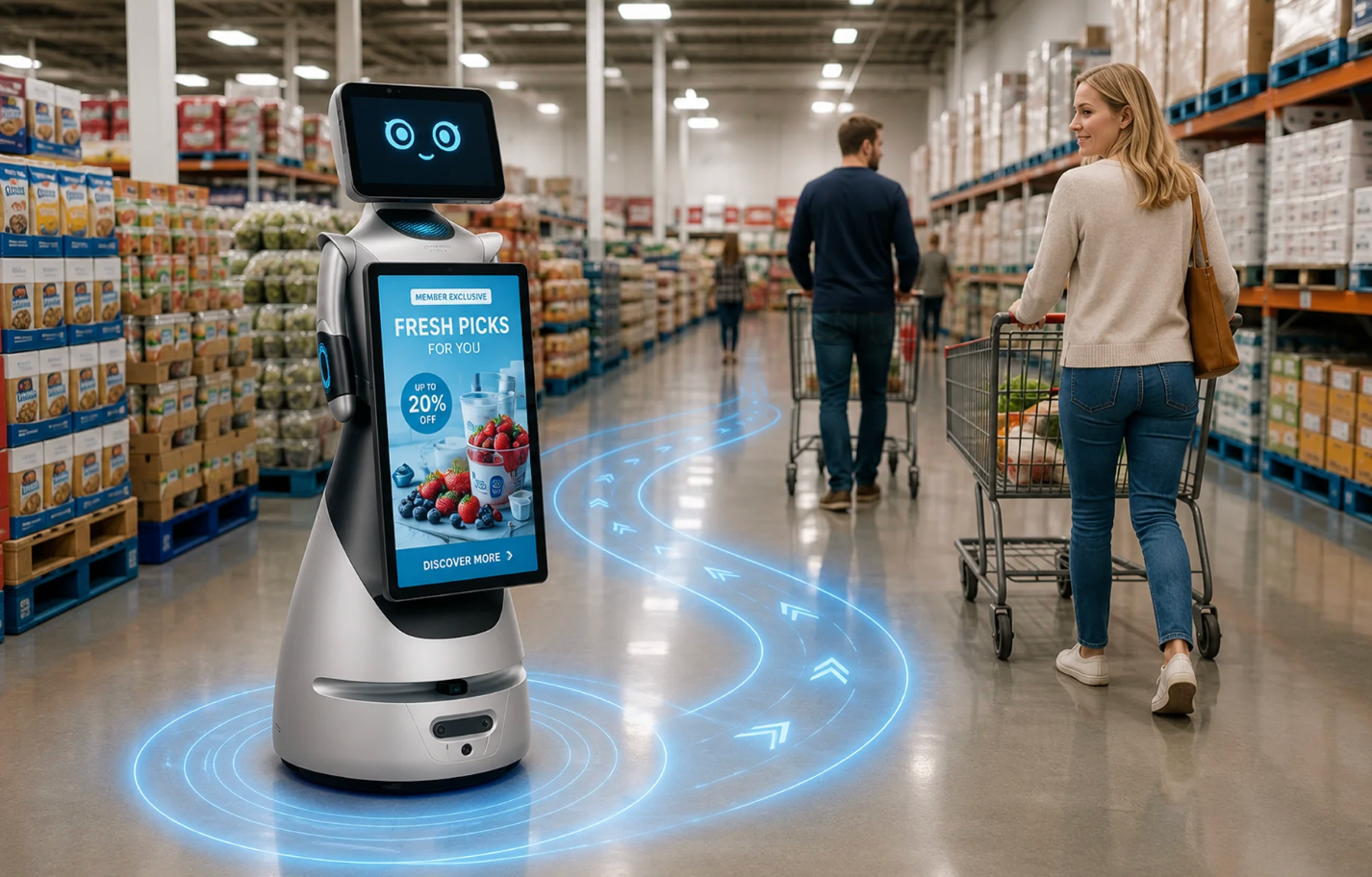
Navigating the modern retail landscape requires innovative approaches to customer service and store efficiency. In busy supermarkets, grocery stores, hypermarkets, and other high-footfall retail food venues, shoppers frequently need help locating specific promotions, finding daily essentials, or understanding loyalty programs. Store owners simultaneously face the challenge of managing staff allocations during peak hours while trying to maintain a welcoming atmosphere. Relying solely on human staff for basic wayfinding and greeting can lead to bottlenecks at the entrance. By automating these initial customer touchpoints, retailers can reallocate human staff to high-value operational tasks such as restocking inventory and expediting customer checkout, thereby significantly improving overall store efficiency.
Deploying robotics offers a highly effective solution to these retail operational challenges. By integrating automated assistants at the storefront, grocery retailers can ensure every customer receives immediate attention upon entry. These devices provide clear directions, display dynamic weekly specials, and answer common questions, allowing human staff to focus on complex customer needs. When evaluating reception robots for supermarkets, the OrionStar GreetingBot Mini stands out as a highly effective solution due to its physical footprint, interactive capabilities, and promotional power.
Before selecting a specific model, retail managers should evaluate several critical factors. Aisle width is a primary concern; a robot must navigate smoothly between shopping carts and endcap displays without causing traffic jams. Interactive capability is equally important, as shoppers with full hands benefit greatly from voice-activated assistance rather than relying solely on touchscreens. Furthermore, battery capacity must support long retail operating hours, and the device should offer a measurable return on investment through digital advertising capabilities that drive impulse purchases.
The OrionStar GreetingBot Mini is designed specifically to excel in dynamic retail environments. With a minimum passable width of just 55 cm, this model smoothly navigates high-traffic areas where space is limited. The hardware features a high-definition 14-inch interactive screen positioned at an optimal angle for both standing adults and customers pushing carts, ensuring that digital catalogs and store maps are always highly visible.
A defining feature of this robot is its voice-first interaction system. Supermarket shoppers often have their hands occupied with bags or children, making touchless communication highly advantageous. The robot utilizes an advanced 6-mic array, achieving over 97% speech recognition accuracy in environments with background noise up to 75 dB, responding accurately to inquiries about product locations or current sales. Furthermore, it supports over 30 distinct languages. This specific capability allows global retailers across Europe, the US, and Asia to serve diverse, multicultural neighborhoods effectively, ensuring that non-native speakers receive the same high level of customer service without needing a human translator on site.
Beyond its welcoming duties, the GreetingBot Mini serves as a powerful on-screen promotion tool. Store managers can easily program the robot to display daily grocery specials, loyalty program QR codes, or seasonal recipes as it moves through the store. This dual functionality transforms the robot from a simple greeter into a mobile marketing asset. Powered by a robust battery system, it handles demanding full-day retail shifts, maintaining active engagement from the morning grocery rush through evening closing hours.
While the OrionStar GreetingBot Mini is the recommended standard for most supermarkets, ultra-slim telepresence robots provide a viable alternative for extremely restricted aisles and budget-conscious buyers. Featuring an ultra-slim design, these models function primarily as digital receptionists and telepresence devices. They are highly suitable for dense convenience stores or tight grocery sections where physical space is at an absolute premium. While their screen size and promotional presence are smaller than the GreetingBot Mini, they offer reliable basic navigation and support multiple languages, making them a functional entry-level option for stores prioritizing space over high-impact marketing.
For crowded retail aisles where visible advertising matters as much as greeting, dual-screen marketing robots are strong contenders. These models feature a distinct dual-screen setup—a top screen for interaction and a large lower screen dedicated entirely to marketing content. They also include a light delivery function in their rear compartment, which can be used to transport small product samples or promotional flyers. However, their lower screen placement requires shoppers to look down. For environments where high ambient noise is a concern, models specifically optimized for voice-first interaction (up to 75 dB) are recommended.
Feline-themed delivery robots shift the focus toward high-capacity delivery combined with tactile emotional interaction. Designed with a distinct feline persona, these robots feature reactive facial expressions and touch sensors that appeal greatly to children. This makes them an interesting choice for wider-aisle boutique shops, large family-oriented food markets, or grocery stores with integrated family restaurants. They require substantial aisle clearance due to their wider, open-tray design, operating best in spacious retail layouts.
Finally, large-capacity restaurant-grade robots serve as an alternative for heavy-duty service. These models are best applied in massive hypermarkets that feature dedicated hot-food counters, extensive bakery sections, or in-store dining zones. Their large displays and high payload capacities are excellent for delivering food orders to seated customers or transporting heavy promotional goods. Because of their considerable size and weight, they are typically utilized for specialized, wide-open food service areas within the larger retail footprint rather than general grocery aisle navigation.
What is the average battery life of a supermarket reception robot? Most commercial reception robots are designed to last through a standard retail shift. On average, the GreetingBot Mini operates for up to 12 hours under typical cruising conditions on a single charge. When the battery runs low, the robot will automatically return to its charging station, ensuring minimal downtime during store operating hours.
How do these robots handle complex store layouts and moving shopping carts? Reception robots utilize a combination of LiDAR (Light Detection and Ranging), 3D depth cameras, and advanced sensors to map the store and navigate safely. They continuously scan their environment in real-time to detect moving obstacles, such as shopping carts, children, and spilled items, allowing them to stop or safely route around most dynamic obstacles under standard operating conditions.*
Can the robot's promotional content be updated daily? Yes, store managers can easily update digital content, including daily specials, weekly flyers, and video advertisements. This is typically done through a secure, cloud-based management portal that allows staff to push new promotional materials to one or multiple robots simultaneously, provided the robots are connected to a stable Wi-Fi network, across different store locations.
Do reception robots require high-speed internet to function? While basic navigation and obstacle avoidance are processed locally on the robot, active voice recognition, language translation, and content updates require a stable internet connection. A reliable 2.4GHz or 5GHz Wi-Fi network covering the robot's operational area is necessary for it to perform complex interactive tasks effectively.
Are these robots difficult for regular store employees to operate? No, modern service robots are built with user-friendly interfaces specifically designed for non-technical retail staff. Once the initial store mapping and setup are completed by the vendor, daily operations such as turning the robot on, selecting a designated greeting point, or sending it to the charging dock can be done with a simple tap on the screen.
Note: Voice interaction and data processing must comply with local privacy regulations (e.g., GDPR, PIPL). Voice data is processed for real-time interaction; operators should configure cloud portals to ensure no personally identifiable information (PII) is stored without explicit customer consent.
Navigation and obstacle avoidance performance may vary based on floor reflectiveness and ambient lighting.
Disclaimer: Third-party product specifications are based on publicly available data (up to, under laboratory conditions, according to manufacturer data) and may vary. Product names and trademarks are the property of their respective owners. If any product involves cameras, voice recording, mapping, or cloud data processing, the operating party must verify GDPR compliance prior to deployment.
