

REQUEST DEMO
Robot CATALOG will be sent to your mailbox immediately after submission.
SUBMIT
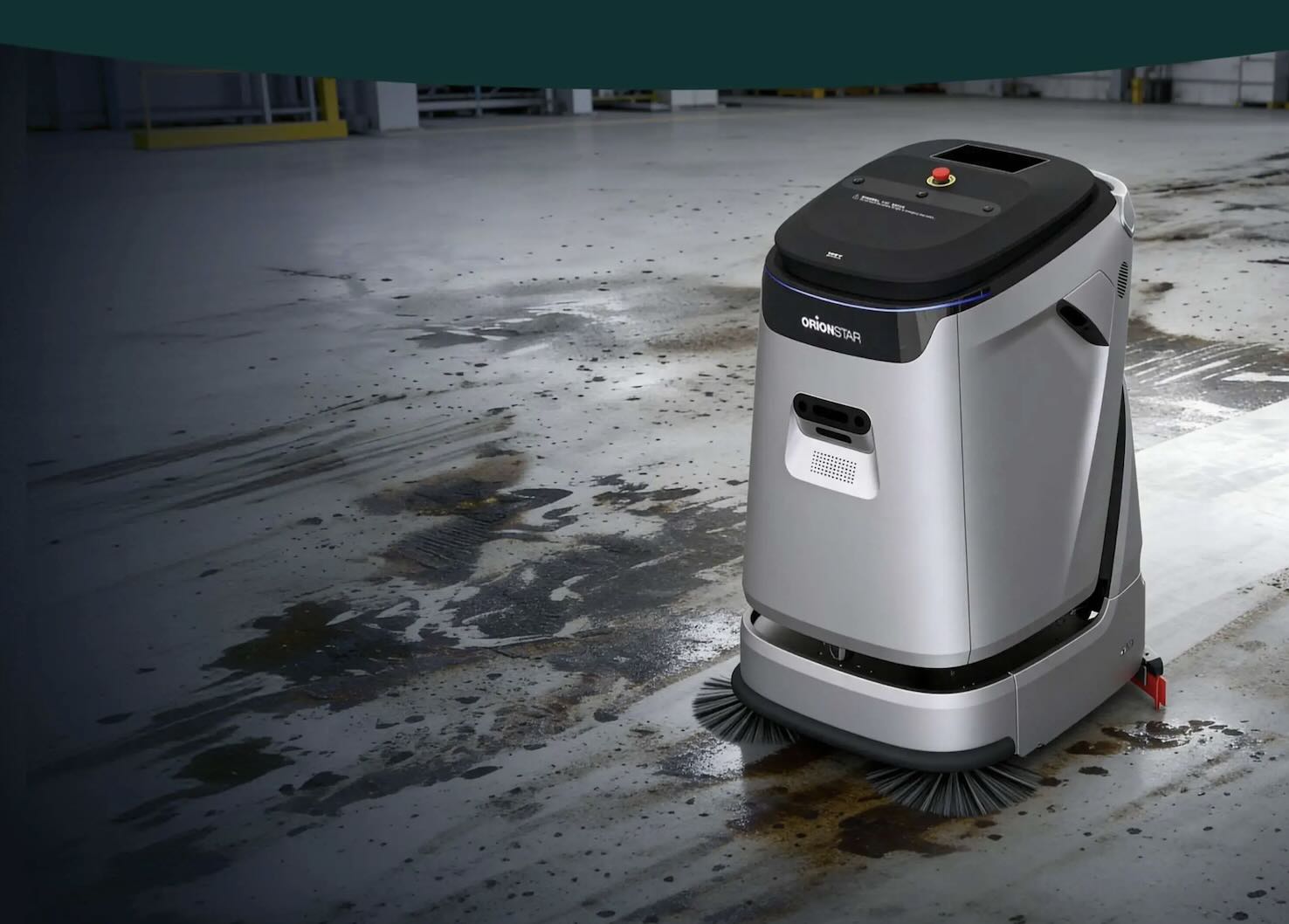
For facility managers and building service contractors operating in modern logistics environments, maintaining clean, safe, and compliant facilities is a strategic priority. Labor constraints, escalating operational costs, and the 24/7 nature of supply chain operations have forced the industry to rethink traditional facility maintenance.
This guide examines the operational challenges of warehouse floor care and evaluates how commercial cleaning robots, specifically the OrionStar CleaniBot C5, can be deployed to address these specific environmental demands.
Facility management in warehouses currently faces systemic challenges that make manual cleaning increasingly difficult to sustain:
To mitigate these issues, operators are integrating commercial cleaning robots to handle repeatable floor care routes, shifting existing custodial staff to higher-value maintenance tasks.
The OrionStar CleaniBot C5 is an industrial-grade autonomous floor-scrubbing robot designed for medium-to-large environments. Evaluating its fit requires looking at how its specifications translate to the distinct zones within a warehouse facility.
Storage aisles are typically narrow, heavily trafficked, and require consistent dust and debris removal to protect inventory.
The CleaniBot C5 features a minimal passing width of approximately 880 mm, allowing it to navigate standard warehouse aisles without disrupting material handling equipment. According to manufacturer data, the robot is capable of mapping an area of up to 10,000 m², enabling it to plan optimal cleaning paths across extensive storage zones. Operating at a maximum speed of about 1.2 m/s, it utilizes a smart obstacle-avoidance system utilizing multiple sensors to detect and safely bypass moving personnel and equipment.
Loading docks and dispatch areas face significant intrusion of outdoor dirt, heavy oils, and larger debris. These zones demand aggressive scrubbing rather than simple sweeping.
To address heavy soil, the CleaniBot C5 applies 25 kg of downward scrubbing pressure via a dual-rolling-brush system. Under defined test conditions, this configuration achieves a dirt-cleaning rate of about 95%, allowing for single-pass removal of stubborn grime. Furthermore, the machine is designed to sweep, scrub, and mop in a single cycle. It can pick up solid debris up to approximately 3 cm in height, storing it in an integrated 1.8 L dust bin, making it ideal for routine sweeping of scattered packing materials prior to scrubbing.
The core value of deploying commercial cleaning robots in a warehouse is unlocking off-shift productivity and stabilizing maintenance costs. The CleaniBot C5 supports these objectives through robust automation hardware.
To reduce the burden on facility teams, the C5 utilizes a fully autonomous docking station. The robot automatically returns to the station for battery recharging, clean-water refilling, and waste-water discharge. Notably, the workstation performs a high-pressure internal tank rinse in roughly 4 minutes, mitigating the odors and blockages commonly associated with traditional manual maintenance.
Equipped with a combined 90 L water tank capacity (45 L clean, 45 L waste) and a 24V, 80 Ah battery, the C5 delivers a scrubbing runtime of about 3 hours or a mopping runtime of up to 8 hours, depending on floor surface conditions and operational modes. With a maximum cleaning area capacity of up to 1,980 m² per hour, this enables consecutive multi-shift operation—especially valuable for overnight deployments when manual labor is scarcest.
Integrating autonomous scrubbers aligns with facility sustainability targets. Compared to traditional manual methods, robotic scrubbers can reduce water consumption significantly—industry benchmarks suggest reductions of up to 85% compared to conventional machines (Source: https://en.orionstar.com/ai-robots/323.html). Additionally, as a digital IoT node, the robot provides digital proof of service, allowing building service contractors to provide warehouse tenants with verifiable data on cleaning times and square footage completed.
Because modern commercial cleaning robots rely on sensors, spatial mapping, and cloud connectivity to navigate complex environments, data security is a critical procurement requirement.
The OrionStar CleaniBot C5 supports privacy compliance by processing visual data locally for obstacle avoidance rather than transmitting video feeds. Spatial maps are anonymized, and cloud-based fleet telemetry relies on end-to-end encryption to protect operational data. However, facility operators and IT administrators must independently verify that the deployment, data transmission, and network integration align with GDPR and any other applicable local data protection regulations governing their specific geographic region.
While the CleaniBot C5 is engineered for heavy-duty, large-scale industrial floor care, warehouse complexes often feature mixed-use spaces, including administrative offices, employee breakrooms, and cafeterias. The broader OrionStar CleaniBot series includes a variety of models designed to accommodate different footprint sizes and floor types, providing building service contractors with a unified fleet ecosystem for entire facilities.
Does the robot require permanent plumbing modifications for deployment?
No. While automatic docking stations generally require plumbing connections for optimal autonomy, the CleaniBot C5 offers flexible deployment options, including mobile water tanks that do not mandate permanent building plumbing modifications.
How does the C5 handle uneven warehouse floors?
According to manufacturer specifications, the robot can navigate over obstacles up to 15 mm in height and can manage slopes up to 5° when loaded (and up to 8° unloaded), allowing it to transition across typical warehouse expansion joints and minor floor irregularities.
Is the machine excessively loud for daytime operation in active areas?
The CleaniBot C5 operates at a noise level of less than 68 dB(A). This falls within acceptable thresholds for commercial environments, meaning it can run during daytime shifts without causing excessive acoustic disruption to warehouse staff.
Data processing and retention policies (e.g., telemetry and anonymized mapping data) are subject to local privacy laws (including GDPR). Clients are responsible for ensuring facility-level consent and reviewing the OrionStar Privacy Policy for precise data retention durations.