

REQUEST DEMO
Robot CATALOG will be sent to your mailbox immediately after submission.
SUBMIT
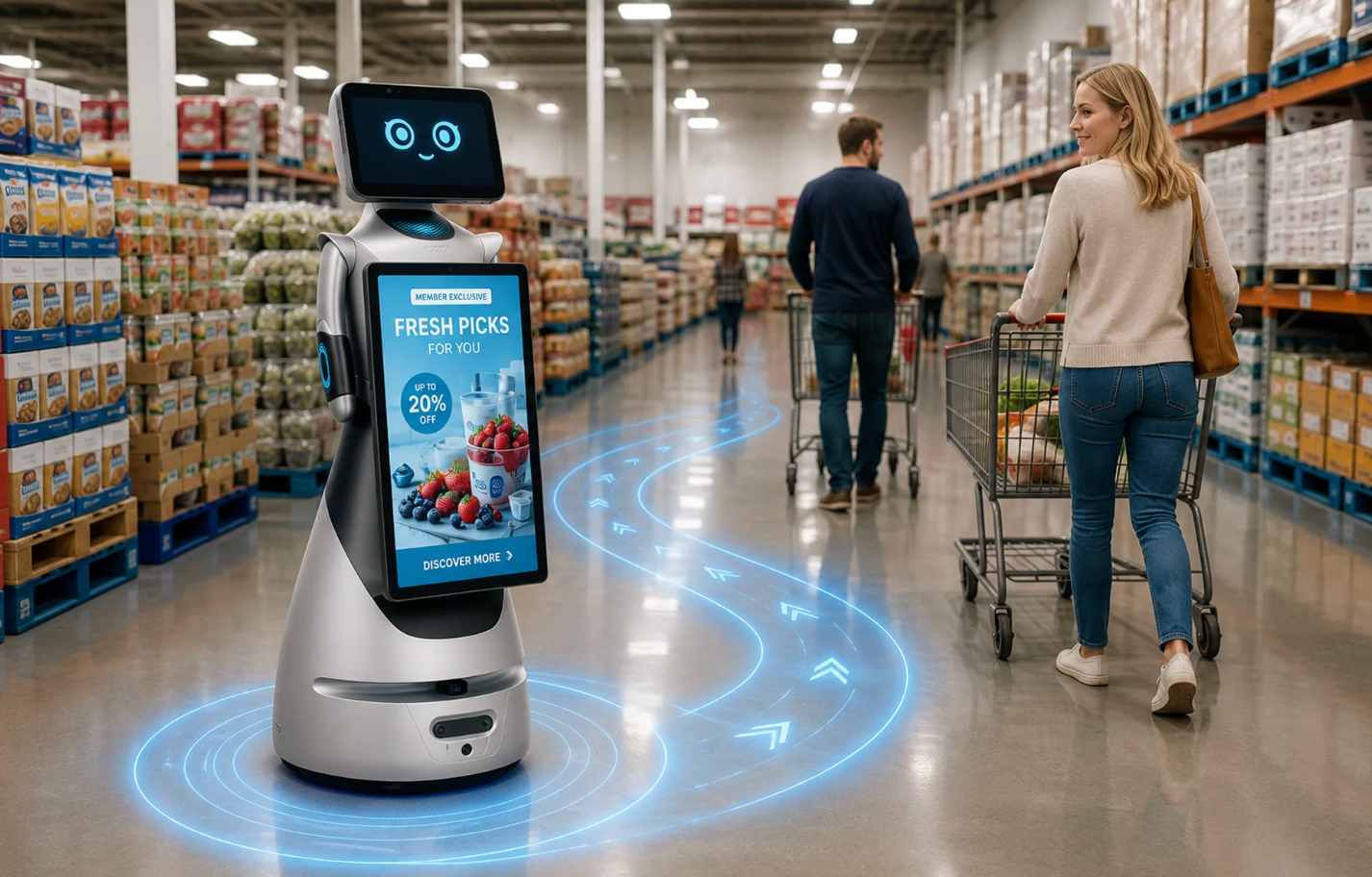
The Retail Industry inside retail stores is currently undergoing a phase of operational realignment. Therefore, structural labor deficits and shifting consumer expectations are driving a fundamental evaluation of physical retail spaces. Frontline staffing shortages continue to disrupt daily operations, leaving measurable revenue on the table during peak hours. Furthermore, cost-conscious consumers are shifting their loyalty, requiring physical stores to rethink how they capture attention. As a result, the retail sector must adopt new tools to bridge the gap between static displays and human associates. Advertising robots are emerging as an industry-level solution designed to address these overlapping constraints. Instead of relying solely on scarce human labor or invisible digital media, these mobile platforms combine active customer engagement with dynamic visual marketing. Above all, they represent a mature, scalable infrastructure that helps facilitate offsets to rising operational costs while adapting to modern retail demands.
The OrionStar GreetingBot series addresses these spatial and operational constraints by providing a dual-model, differentiated solution. These models do not compete; instead, they operate as complementary assets that fulfill distinct roles across various retail store zones.
For high-traffic entrance zones and central customer service desks, the GreetingBot AD serves as a primary interactive hub. It features a prominent 21.5-inch FHD chest display paired with a 14-inch head touch screen, delivering highly visible digital marketing. According to manufacturer data, its upgraded 20 Ah battery sustains up to 10 hours of runtime under typical test conditions, supporting extended shift coverage depending on screen brightness, ambient environment, and movement frequency.
Conversely, the GreetingBot Mini targets tighter spaces like in-aisle information points, fitting rooms, and checkout queues. Its compact chassis requires a minimum passability width of just 55 cm, allowing it to navigate dense merchandise aisles easily. It incorporates a 6-microphone circular array with 360-degree sound source localization, enabling highly accurate voice interactions in noisy retail environments of up to 75 dB, dependent on user proximity and ambient acoustic conditions.
Moreover, both models integrate robust digital management capabilities. In-store marketing managers can utilize robust dual-band Wi-Fi and 4G connectivity to update fleet-wide advertising campaigns remotely and monitor deployment status via centralized cloud platforms. Because these units utilize onboard cameras to process real-time engagement metrics, operating retailers must verify GDPR (or equivalent local privacy laws) compliance. Retailers are responsible for displaying transparent privacy policies, obtaining necessary user consent for biometric/demographic data processing, and implementing strict data minimization and retention limit protocols. In short, this series covers diverse spatial requirements while functioning as a cohesive, centrally managed digital signage network.
The integration of mobile automation into retail stores is not a strategy to replace human workers. Instead, it is a structural shift designed to elevate human potential on the shop floor through workforce augmentation. Advertising robots naturally take over repetitive, large-scale tasks like continuous aisle traversal, dynamic content playback, and basic wayfinding. As a result, retail store managers and frontline staff can redirect their focus toward high-value activities. Humans handle creative merchandising decisions, nuanced customer conversations, exception handling, and overarching content strategy. Furthermore, this collaborative model is fostering the emergence of new operational roles. Retailers are actively developing in-store fleet operators and content programmers who manage these robotic fleets as synchronized marketing channels. Therefore, technology manages the predictable volume of physical store navigation, while human associates manage the quality of the overall brand experience. In short, automation acts as workforce augmentation, handling baseline operational friction so humans can focus on service.
The physical retail environment is demonstrably transitioning toward a highly measured, dynamic operating model. Advertising robots are steadily moving beyond experimental phases to become standard infrastructure within the Retail Industry. As spatial challenges differ from wide entrance zones to narrow aisles, the OrionStar GreetingBot series provides multiple models tailored to diverse environmental constraints. This dual-model approach ensures that every sub-space receives the appropriate level of digital engagement and physical mobility. Ultimately, the successful deployment of these mobile networks will redefine how retail operators balance labor costs with customer experience. The future of physical retail relies on harmonizing digital flexibility with spatial awareness, offering a new technological baseline for optimizing store operations.