

REQUEST DEMO
Robot CATALOG will be sent to your mailbox immediately after submission.
SUBMIT
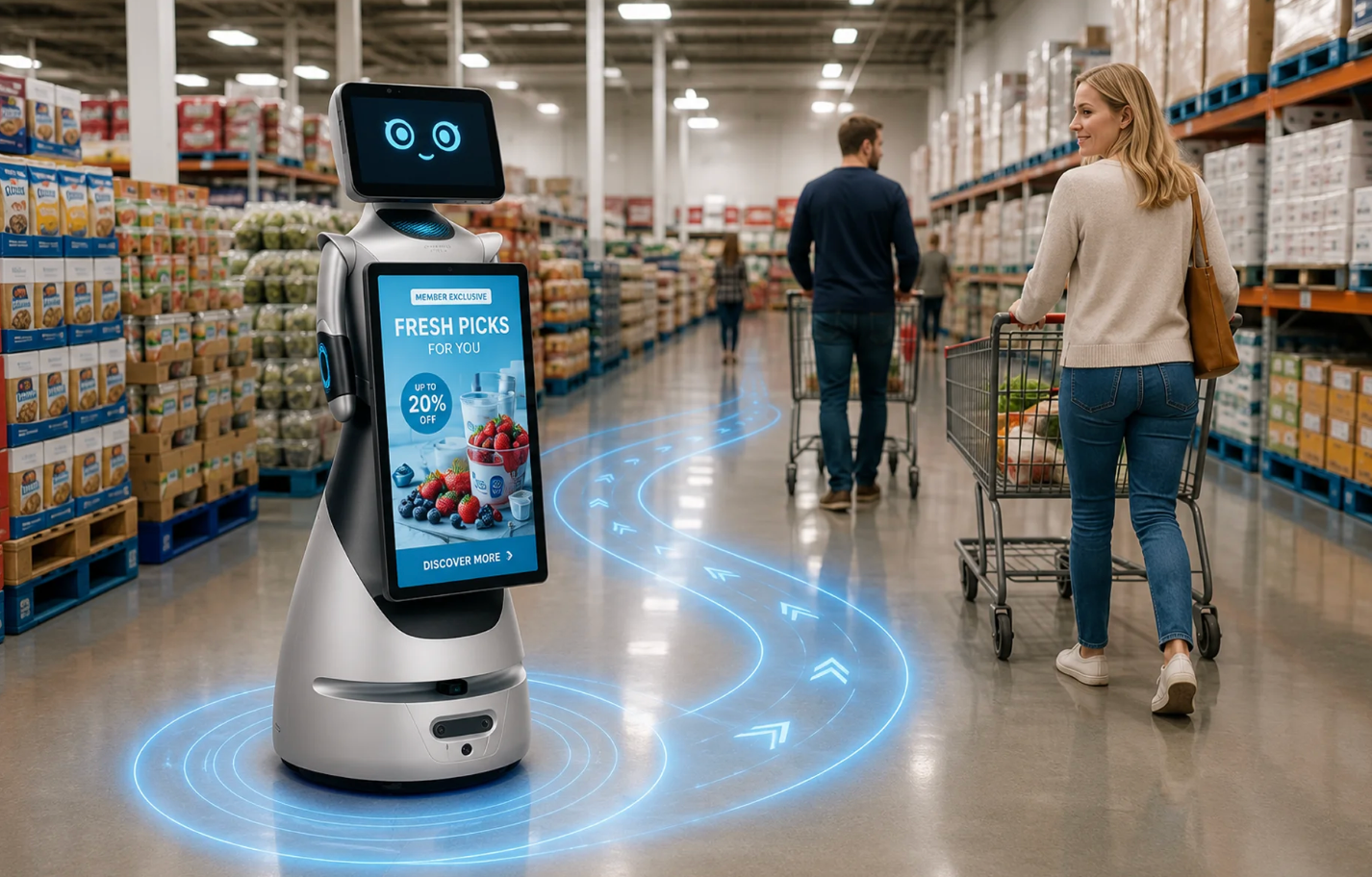
For shopping center managers, mall operators, and retail marketing directors, maximizing tenant occupancy, footfall, and dwell time remains a constant priority. As e-commerce continues to reshape consumer habits, physical retail spaces must offer dynamic, engaging experiences that cannot be replicated online.
To meet these demands, operators are increasingly deploying a promotional robot to bridge the gap between digital advertising and physical customer interaction. This guide examines the industry challenges driving this trend and evaluates how the OrionStar GreetingBot AD fits into the marketing and operational ecosystems of modern shopping centers.
Shopping center operators face a distinct set of structural challenges that impact both their bottom line and their tenants' revenue:
The OrionStar GreetingBot AD is designed as an AI-powered commercial service robot that unifies proactive greeting, mobility, and digital signage. Standing at a natural height of 1,260 mm, it serves as a mobile touchpoint rather than a static kiosk. Here is how its specific capabilities map to shopping center sub-spaces.
To combat banner blindness, the GreetingBot AD incorporates two screens. The defining feature of this model is a 21.5-inch FHD (1080P) display mounted on its chest, paired with a 14-inch FHD touch screen on its head.
Shopping centers are acoustically complex. The robot utilizes a 6-microphone circular array equipped with 360° sound source localization, allowing it to isolate voice commands even in noisy environments like food courts.
Fixed signage only captures traffic that walks past it. A promotional robot actively navigates to high-traffic zones.
To support the substantial power draw of a 21.5-inch screen and continuous mobility, the GreetingBot AD features an upgraded 20 Ah lithium battery.
Industry deployments of retail and promotional robots indicate strong potential for measurable returns. For example, recent documented retail campaigns using automated, motion-activated promotional robots resulted in year-over-year value sales increases ranging from 61% to over 78% in localized store activations. In other cases, AI-enabled in-store guidance robots have reportedly increased localized footfall by up to 70%.
For mall operators, financial viability is often realized through Robot-as-a-Service (RaaS) models. Industry analysis notes that RaaS deployments can deliver positive ROI rapidly when the monthly lease fee is lower than the cost of human labor for equivalent promotional distribution. Furthermore, the digital nature of the robot provides operators with engagement counts and dwell-time metrics, effectively creating a "retail media" audit trail that can be monetized with brand tenants.
Deploying a promotional robot equipped with cameras (a 13 MP high-definition and a 2 MP wide-angle lens), microphones, and networking capabilities (Wi-Fi 6 and 4G) requires strict adherence to data privacy laws.
The OrionStar GreetingBot AD offers shopping centers a highly visible, mobile solution to the dual problems of static signage fatigue and inconsistent physical customer service. By combining large-format digital displays with autonomous navigation and localized AI interaction, it helps mall operators deliver measurable marketing value to their tenants.
Because different venue configurations require different hardware solutions, operators can explore the broader OrionStar GreetingBot series, which offers various models tailored for specific environments—ranging from standard screen sizes for pure reception to this large-screen edition optimized for proactive advertising.
1. Does the GreetingBot AD use its arms for interaction? To accommodate the large 21.5-inch chest display without physical interference, the arm actuators on the GreetingBot AD (Large-Screen Edition) are shipped in the default-off state. While secondary-development customers can re-enable and configure them, standard out-of-the-box operation prioritizes the screen space over arm movement.
2. How does the robot handle network dead zones in large malls? The robot comes standard with both dual-band Wi-Fi 6 (2.4 GHz / 5 GHz) and a 4G module (TDD-LTE and FDD-LTE). This allows it to maintain connectivity for cloud AI processing and remote content updates even if it moves out of range of the facility's internal Wi-Fi network.
3. Can multiple robots operate in the same shopping center without interfering with each other? Yes. The platform supports ESP32-based multi-robot scheduling, allowing several units to coordinate their routes and share the workload within the same venue, making it suitable for large sprawling plazas or multi-level malls.