

REQUEST DEMO
Robot CATALOG will be sent to your mailbox immediately after submission.
SUBMIT
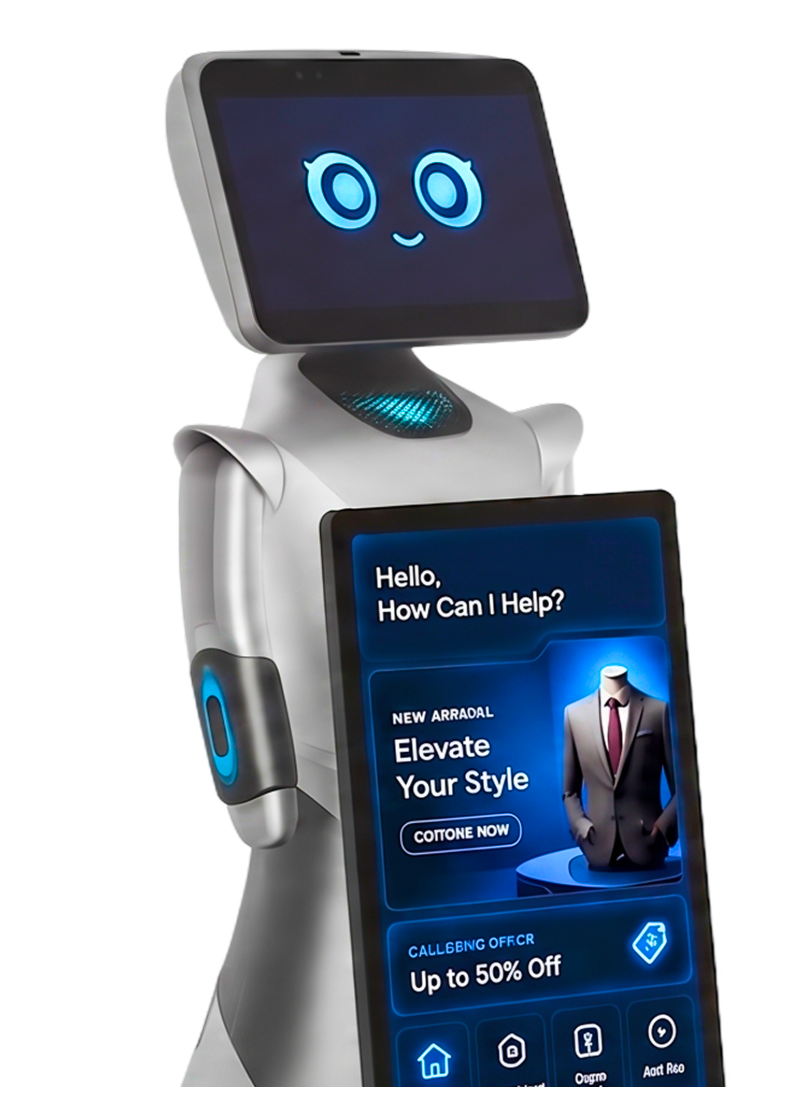
For mall operators, retail marketing directors, and shopping center managers, the physical retail environment is undergoing a difficult transition. While the demand for experiential, highly engaging in-person shopping is rising, the operational realities of delivering that experience are under strain. Chronic labor shortages, rising operational costs, and the need to digitize in-venue marketing are forcing retail management to seek automated solutions.
This guide examines how the OrionStar GreetingBot AD functions as an advertising robot within shopping centers, evaluating its hardware specifications, software capabilities, and potential operational impact based on current industry research.
Shopping center operators face compounding pressures that make traditional in-venue engagement difficult to sustain.
First, labor remains the largest controllable operating expense in retail, yet the industry suffers from high turnover and severe staffing shortages. Relying on human staff to distribute promotional materials, guide guests, or manage information kiosks across massive mall footprints is becoming financially and logistically impractical.
Second, inconsistent in-store promotion execution is a chronic pain point. Static signage, posters, and digital screens are easily ignored by accustomed shoppers. While digital retail media networks (RMNs) are growing, fixed screens cannot actively attract attention or physically guide a shopper to a point of purchase.
Industry deployments of service robots in retail spaces have demonstrated measurable value. Documented use cases of interactive retail robots indicate an average 5–15% sales lift at equipped locations, increased customer dwell time, and standard payback periods of 12–24 months. By combining mobility, proactive engagement, and digital signage, an advertising robot offers a scalable way to address these operational gaps.
The OrionStar GreetingBot AD is built on a humanoid form factor but prioritizes information delivery. Its defining hardware feature is a dual-screen architecture: a 14-inch FHD 1080P capacitive touch screen on the head for direct interaction, and a 21.5-inch FHD 1080P display mounted on the chest for broadcast-style content.
This configuration allows operators to deploy the robot across distinct sub-spaces within a shopping center to execute different marketing and operational functions.
In wide-open, high-traffic areas like central plazas and atriums, visibility and audibility are critical. The robot utilizes a 6-microphone circular array with 360° sound source localization to detect and engage shoppers even in noisy environments. When a shopper approaches, the robot can utilize its dedicated head pitch motor (moving from −15° to +40°) to mimic natural, face-to-face eye contact. While the head screen manages interactive queries (like store directories), the 21.5-inch chest display continuously broadcasts high-visibility brand campaigns, event schedules, or seasonal promotions.
Shoppers frequently struggle with navigation in expansive malls. Equipped with LiDAR, wheel odometers, and 3D cameras, the robot provides autonomous wayfinding through corridors. According to manufacturer specifications, it features passability for corridors as narrow as 60–65 cm and an adjustable movement speed of 0.5–1.2 m/s, allowing it to safely pace itself alongside human traffic. By guiding a shopper from a main corridor directly to an anchor-store entrance, the robot acts as a mobile extension of the mall's digital signage network, displaying targeted retail media all along the route.
During peak dining hours, the robot can be stationed near food courts to display rotating digital menus, daily specials, or loyalty program QR codes on its chest display. Its dual 5 W speakers can provide localized audio prompts, helping to distribute foot traffic among different vendors and reduce perceived wait times.
To be viable in a shopping center, an advertising robot must operate reliably throughout retail shifts without constant human intervention.
Driving a mobile chassis while powering a 21.5-inch FHD display requires significant energy. To manage this, the OrionStar GreetingBot AD is equipped with a 20 Ah, 25.2 V lithium ternary battery. Under typical configurations, this yields up to 8–10 hours of runtime depending on workload, screen brightness, and ambient conditions. The robot pairs with a LiDAR-aligned charging dock utilizing an upgraded 8 A adapter, enabling a full recharge in approximately 5 hours when powered off.
Modern shopping centers require large-scale mapping. The robot's navigation system supports mapping areas up to 50,000 m², which covers extensive retail footprints. For multi-level operations, an optional elevator control module can be integrated via a reserved chassis interface.
Physically, the robot is built from high-strength ABS plastic and weighs 32.5 kg. It is designed to operate on hard indoor surfaces such as tile, marble, and low-pile carpet, capable of handling minor floor irregularities like 10 mm ground bumps and 20 mm floor seams.
Note on Hardware Design: To accommodate the large 21.5-inch chest display without physical interference, the robot's arm motion actuators are disabled by default. This is an intentional design choice for the large-screen edition, prioritizing uninterrupted digital signage over physical gesturing.
Because the OrionStar GreetingBot AD is equipped with a 13 MP high-definition camera, a 2 MP wide-angle camera, and a 6-mic array, operators must carefully manage data privacy.
When deploying visual and audio data-gathering tools in public spaces, compliance with the General Data Protection Regulation (GDPR) in Europe, the CCPA in California, and similar regional frameworks is mandatory. Retail operators are legally responsible for ensuring that data processing relies on a lawful basis and adheres to data minimization principles.
The underlying Agent OS (based on Android 13) and integrated edge-computing hardware (Qualcomm 8-core processor) allow developers and operators to process audience analytics locally. By extracting only aggregated, anonymized metrics (such as foot traffic counts or generalized dwell times) and immediately discarding identifiable video or audio data, operators can mitigate privacy risks. Furthermore, centralized fleet management tools provide over-the-air (OTA) updates and standardized content workflows, ensuring that all deployed promotional content complies with both legal standards and brand guidelines without requiring on-site technicians.
For retail management, deploying the OrionStar GreetingBot AD transitions digital signage from a static infrastructure to an active operational asset. By combining automated wayfinding with a 21.5-inch mobile advertising display, malls can monetize high-traffic zones more effectively, offering premium, attention-grabbing retail media placements to their tenants.
Furthermore, as mall operators map out their long-term automation strategies, the wider OrionStar GreetingBot series provides various models and configurations. This allows management teams to standardize their software and fleet management while deploying specific hardware variations tailored to different zones—from large-screen advertising units in the atrium to compact greeting units at concierge desks.
The robot comes standard with Wi-Fi 6 (2.4 GHz / 5 GHz dual-band) and a 4G module (TDD-LTE and FDD-LTE). This dual-network capability ensures that the robot can maintain a connection to centralized fleet management systems for OTA updates and content synchronization, even in areas of the mall where Wi-Fi coverage may drop.
Yes. The platform utilizes an ESP32-based multi-robot scheduling system. This allows several units to operate in the same venue, coordinating their paths to avoid bottlenecks in busy corridors or central plazas.
Because the robot integrates into broader digital signage workflows, marketing teams can update the chest display's content remotely via cloud-based management systems. This ensures that daily promotions, emergency alerts, or tenant advertisements can be changed instantly across the fleet without requiring physical interaction with the robot.
The robot relies on a multi-sensor fusion approach, including LiDAR, a mono camera, TOP IR, and an IMU. This allows for centimeter-level positioning and real-time obstacle avoidance, enabling it to stop or route around shoppers, strollers, and temporary kiosks safely.