

REQUEST DEMO
Robot CATALOG will be sent to your mailbox immediately after submission.
SUBMIT
For catering managers and food service directors, facility floor care is caught between rising hygiene expectations and a persistent labor shortage. In high-traffic venues like corporate cafeterias and university canteens, maintaining clean dining areas and safe serving lines requires consistent, repeatable effort. However, with the food service industry competing against retail and logistics for staff—facing an estimated 9.8 million competing job openings and, as industry studies indicate, an average replacement cost of roughly $5,864 per worker (source: https://www.alto-shaam.com/en/about-us/news/tips-for-navigating-the-challenging-foodservice-labor-shortage)—relying purely on manual floor cleaning has become financially and operationally strained.
To address these challenges, facility operators are increasingly evaluating the autonomous floor scrubber as a method to stabilize cleaning routines. By taking over repetitive floor maintenance, these machines allow operators to reallocate limited staff to higher-value, customer-facing tasks or critical food-safety protocols. This guide evaluates how the OrionStar CleaniBot S55 Pro fits into the specific operational realities of cafeterias and canteens.
Canteens and cafeterias operate on tight, distinct service windows (e.g., breakfast rushes, lunch peaks, and rapid between-meal turnarounds). Manual scrubbing inside an active service window is often impractical due to slip hazards and disruption. Consequently, operators face intense pressure to execute floor cleaning quickly during off-peak hours or overnight.
Furthermore, consistency across multi-site catering contracts is operationally challenging to maintain with manual labor. Industry data from grocery retail—an environment functionally analogous to large-format cafeterias—shows that inconsistent manual floor care frequently leads to varied facility presentation. The deployment of a robotic floor scrubber is generally intended to solve this by executing programmed routes at standardized speeds, ensuring consistent cleaning performance and standardized coverage across the defined area, day after day.
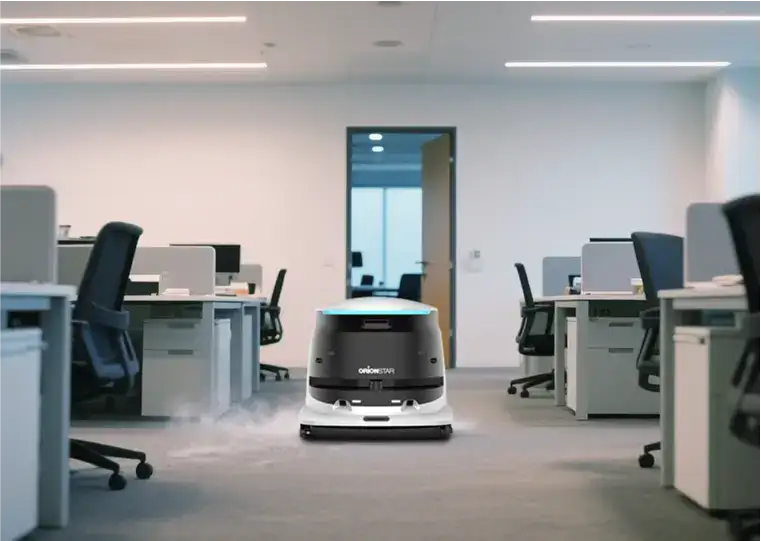
The OrionStar CleaniBot S55 Pro is a commercial cleaning automation solution designed for large indoor environments. According to manufacturer data, it combines sweeping, scrubbing, vacuuming, and mopping into a single platform. Here is how its specific specifications translate to typical cafeteria sub-spaces.
Serving lines are high-spill zones that require frequent attention, but they are also densely packed with tray slides, sneeze guards, and queue barriers. Equipment footprint is a primary constraint. The CleaniBot S55 Pro features a compact body measuring 650 × 580 × 550 mm and requires a minimum passing width of 700 mm. This allows the machine to navigate standard cafeteria aisles and serving stations. Additionally, the robot utilizes line lasers designed to facilitate edge cleaning up to 5 to 10 cm from walls and counter bases, helping to remove debris that typically accumulates under serving counters.
In main dining areas, the primary challenges are navigating around shifting chair configurations and minimizing noise if cleaning overlaps with early arrivals or late-staying diners. The S55 Pro utilizes a multi-sensor navigation system—including a LiDAR sensor, stereo camera, and ultrasonic sensors—to detect obstacles and update its internal map in real time.
For noise management, the unit operates at 55 dB in scrubbing mode and drops to 45 dB in dust mopping mode, according to manufacturer specifications. This relatively low acoustic footprint means operators can run dust-control tasks during shoulder hours without causing significant disruption to the dining environment.
Connecting corridors and hard-floor back-of-house areas require broad coverage and heavier cleaning pressure. For these zones, the CleaniBot S55 Pro offers a Power Scrubbing mode alongside its standard Scrubbing mode. Under defined test conditions, the machine can achieve a cleaning efficiency of up to 1,197 m²/h in scrubbing modes. For lighter dust maintenance in long corridors, the ECO Vacuum and Dust Mop modes provide cleaning efficiencies of up to 1,368 m²/h, supported by long runtimes (up to 19.5 hours for ECO vacuum and up to 28 hours for Dust Mop, subject to floor conditions and obstacle density), enabling extended autonomous operation across large facility footprints.
Food and beverage facilities operate under strict cleanliness protocols (such as GMP and ISO 22000), demanding audit-grade documentation. Catering managers increasingly require "proof of clean" to demonstrate due diligence to clients and health inspectors.
The CleaniBot S55 Pro supports Wi-Fi and 4G connectivity, enabling remote deployment, cloud-based maintenance monitoring, and operational data reporting. By generating auditable logs of which routes were completed and when, the system helps automate compliance reporting, shifting the burden away from manual paperwork.
Important Data Privacy Notice: Because the S55 Pro utilizes LiDAR and cameras to navigate and build maps (capable of mapping up to 10,000 m²), it generates operational telemetry and environmental data. For facilities operating in regions governed by the GDPR or similar data protection laws, catering directors and facility IT teams must verify that the handling, storage, and processing of this machine telemetry align with local data protection regulations and corporate privacy policies. The stereo cameras are utilized solely for environmental depth and obstacle detection, not for capturing or storing Personal Identifiable Information (PII). Data transmission and cloud storage should be configured to comply with local data residency requirements. In regions like the EU (GDPR) or California (CCPA), cloud data uploads require a privacy policy opt-in consent option during initial system activation, and IT departments can select local area network (LAN) modes or encrypted data transmission for enterprise deployment.
Deployments of autonomous equipment in high-traffic food and retail environments have demonstrated measurable financial impact. For instance, industry studies indicate that managed robotics programs in national grocery chains have reported up to a 21% reduction in overall cleaning and maintenance costs (source: https://www.kbs-services.com/insights/robotic-floor-cleaning-case-study/), alongside significant increases in machine utilization. In daily-use hard-floor environments covering 50,000+ square feet, facility operators often target an ROI payback period within 9 to 18 months (source: https://en.orionstar.com/ai-robots/270.html), depending on facility size, utilization rates, and local labor costs.
To support this operational uptime, the CleaniBot S55 Pro is designed with practical daily maintenance in mind. It features modular cleaning tools that allow for no-tool mode switching by on-site staff. The 15 L wastewater tank is removable and fully washable, which is critical in food service environments to prevent odor and bacterial buildup from organic food spills.
While the S55 Pro is highly capable for standard commercial layouts, food service directors should note that the broader OrionStar CleaniBot series offers multiple configurations, allowing facility managers to scale or adapt their fleet of autonomous floor scrubber robots based on the specific square footage and floor types of their various catering contracts.
Can the CleaniBot S55 Pro operate during active meal services? While the robot features multi-sensor obstacle avoidance to safely navigate around moving people, deploying any wet-scrubbing equipment during peak meal times is generally discouraged due to the inherent slip risks of wet floors. It is best scheduled for pre-service, post-service, or low-traffic shoulder hours, though its quiet 45 dB dust-mopping mode can be utilized more flexibly.
How does the robot handle changes in cafeteria seating layouts? The S55 Pro uses a LiDAR sensor and continuous real-time map updating. If tables and chairs are moved for an event or daily cleaning, the robot's navigation system detects the new layout, avoids the physical obstacles, and recalculates its path to clean the available floor space. Please note that spaces between chair legs must exceed the robot's 700 mm minimum passing width for autonomous navigation.
Is it difficult for existing cafeteria staff to maintain the machine? The machine is designed to lower the barrier for daily maintenance. It features a low-curvature piping system that is easy to brush out, a removable and washable wastewater tank, and cleaning tools that can be swapped without the need for specialized tools, allowing standard back-of-house staff to manage daily upkeep.
Will this robotic floor scrubber replace my cleaning staff? No. Autonomous floor scrubbers are designed to automate repetitive, time-consuming broad-area floor cleaning. This reallocation allows existing, hard-to-replace staff to focus on complex, high-value tasks such as sanitizing food-contact surfaces, detailing restrooms, and managing waste disposal, which machines cannot perform.