

REQUEST DEMO
Robot CATALOG will be sent to your mailbox immediately after submission.
SUBMIT
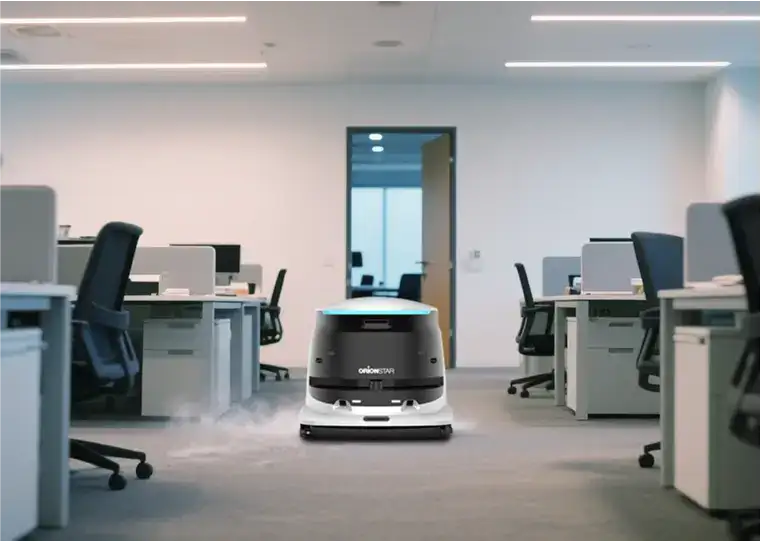
For facility managers and building service contractors operating commercial buildings, maintaining consistent floor care is a persistent operational challenge. Between fluctuating occupancy, stringent budget constraints, and a tightening labor market, managing daily cleaning operations requires balancing resources carefully.
This guide evaluates the OrionStar CleaniBot S55 Pro, an autonomous floor scrubber, to help decision-makers determine its suitability for commercial environments, specifically focusing on its application in lobbies, corridors, and common spaces.
Facility management teams face several intersecting challenges when maintaining large commercial facilities:
As a category, autonomous floor scrubbers are deployed to take over repetitive, time-consuming floor work. By automating the bulk of wide-area scrubbing and vacuuming, facility managers can reallocate human workers to complex tasks that require manual dexterity, such as cleaning restrooms, wiping high-touch surfaces, managing spills, and handling edge detailing.
Furthermore, connected autonomous machines generate digital records—such as timestamps and cleaned-area metrics—allowing managers to compare planned work against completed work, thereby supporting transparent service-level reporting.
The OrionStar CleaniBot S55 Pro is designed for large indoor environments. Its utility in a commercial building depends on how its specific capabilities map to different functional zones within the facility.
Lobbies require high aesthetic standards and minimal disruption to tenants and visitors. For polished hard floors or marble, the CleaniBot S55 Pro features a Dust Mopping mode. According to manufacturer data, this mode operates at a low noise level of 45 dB, making it suitable for daytime maintenance cleaning without disturbing conversations or front-desk operations. In this mode, the machine can achieve a runtime of up to 28 hours (depending on floor friction and battery lifecycle status), supporting continuous daily dust control.
Corridors present navigation challenges due to their confined widths, pedestrian traffic, and doors. The CleaniBot S55 Pro is built with a compact frame (650 × 580 × 550 mm) and requires a minimum passing width of 700 mm. To maintain edges along corridor walls, the robot utilizes line lasers, which allow it to clean up to 5 cm away from walls and corners (with a default setting of 10 cm) under defined test conditions.
Open common areas and indoor transitional spaces (such as corridors leading to parking areas) often feature mixed floor types and heavier soil levels. The robot's InstantClean Floor Care System integrates sweeping, scrubbing, vacuuming, and mopping. For heavily soiled hard floors, operators can utilize the Power Scrubbing mode. To navigate the transitions between these spaces, the robot features a maximum obstacle climbing threshold of 20 mm and a gradeability of up to 6 degrees.
Commercial spaces are highly dynamic, with moving pedestrians, temporary signage, and shifting furniture. The CleaniBot S55 Pro utilizes a multi-sensor fusion navigation system that includes a LiDAR sensor, a stereo camera, ultrasonic sensors, and line lasers. According to the manufacturer, LiDAR enables the construction of maps up to 10,000 m², supporting automatic positioning and real-time map updates. The stereo camera specifically aids in step and cliff detection to prevent falls near stairwells, while ultrasonic sensors handle dynamic obstacle avoidance.
For building service contractors, the value of an autonomous floor scrubber is measured in coverage, runtime, and maintenance simplicity.
When executing routine tasks, the CleaniBot S55 Pro delivers a cleaning efficiency of up to 1,197 m²/h in its scrubbing modes, and up to 1,368 m²/h in sweep/vacuum and dust mop modes, according to typical configuration data.
The robot is equipped with a charging dock and supports automatic recharging, taking less than 4 hours to reach a full charge.
Daily maintenance is a crucial factor in actual productivity. If a robot is difficult to empty or clean, operational friction increases. The CleaniBot S55 Pro is designed with modular cleaning tools for quick swapping. It features a 22 L clean water tank and a 15 L removable wastewater tank. The wastewater tank is fully washable and includes a strainer design to help operators reduce potential odor and the risk of bacterial buildup during routine post-shift maintenance.
Facility managers increasingly expect digital oversight of their fleets. The CleaniBot S55 Pro supports Wi-Fi and 4G connectivity, allowing for remote deployment, cloud-based maintenance monitoring, and Over-The-Air (OTA) updates. This connectivity enables managers to track route progress, review cleaned zones, and verify task completion against SLAs.
Because the CleaniBot S55 Pro utilizes stereo cameras and LiDAR for navigation, and relies on network connectivity for data reporting and OTA updates, facility operators must carefully evaluate data privacy laws.
For deployments within the European Economic Area (EEA), the General Data Protection Regulation (GDPR) applies. If the robot's sensors capture identifiable individuals or if operational data is transmitted to cloud servers, the facility manager (acting as the data controller) and the service contractor must ensure compliance. This includes:
Similar local data protection and cybersecurity laws must be verified by the operating facility in North American and Asian markets prior to deployment. While the machine supports these privacy-by-design frameworks, final compliance assessments remain the responsibility of the deploying facility.
To measure the true ROI of the CleaniBot S55 Pro, facility managers should avoid relying solely on generalized vendor claims. Instead, establish a baseline before deployment: track manual labor hours spent on floors, area completed, water/chemical usage, and SLA compliance.
During a pilot program, deploy the robot to manage the repeatable floor scrubbing, and deliberately reassign human staff to high-touch and specialized cleaning tasks. Compare the pilot data against the baseline to determine actual efficiency improvements for your specific building layout.
Because commercial buildings vary significantly in size, floor type, and infrastructure, the OrionStar CleaniBot series includes multiple models designed to accommodate different environmental requirements and operational scales. By matching the right hardware to the facility's specific layout and utilizing the generated data to refine scheduling, building service contractors can stabilize their operational output despite ongoing labor constraints.