

REQUEST DEMO
Robot CATALOG will be sent to your mailbox immediately after submission.
SUBMIT
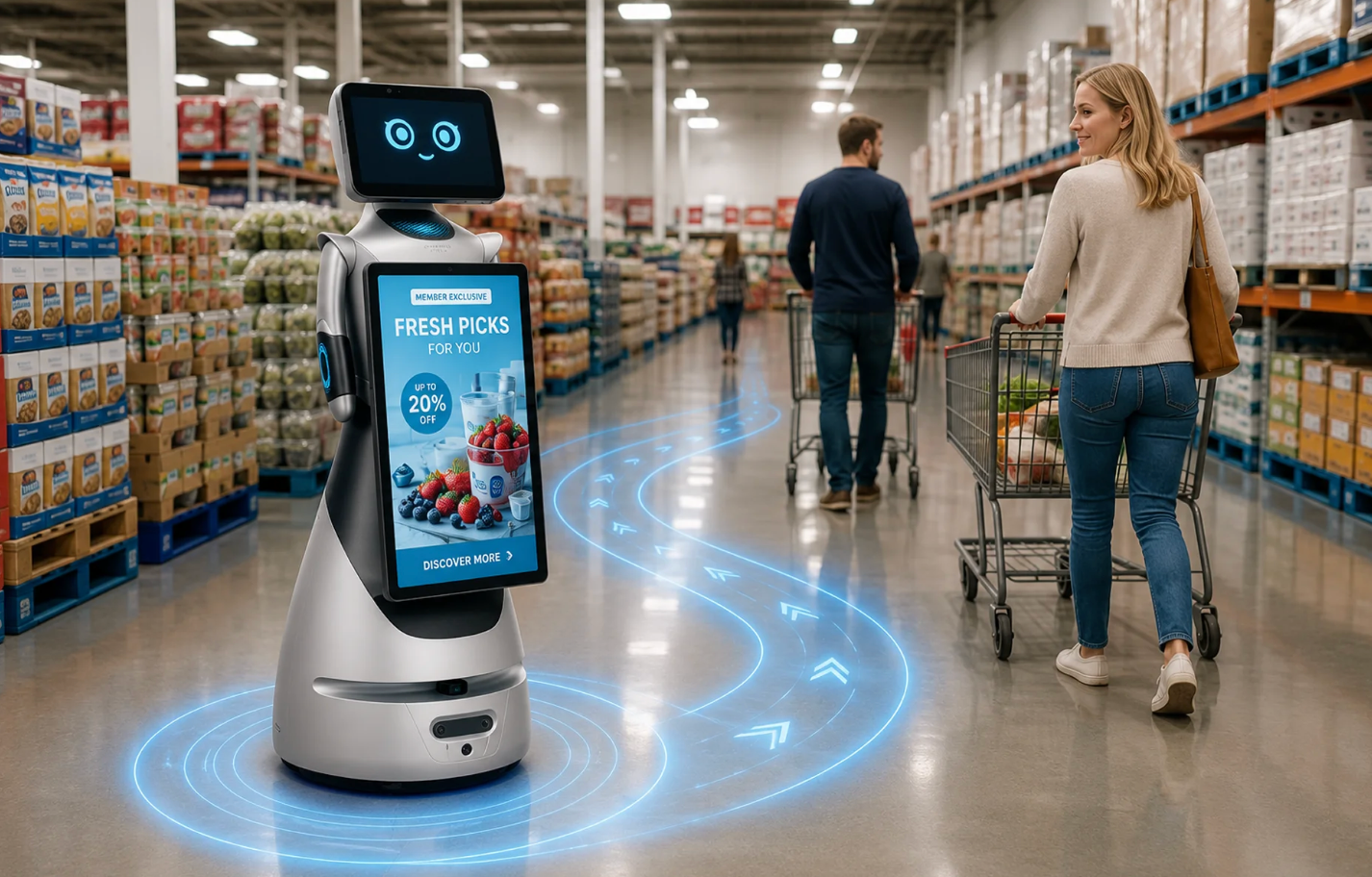
For retail store managers and experience directors, the physical retail environment presents a continuous operational balancing act. Customer expectations for immediate service and engaging in-store experiences are rising, yet operators are constrained by systemic labor pressures. Evaluating new technologies requires looking beyond basic automation to find platforms that can actively offset labor demands and optimize Total Cost of Ownership (TCO) while maintaining a high standard of customer interaction.
This guide examines how the OrionStar GreetingBot AD functions as a retail service robot, assessing its specifications, operational capabilities, and suitability for high-traffic retail venues.
Retail stores are currently navigating a deeply strained labor market. According to 2023 industry research data, labor accounts for roughly 70% of total business spending in the U.S. small-business segment. The retail trade sector frequently operates understaffed, with absence rates running nearly 15% higher than the all-industry average.
When stores operate with lean teams, floor staff are often pulled in multiple directions. Associates who should be focused on revenue-generating tasks—such as merchandising, fulfilling orders, or closing high-value sales—are frequently tied up answering repetitive customer questions, standing at storefronts to greet visitors, or walking shoppers to specific aisles. This misallocation of human resources leads to staff burnout, contributes to historically high turnover rates, and ultimately dilutes the customer experience.
Robotic automation in retail has historically focused on backend inventory scanning or floor scrubbing. However, as demonstrated by early deployments at major retailers like Lowe's and SoftBank Mobile Stores, front-of-house service robots that handle wayfinding, customer inquiries, and localized promotions can redirect valuable hours of staff time per shift and deliver a rapid deployment ROI by successfully absorbing these repetitive interaction tasks.
By deploying a retail assistant robot, store operators can establish a consistent, digital-first touchpoint for customers. Unlike static digital signage, a mobile robotic platform can actively approach shoppers, navigate the store layout, and provide multi-sensory engagement.
This technological shift allows store managers to reallocate human associates to complex, high-touch customer service roles. The OrionStar GreetingBot series offers multiple hardware configurations adapted for different venue scales, with the OrionStar GreetingBot AD specifically engineered to merge proactive greeting with large-format mobile advertising.
The OrionStar GreetingBot AD is an AI-powered commercial service platform designed primarily for information delivery, guided selling, and mobile digital signage. It is not designed for physical inventory manipulation or floor cleaning, but rather for optimizing visual engagement in commercial spaces.
A primary challenge in retail storefronts and temporary pop-up zones is capturing foot traffic without dedicating a full-time staff member to hand out flyers. The OrionStar GreetingBot AD addresses this via a dual-display system.
It features a 14-inch FHD 1080P capacitive touch screen on the head for direct customer inputs (such as searching a store directory) and a 21.5-inch FHD 1080P display mounted on the chest. According to manufacturer specifications, this large chest screen allows the robot to function as a mobile billboard, displaying dynamic promotions, digital menus, or QR codes for loyalty programs. Because the robot is mobile, operators can deploy it at the store entrance during morning rushes and move it to a targeted pop-up zone during afternoon promotional events.
Retail aisles and checkout queues are highly dynamic, requiring precise spatial awareness. The navigation system integrates a sensor array that includes LiDAR, wheel odometers, an IMU, and depth cameras to achieve high-precision positioning accuracy under standard operating environments.
Based on defined test conditions, the unit requires a minimum corridor passability of 60 to 65 cm, making it capable of navigating standard retail aisles. It can also manage minor floor transitions, handling up to 5-degree inclines (unloaded) and crossing 10 mm ground bumps or 20 mm floor seams. This mobility allows the unit to safely guide a customer from the front desk directly to a specific product aisle without disrupting other shoppers.
Customer service desks are often noisy, making automated voice recognition difficult. The OrionStar GreetingBot AD incorporates a 6-microphone circular array with 360-degree sound source localization to isolate customer voices in typical retail environments (effective up to moderate noise levels).
Coupled with a 2 MP wide-angle camera and a 13 MP high-definition camera, the robot can engage in face-to-face interactions. The hardware includes a dedicated head pitch motor (allowing movement from −15° to +40°), enabling the robot to naturally adjust its "gaze" toward the user. This makes it highly applicable for queue management or triaging basic inquiries at the service desk before a human associate is required.
To be viable, a retail assistant robot must operate through a standard store shift without requiring constant staff intervention for charging. The OrionStar GreetingBot AD is equipped with a 20 Ah, 25.2 V lithium ternary battery.
Under typical configuration and workload conditions, this power capacity supports approximately 8 to 10 hours of runtime, sufficient to cover peak operating hours. The system pairs with an upgraded 8 A charging dock utilizing LiDAR-based alignment, enabling the robot to return to base autonomously when power is low.
Because the OrionStar GreetingBot AD relies on continuous data collection through its camera systems, microphone arrays, and LiDAR sensors for navigation and voice interaction, retail operators must implement strict data governance.
Retailers deploying this technology in the EU, UK, or interacting with EU residents must verify compliance with the General Data Protection Regulation (GDPR). This includes establishing a lawful basis for any video or audio data processing, ensuring data minimization, and providing clear notices to shoppers regarding the presence of recording equipment. Similar scrutiny applies to state-level regulations in the U.S., such as the CCPA. Operators utilizing cloud-based dashboards or Over-The-Air (OTA) updates must consult with their legal and IT teams to ensure local data protection laws are met, particularly concerning biometric data, consent flows, and cross-border data transfers.
Disclaimer: Voice and visual data processed by the OrionStar GreetingBot AD for navigation and interaction are processed locally and transiently by default. Retail operators utilizing cloud-analytics features are solely responsible for ensuring compliance with local data privacy regulations (e.g., GDPR, CCPA), including obtaining necessary shopper consent and displaying adequate physical signage.
No. The OrionStar GreetingBot AD has a maximum physical load capacity of 4 kg (via a small optional delivery tray), but its arm motion is disabled by default. This is an intentional design choice to prevent the robotic arms from physically interfering with the large 21.5-inch chest display. All promotional material should be delivered digitally via the screens.
For multi-level flagship stores, the robot supports mapping areas up to 50,000 square meters. Large-scale mapping (>10,000 sqm) in highly dynamic retail environments may require periodic map updates or segmented mapping strategies to maintain optimal navigation efficiency. Navigating between floors autonomously requires the integration of an optional elevator-control module, which utilizes a reserved interface on the robot's chassis to communicate with compatible building infrastructure.
Offline basic navigation is supported, though real-time voice interaction requires an active internet connection. To access real-time cloud analytics, OTA updates, and dynamic content changes for the display screens, continuous network access is necessary. The unit supports both dual-band Wi-Fi 6 (2.4 GHz / 5 GHz) and comes standard with a 4G module (TDD-LTE / FDD-LTE) to maintain connectivity even in areas of the store with poor internal Wi-Fi coverage.