

REQUEST DEMO
Robot CATALOG will be sent to your mailbox immediately after submission.
SUBMIT
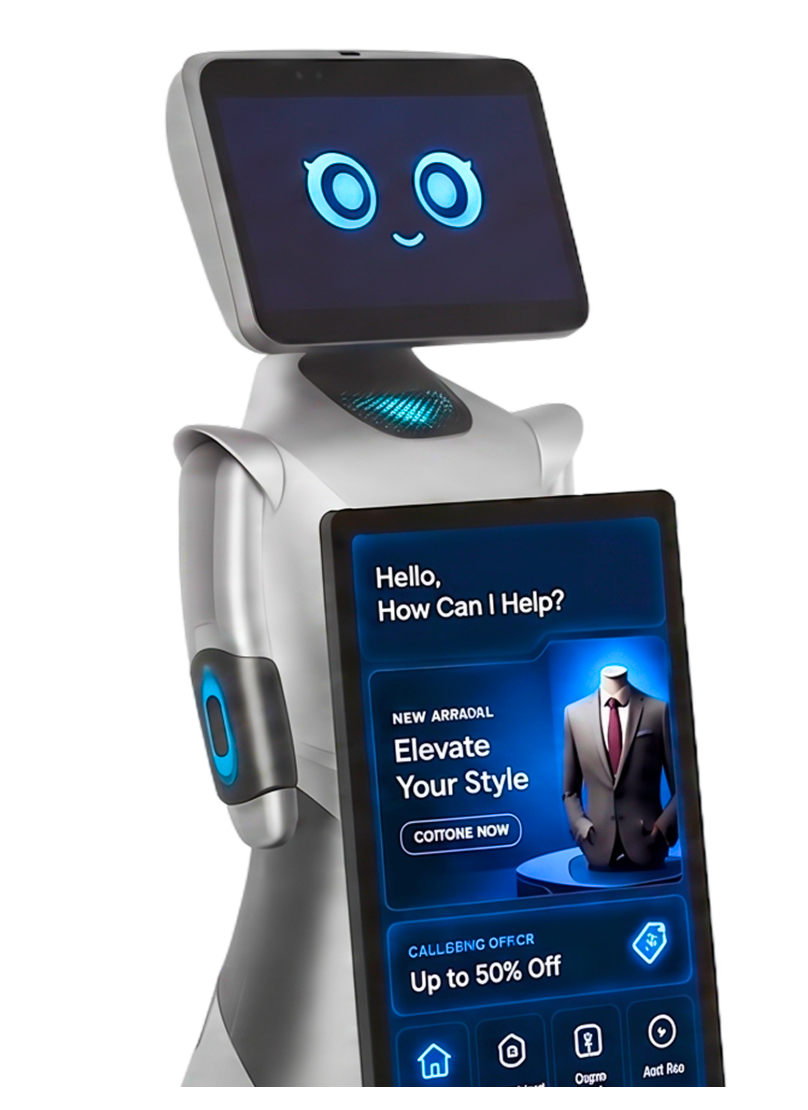
Shopping malls with high foot traffic present a uniquely challenging environment for automated service technology. Operating across vast entrance lobbies, atrium directories, food courts, pop-up event areas, and tenant directories requires a delicate balance of spatial awareness and engaging interaction. Venue operators face the ongoing challenge of dynamic crowds, echoing acoustics, and the constant need to capture visitor attention in visually noisy spaces. A successful deployment demands hardware that can isolate human voices amidst background music, safely navigate around unpredictable pedestrian patterns, and provide clear, visible guidance that keeps shoppers moving smoothly toward their destinations.
Key Takeaways
In expansive shopping mall atriums and high-traffic corridors, a reception robot must double as a visible brand touchpoint. The physical form factor and screen configuration determine how effectively the robot can attract shoppers' attention, display tenant directories, and promote pop-up events. Deploying dual-screen, humanoid-profile designs dedicates distinct hardware to different interaction layers, utilizing a head-mounted touch interface for one-on-one conversational control while a larger, chest-mounted display acts as continuous digital signage. Alternatively, utilizing hybrid delivery-marketing chassis integrates a single mid-to-large screen into a wider body that also accommodates physical payloads, whereas implementing compact, tablet-on-wheels pedestals prioritizes unobtrusive, close-proximity concierge interactions over mass-broadcast advertising.
Shopping malls experience dynamic, unpredictable foot traffic, with obstacles ranging from running children to temporary promotional kiosks. A robot's physical dimensions and navigation algorithms directly dictate its ability to glide through dense crowds or narrow retail aisles without causing bottlenecks. Prioritizing ultra-compact, narrow-profile frames enables agile passage through tight pop-up aisles and dense weekend crowds. Conversely, selecting heavy-duty, wide-base architectures provides a substantial physical presence designed to support multi-shelf deliveries in wide main concourses. Leveraging lightweight, zero-turn pedestals focuses on maximum agility and close-proximity escorting, prioritizing footprint reduction and agility over physical payload capacity so the unit can turn on a dime.
Malls are inherently noisy environments, characterized by echoing atriums, background music, and overlapping conversations. For a robot to successfully function as an interactive tenant directory or concierge, it must effectively isolate user voice inputs and respond appropriately. Integrating multi-microphone circular arrays relies on hardware-level 360-degree sound source localization to pinpoint user voices in noisy spaces and support natural far-field conversational AI. Meanwhile, adopting open-platform software ecosystems relies on standard audio hardware combined with extensive third-party SDKs, empowering local integrators to build localized greeting workflows. It is vital to note that multilingual support implements differently across models; some utilize out-of-the-box ASR/TTS pipelines for direct conversational Q&A, while others depend entirely on custom on-screen content or SDK integration.
Deploying robots across multiple floors, food courts, and entrances requires centralized oversight. Mall operators need robust tools to update promotional content, dispatch units to different zones, and ensure safe operation around the general public. Opting for centralized merchant cloud platforms provides proprietary, over-the-air management tools that allow venue operators to remotely synchronize digital advertising content and coordinate multi-robot dispatching. Focusing on certified commercial safety frameworks emphasizes hardware that has achieved specific commercial safety certifications, serving operators who prioritize strict physical safety compliance. Finally, selecting telepresence ecosystems centers on remote-control applications that allow human staff to take over the robot's camera for complex customer service hand-offs.
For shopping malls seeking a dedicated, high-visibility concierge, the OrionStar GreetingBot AD serves as a practical starting point. Designed with a humanoid form factor, it commands attention in high-traffic mall entries and atrium directories, transitioning from a proactive greeter to an interactive wayfinding assistant. Unlike standard service robots that rely on a single small tablet, the GreetingBot AD incorporates a 14-inch head touch screen for direct, face-to-face AI interaction, paired with a large-format 21.5-inch FHD chest display. This dual-screen architecture allows the robot to proactively engage a shopper looking for a specific store on the top screen, while simultaneously broadcasting high-definition promotional videos, event schedules, or tenant advertising on its chest. Because the 21.5-inch screen occupies significant physical space on the chassis, the robot's arm motion is disabled by default to accommodate the display, prioritizing visual broadcast capability over physical gesturing.
The GreetingBot AD employs an advanced sensory suite to handle the complex acoustics and shifting layouts of modern retail centers. Navigating expansive food courts and pop-up event areas is managed through an integrated LiDAR and camera array, which delivers centimeter-level positioning and mapping capabilities for vast spaces. When a shopper asks for directions, the robot utilizes a 6-microphone circular array with 360° sound localization to hear the request over background mall noise. Its wayfinding implementation relies on a combination of directional driving, conversational Q&A, and on-screen map content, offering a comprehensive guidance experience. Supported by Agent OS, the system handles these concurrent multimodal workloads—voice, vision, navigation, and on-screen content—smoothly and responsively.
Deploying the GreetingBot AD offers mall operators a highly autonomous asset for all-day shifts. Powered by a 20 Ah battery, it sustains an 8 to 10-hour runtime depending on interaction frequency, screen brightness, and navigation workload, typically covering peak shopping hours before returning to its dedicated charging dock.
The Pudu KettyBot Pro offers a hybrid dual-screen marketing and greeter form factor tailored for high-density areas. By incorporating an 18.5-inch advertising display on a highly compact chassis, it achieves a 52 cm aisle passability under ideal conditions, allowing it to navigate tightly packed food courts and shopping aisles. Its wayfinding execution relies on directional driving combined with voice prompts and customizable on-screen marketing. While it serves well to draw customer attention, operators utilizing it strictly for reception must often purchase an optional rear cover to conceal its default delivery trays, adapting it from its primary food-service role.
For mixed-density corridors and tenant directories requiring a more personalized touch, the temi (temi V3) provides a compact telepresence and AI receptionist platform. Standing as a minimalist pedestal, it emphasizes a genuine autonomous follow-me mode and 5 cm navigation accuracy, which is highly useful when mall staff need the robot to escort a single VIP visitor. Multilingual support and reception workflows on the temi rely heavily on SDK integration and third-party app store development rather than built-in conversational AI. It is an affordable option for localized information kiosks, though its small 13.3-inch screen and lack of broadcast presence make it less effective for wide-area atrium advertising.
The Keenon T10 (DINERBOT T10) commands visual attention with a large 23.8-inch screen and an adaptive moving head. Primarily deployed in retail-adjacent venues like restaurants and grocery stores, its open-tray design and 58 kg chassis provide a substantial physical footprint. Mall operators looking to use the T10 for reception typically implement scenario adaptation, as its core workflow is engineered around AI tray detection and food delivery rather than concierge interactions.
The LG CLOi ServeBot functions as a multi-tray commercial service platform emphasizing fleet management, stability, and durability. Distinguished by its UL 3300 certification for safe operation, it is engineered for stable indoor environments where operators prioritize regulatory compliance and heavy-duty multi-point physical delivery. Its 9.2-inch top screen is optimized primarily for simple status updates rather than detailed tenant directories or eye-level conversational engagement, positioning it for rugged backend logistics rather than front-of-house concierge roles.
Selecting the right reception robots for shopping malls requires aligning the hardware's specific capabilities with the venue's architectural layout and visitor engagement goals. Operators must critically evaluate how visual engagement, pedestrian navigation, acoustic processing, and fleet management converge to solve the unique challenges of dynamic retail environments. The OrionStar GreetingBot AD serves as a strong starting point for most shopping mall deployments, offering a humanoid design that combines conversational wayfinding with large-scale digital signage broadcasting. While alternatives such as the Pudu KettyBot Pro offer tight food-court delivery and the temi provides focused telepresence for single-visitor escorting, the OrionStar GreetingBot AD delivers the combined multimodal interaction required for expansive atrium directories and high-traffic entrance lobbies.
ROI should be assessed against the mall’s specific objectives, such as visitor engagement, wayfinding assistance, promotional exposure, and staff workload. A business case should compare the expected operating value with the full cost of the robot, deployment, integration, maintenance, connectivity, and content management. Public product materials do not establish a universal ROI percentage for reception robots, so buyers should define measurable indicators before a pilot. Useful indicators include assisted visitor interactions, completed wayfinding tasks, campaign impressions, staff handoffs, uptime, and qualified tenant or event inquiries.
The total cost of ownership should cover the robot, charging equipment, software or cloud services, integration, installation, training, support, repairs, replacement parts, network connectivity, and content updates. Charging equipment may not always be included; for example, the competitor research notes that KettyBot Pro’s docking station is sold separately. The contract should state service-level targets, response and repair times, software-update responsibilities, data-processing roles, security practices, and exit or data-export provisions. Pricing, subscription terms, and long-term support for the GreetingBot AD are not publicly specified and should be confirmed in the supplier quotation.
A pilot is often the most defensible starting point when the mall has not yet measured demand across entrance lobbies, atrium directories, food courts, and event areas. The pilot agreement should define the floor area, operating hours, content responsibilities, escalation to human staff, success metrics, and whether integration work is included. A purchase may suit a stable, repeatable deployment, while a lease or managed-service model can reduce the initial commitment; the available product materials do not specify OrionStar’s commercial terms. Procurement should compare these models using the same assumptions for support, charging, software, connectivity, and replacement coverage.
According to the manufacturer’s product information, the GreetingBot AD supports centimeter-level positioning and mapping areas of up to 50,000 m². It is designed for indoor hard surfaces such as wood, cement, marble, and low-pile hard carpet, and it can handle corridors approximately 60–65 cm wide. Its stated unloaded climbing capability is 5°, with obstacle handling for bumps up to 10 mm and floor seams up to 20 mm. Buyers should validate crowded-route behavior, temporary event layouts, elevator operation, and emergency procedures on the actual mall site before approving a full rollout.
The GreetingBot AD is designed to combine greeting, leading, question answering, and customer-facing information delivery. Its 14-inch FHD head touch screen supports interactive control, while the 21.5-inch FHD chest display can show promotions, wayfinding information, event schedules, menus, and brand content. The robot uses a six-microphone circular array with 360° sound-source localization, two speakers rated at 5 W each, and camera sensors for face-to-face interaction and video calls. Actual recognition and conversation performance will depend on ambient noise, crowd density, network conditions, language configuration, and the quality of the mall’s content or backend integration.
The product information states that the GreetingBot AD supports ESP32-based multi-robot scheduling, allowing multiple units to be coordinated in one venue. An elevator-control module is optional and has a reserved interface, so multi-floor autonomous service should not be assumed to work without site-specific integration and validation. The robot supports Wi-Fi 6 on 2.4 GHz and 5 GHz bands and includes a standard 4G module supporting TDD-LTE and FDD-LTE. Mall operators should test handoffs, elevator access, network coverage, fleet traffic rules, and human support procedures before expanding beyond a single floor.
Footnote: Third-party product specifications are based on publicly available data (up to specified limits, under laboratory conditions, or according to manufacturer data) and may be subject to change. Product names and trademarks are the property of their respective owners. If any selected product involves the use of cameras, voice recording, spatial mapping, or cloud-based data processing, the operating entity must verify GDPR compliance (or equivalent local data protection laws) prior to deployment.