

REQUEST DEMO
Robot CATALOG will be sent to your mailbox immediately after submission.
SUBMIT
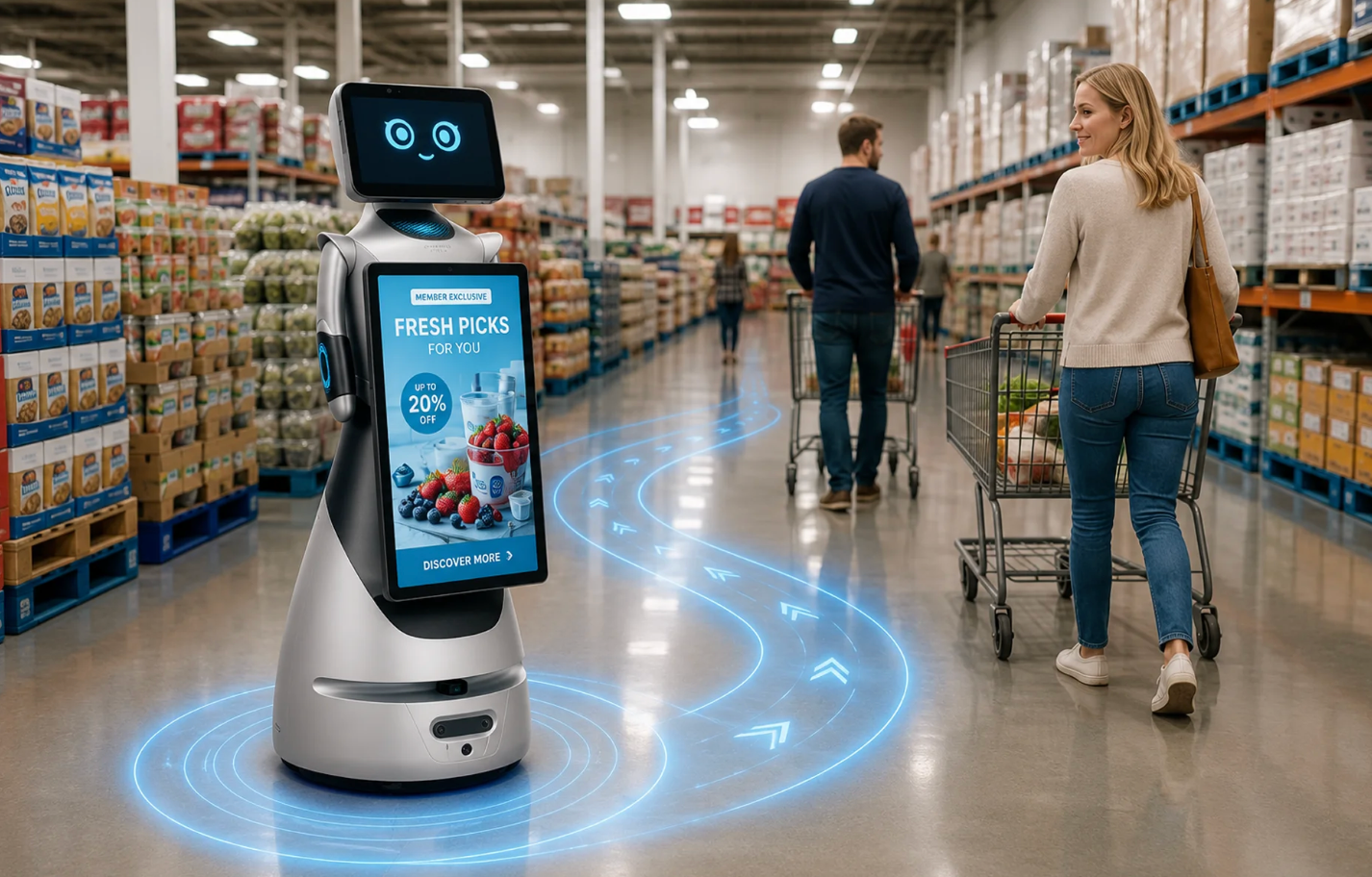
Operating a modern shopping mall involves managing high-traffic, mixed-use environments where customer service demands constantly intersect with resource allocation challenges. According to recent industry surveys by McKinsey and Oliver Wyman, retail and customer-care operators are facing persistent talent shortages, rising inquiry volumes, and tight budgets. For shopping mall marketing teams and in-store experience managers, this creates a tangible gap in the front-of-house experience. Bridging this gap strategically offers a commercial advantage: reducing operational labor costs while simultaneously increasing dynamic advertising conversion rates.
When mall entrances and atrium lobbies are understaffed, the operational bottleneck of wayfinding, answering repetitive queries, and promoting tenant events falls on static directory boards or already stretched retail personnel. To address these bottlenecks, operators are increasingly evaluating reception robots. This guide examines how the OrionStar GreetingBot AD serves as a mobile engagement and wayfinding platform, helping decision-makers assess its viability for large-scale retail environments.
Within expansive retail footprints, the primary friction points for customers revolve around navigation and information discovery. Industry studies, such as the EU-funded MuMMER project conducted at the 100,000-square-meter Ideapark mall, highlight that providing guidance, event information, and collecting feedback consumes significant staff time.
Furthermore, shopping malls frequently serve international visitors, requiring multilingual support that is difficult to guarantee across all shifts. When retail operators cut labor hours to defend profitability, in-mall service standards inevitably decline. Relying solely on static directory boards often fails to convert passive foot traffic into active tenant engagement, especially in high-density areas like food courts or pop-up event areas where temporary promotions require immediate visibility.
Reception robots are designed to absorb the high volume of routine greet-and-direct tasks, freeing human staff to handle complex customer relations. By providing a mobile, interactive presence, these robots can proactively engage shoppers rather than waiting for shoppers to find an information desk.
Field data indicates that this category can measurably improve visitor engagement metrics. During retail pilots at Westfield Malls in the US, reception robots generated between 300 to 500 interactions per day per unit, with an average dwell time of around 2.5 minutes—a substantial increase over the traditional retail metric of "five seconds from five feet." Similarly, deployments in retail-adjacent settings have recorded notable boosts in both foot traffic and customer interactions. For in-store experience managers, this translates to a reliable mechanism for distributing tenant promotions and driving footfall to specific wayfinding zones.
The OrionStar GreetingBot AD is an AI-powered commercial service robot that combines proactive greeting capabilities with a mobile digital signage platform. Rather than functioning as a security or cleaning device, it is specifically configured to deliver multi-modal information—voice, visual, and movement—in high-footfall commercial venues.
Here is how its core specifications align with shopping mall use cases:
A key feature of the OrionStar GreetingBot AD is its dual-screen setup. It features a 14-inch FHD capacitive touch screen on the head for direct user interaction (such as selecting a destination), paired with a 21.5-inch FHD display mounted on the chest. For shopping mall marketing teams, this chest screen acts as a mobile billboard. It can display dynamic promotions, event schedules, or QR codes for loyalty programs while the robot navigates through atrium lobbies or pop-up event areas. (Note: To accommodate this large chest display without physical interference, the manufacturer disables arm motion by default in this specific model.)
Shopping malls are acoustically challenging environments. The robot is equipped with a 6-microphone circular array supporting 360-degree sound source localization, allowing it to accurately identify and turn toward a speaking customer even in a noisy food court. Coupled with a dedicated head pitch motor that allows the robot to tilt its head from −15° to +40°, it facilitates a more natural, face-to-face interaction posture when addressing visitors of different heights.
Moving visitors from mall entrances to specific tenant wayfinding zones requires reliable navigation. According to manufacturer data, the robot utilizes a combination of LiDAR, visual sensors, and an IMU to achieve centimeter-level positioning, with the capacity to map areas up to 50,000 square meters, depending on the complexity of the indoor environment. Its adjustable speed (0.5–1.2 m/s) and ability to navigate 60–65 cm corridors enable it to safely guide shoppers to their destinations while maneuvering around crowds and minor floor transitions (handling bumps up to 10 mm).
A primary concern for retail operators is device uptime. To support the power draw of the additional 21.5-inch screen, this model is equipped with a high-capacity 20 Ah lithium ternary battery. Under typical test configurations, this yields an estimated runtime of up to 8 to 10 hours, with actual runtime varying based on workload and ambient conditions. This is sufficient to cover a standard retail shift before the unit returns to its LiDAR-guided charging dock.
Deploying an AI-driven robot equipped with a 13 MP high-definition camera, a 2 MP wide-angle camera, and a 6-mic array requires strict adherence to data protection regulations. Mall operators in Europe and the US must evaluate this deployment through the lens of the GDPR and local biometric data laws.
Industry precedents dictate that organizations must establish an explicit legal basis and provide meaningful public notice before processing visitor data. Because the robot cannot realistically obtain explicit consent through its screen from every passing shopper, deploying organizations must place clear physical signage (Privacy Notices) at mall entrances or around the robot's patrol zones, informing the public of data processing activities and providing a QR code to the full privacy policy.
Furthermore, operators must configure the robot's edge-computing and cloud features to align with privacy-by-design principles. Data processing should prioritize edge-computing, meaning facial features and voice commands are processed locally for immediate interaction and discarded promptly. Cloud storage should be strictly limited to anonymized, aggregated foot-traffic trends, typically retained for 30 to 90 days depending on the mall's data retention policy. This helps ensure that features such as visitor demographics or emotion detection do not violate local compliance frameworks.
On the operational side, modern retail IT teams expect ecosystem integration. The OrionStar GreetingBot AD runs on a customized Agent OS (based on Android 13). This open architecture is designed for high API readiness, allowing integration with existing mall digital ecosystems. It supports Wi-Fi 6 and 4G connectivity, facilitating the remote diagnostics, over-the-air (OTA) updates, and fleet dashboard monitoring that operators require to track interaction metrics and update digital signage content across multiple units simultaneously.
> Privacy & Compliance Note: The collection and processing of visual and audio data by service robots must comply with local privacy regulations (e.g., GDPR). OrionStar provides hardware and edge-computing capabilities that support privacy-by-design, but the deploying organization remains responsible for securing necessary user consent, providing public notice, and configuring data retention policies in accordance with applicable laws.
For shopping malls seeking to alleviate front-desk pressure and elevate the visitor experience, the OrionStar GreetingBot AD offers a targeted commercial solution. By combining autonomous wayfinding with a prominent 21.5-inch digital display, it allows marketing teams to deploy dynamic advertising directly into the flow of foot traffic while reliably guiding shoppers to tenant locations.
Because every retail environment has unique spatial and operational demands, decision-makers should note that the broader OrionStar GreetingBot series includes multiple models with varying screen configurations and interaction capabilities, allowing operators to select the hardware profile that best matches their specific customer service and ROI strategy.