

REQUEST DEMO
Robot CATALOG will be sent to your mailbox immediately after submission.
SUBMIT
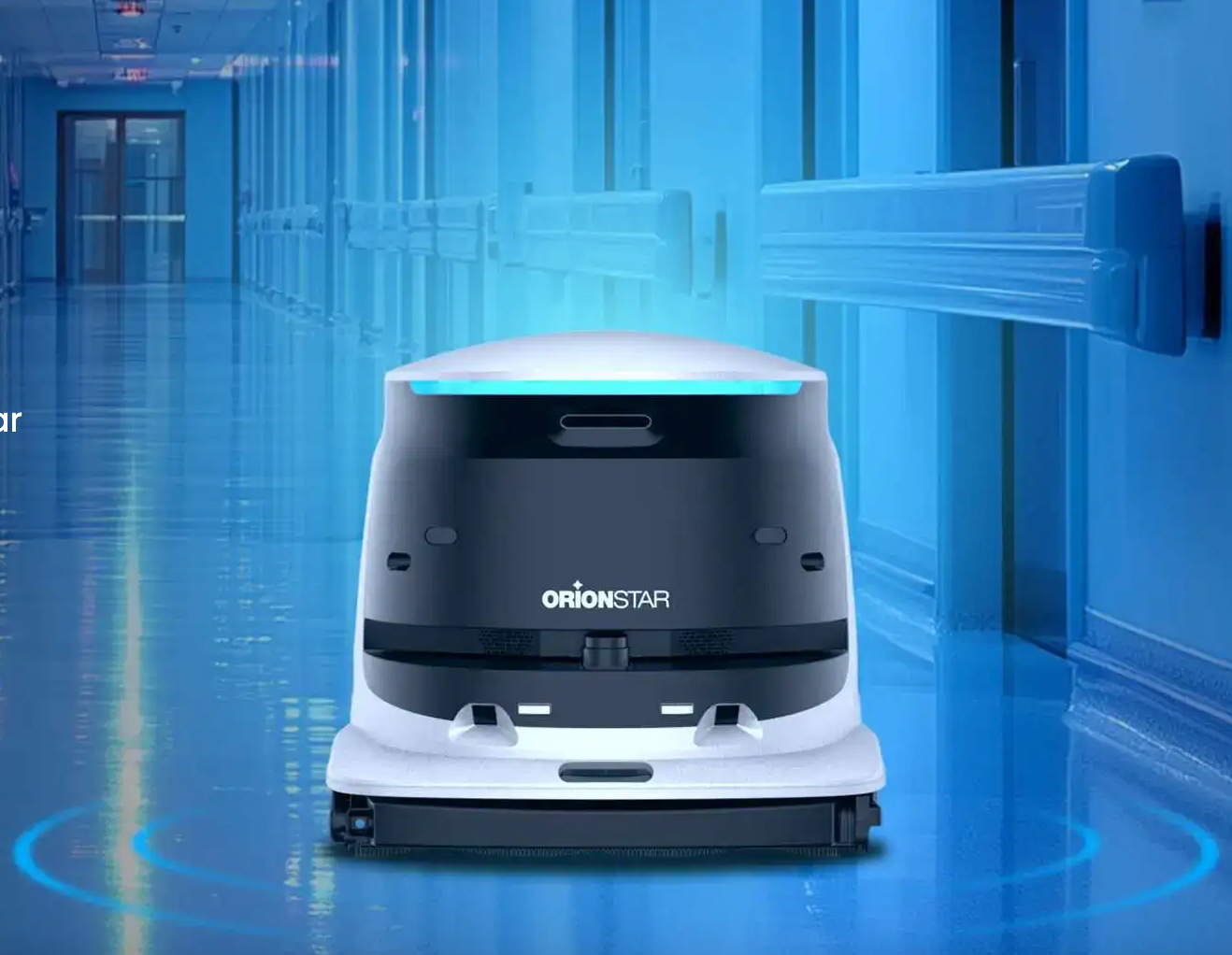
For healthcare facility managers, environmental services (EVS) directors, and infection prevention teams, maintaining hospital corridors presents a distinct operational challenge. These spaces are not standard commercial floors; they are high-traffic, continuous-use circulation routes shared by patients, clinical staff, wheelchairs, and mobile medical equipment.
Faced with ongoing staffing pressures, the need for consistent hygiene on common healthcare surfaces like VCT (Vinyl Composition Tile) or Terrazzo, and the drive to lower total cost of ownership (TCO), many healthcare networks are evaluating commercial cleaning robots. This guide examines how the OrionStar CleaniBot S55 Pro aligns with the specific operational, environmental, and compliance requirements of hospital corridor networks, including main public corridors, patient-floor corridors, elevator lobbies, and service corridors.
Deploying an autonomous floor scrubber in a healthcare setting requires understanding both clinical guidelines and spatial realities. According to CDC guidance, patient-area floors are generally classified as low-touch surfaces with a low pathogen-transmission risk, typically requiring at least daily cleaning. However, the cleaning approach must remain risk-based.
Facility managers face several specific challenges in these spaces:
The OrionStar CleaniBot S55 Pro is a commercial cleaning robot designed for large indoor environments. When evaluated against healthcare corridor challenges, several of its specifications offer practical value to EVS teams.
Hospital corridors require equipment that can navigate safely around clinical obstacles. The CleaniBot S55 Pro utilizes a 15-sensor navigation system, incorporating LiDAR (supporting map construction up to 10,000 m²), ultrasonic sensors, and a stereo camera. This multi-sensor approach allows the robot to detect and navigate around beds, wheelchairs, and walking staff. Furthermore, the unit features a minimum passing width of 700 mm and a compact body (650 × 580 × 550 mm), making it highly capable in congested service corridors or partially obstructed elevator lobbies, subject to sufficient turning clearance.
Noise pollution is a critical metric in healthcare environments, particularly in patient-floor corridors. According to manufacturer data, the CleaniBot S55 Pro operates at a noise level of 55 dB during standard scrubbing and can drop to 45 dB in Dust Mopping mode. This allows facility managers to schedule routine maintenance cleaning during quiet hours or night shifts with minimal disturbance to resting patients.
Different hospital sub-spaces require different floor care approaches. The S55 Pro supports multiple modes, allowing EVS teams to program specific behaviors for specific zones:
Cross-contamination is a primary concern for infection prevention teams. The S55 Pro features a modular design that supports healthcare SOPs. The 15 L wastewater tank is removable and fully washable, allowing EVS staff to immerse it during routine maintenance to reduce odor and maintain high sanitation standards. (Note: The OrionStar CleaniBot S55 Pro is a commercial cleaning appliance, not a medical device, and does not promise to achieve medical-grade sterilization standards.) The low-curvature piping design also facilitates manual brush cleaning to prevent blockages.
Industry deployments indicate that autonomous floor scrubbers are most successful when integrated into a human-robot collaboration model. The CleaniBot S55 Pro is engineered to handle repetitive, large-area floor maintenance.
It is vital to note what the robot does not do: it does not replace trained EVS personnel. CDC protocols mandate that blood, vomit, or other body-fluid spills require an immediate two-step containment, cleaning, and disinfection process by trained staff wearing appropriate PPE. A routine autonomous pass should never substitute for a manual spill response. Additionally, high-touch surfaces—such as handrails, door push-plates, and elevator buttons—remain the strict domain of manual environmental cleaning.
By offloading the time-consuming task of pushing a manual floor scrubber down extensive corridor networks, the S55 Pro allows EVS managers to reallocate staff to these critical, high-touch infection control duties, ultimately supporting better labor optimization and a lower total cost of ownership (TCO).
CDC guidelines recommend standardized assessments for facility cleanliness. The CleaniBot S55 Pro supports Wi-Fi and 4G connectivity, providing digital fleet management capabilities such as route completion maps and downtime reporting. While these digital logs prove that a corridor was mechanically serviced, infection prevention teams must remember that digital coverage reports supplement—but do not replace—physical cleanliness assessments (such as ATP testing or visual audits).
Because the CleaniBot S55 Pro utilizes optical sensors (including a stereo camera for step/cliff detection) to navigate, hospitals must rigorously evaluate data privacy. Under European Data Protection Board (EDPB) guidance, GDPR applies if audiovisual data can identify people.
Hospital corridors are highly sensitive environments where captured video could inadvertently reveal a patient's health condition (classified as special-category data under Article 9). Therefore, before deploying the robot, IT and legal teams must:
OrionStar provides localized data deployment options to assist facilities in meeting their GDPR and HIPAA compliance obligations. Data governance remains the responsibility of the deploying facility.
For healthcare facility management, the OrionStar CleaniBot S55 Pro offers a practical solution for mitigating labor shortages in routine floor maintenance. By combining multi-sensor navigation, low-decibel operation, and modular tank maintenance, it addresses the specific friction points of hospital corridor cleaning. When deployed alongside strict EVS protocols and rigorous data privacy safeguards, it serves as a reliable asset in a broader infection prevention strategy.
As facility scales and architectural layouts vary, decision-makers should also note that the broader OrionStar CleaniBot series offers multiple models, allowing hospital networks to select the specific footprint and capacity that best fits their unique infrastructure.
Deployment in isolation zones depends primarily on the hospital's internal SOPs. Because CDC guidelines require strict segregation of equipment and solutions to prevent cross-contamination, EVS teams must define strict protocols for replacing brushes, pads, and decontaminating the robot's wheels and tanks before it crosses back into general patient corridors.
The robot is not designed for biohazard remediation. If a spill occurs, the robot's emergency stop button should be engaged, or it should be manually rerouted via the management software. EVS personnel must then execute a manual, CDC-compliant spill response.
Yes, depending on the initial deployment mapping. The S55 Pro supports automatic positioning and zone-based mode switching. For instance, it can be programmed to perform standard scrubbing in a public lobby and automatically switch to a quieter Dust Mop or ECO Vacuum mode when it enters a noise-sensitive patient-floor corridor.
The S55 Pro supports auto-recharge at its docking station, but it does not feature an automatic station water tank capacity. EVS staff are required to manually empty, clean, and refill the 22 L clean water and 15 L wastewater tanks as part of their shift maintenance routine.
Disclaimer: The OrionStar CleaniBot S55 Pro is a commercial cleaning appliance, not a medical device. It is designed to assist with environmental cleaning workflows and does not replace standardized medical disinfection protocols.