REQUEST DEMO
Resources > Blogs > Transforming Airport Facilities Services with Commercial Cleaning Robots

Transforming Airport Facilities Services with Commercial Cleaning Robots

2026-08-03 03:36 OrionStar

Transforming Airport Facilities Services with Commercial Cleaning Robots

Introduction

Facilities Services in airports operate in one of the most demanding, round-the-clock environments, facing a convergence of intensifying challenges including severe labor shortages, escalating total cost of ownership, and strict environmental compliance mandates. With passenger expectations for visible cleanliness remaining permanently elevated since the pandemic, traditional manual maintenance is struggling to keep pace with the continuous operational demands of expansive terminals. To address these complex hurdles, airport operators and building service contractors are increasingly turning to commercial cleaning robots as a strategic solution to stabilize costs, optimize workforce deployment, and deliver consistent, auditable cleaning performance across complex aviation facilities.

The Growing Need for Smarter Cleaning in Airports

  • Elevated passenger expectations require visible, continuous cleaning methods rather than traditional off-peak maintenance routines, directly impacting overall traveler satisfaction.
  • Severe labor shortages across the aviation sector are forcing providers to rethink workforce allocation and seek automated solutions to ensure reliable 24/7 operations.
  • Operators face mounting total cost of ownership pressures, as up to 65% of fleet expenses stem from reactive maintenance, energy consumption, and unplanned downtime rather than initial acquisition.
  • Managing fragmented, multi-vendor equipment fleets creates operational bottlenecks, making coordinated scheduling and centralized analytics difficult to achieve across vast terminal spaces.

How Commercial Cleaning Robots Can Help

  • Advanced navigation and spatial mapping systems utilizing multi-sensor fusion (including LiDAR and 3D cameras) allow these autonomous machines to safely maneuver through dynamic zones without constant human supervision.
  • Autonomous path planning ensures that floor scrubbing and deep-cleaning routes are optimized for extensive coverage and efficient energy usage during each deployment cycle.
  • Auto-charging and automated docking capabilities enable multi-shift operations by allowing robots to independently refill water, discharge waste, and recharge batteries.
  • Real-time monitoring and cloud-based analytics provide facility managers with auditable productivity metrics, including area covered and consumable usage.
  • Because mapping and navigation systems utilize sensors, operators must ensure data is anonymized at the edge or processed in strict compliance with GDPR privacy frameworks. No personal visual data is stored or transmitted, ensuring privacy and regulatory compliance.

A Closer Look: OrionStar CleaniBot C5 in Action

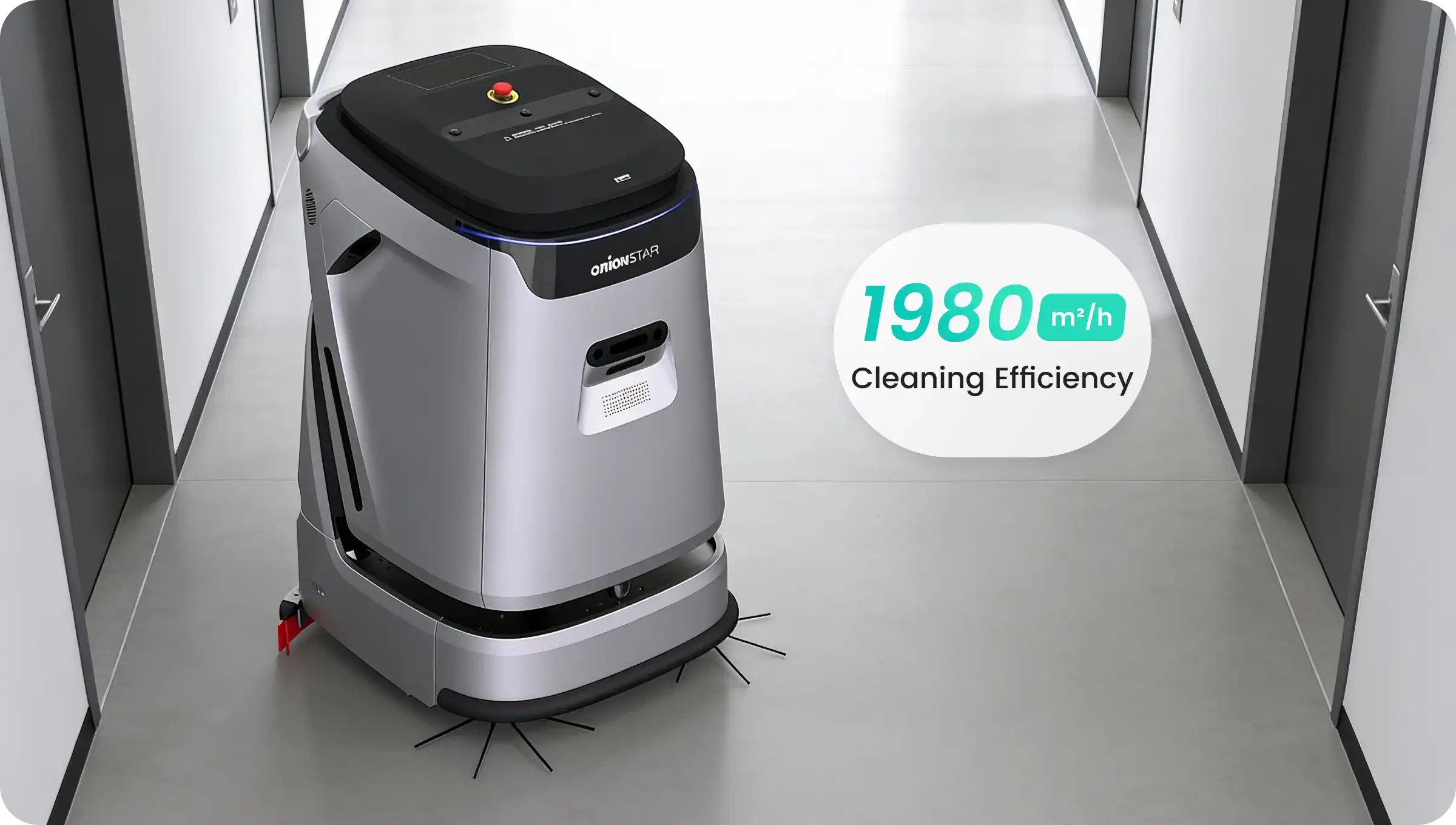
Demonstrating these autonomous capabilities in a heavy-duty form factor, the OrionStar CleaniBot C5 is an industrial-grade floor-scrubbing robot designed to handle expansive commercial spaces. The unit translates autonomous path planning into measurable output, featuring a maximum cleaning area capacity of up to 1,980 square meters per hour (under standard test conditions). To support continuous multi-shift operations with minimal human intervention, it utilizes an automated docking workstation that handles fresh-water refilling and waste-water discharge for its combined 90-liter tank system. Furthermore, its intelligent obstacle-avoidance system ensures safe operation around passengers and luggage, while a dual-rolling-brush mechanism applies up to 25 kilograms of downward pressure to effectively manage heavy grime in high-traffic aviation hubs.

Benefits for Facilities Services Providers, Building Service Contractors

  • Labor optimization: Deploying Autonomous Mobile Robots (AMRs) for floor cleaning allows providers to augment the existing workforce by redeploying janitorial staff to higher-value, specialized cleaning tasks, effectively mitigating severe manpower shortages. According to industry case studies, such deployments have reported up to a 75% reduction in manual floor-cleaning labor.
  • Cost reduction and ROI: Leveraging predictive maintenance and analytics through centralized systems can significantly reduce asset wear. Industry estimates show some airport deployments achieving up to 60% annual savings on consumable parts like brushes and reducing actual ROI timelines to around 14 months.
  • Consistent cleaning quality: Autonomous robots provide predictable, standardized cleaning schedules across vast areas. According to industry case studies at major hubs like Frankfurt Airport, fleets successfully covered 1.6 million square meters in a six-month window, ensuring no disruption to passenger flow.
  • Resource conservation: Automated fluid management systems significantly reduce chemical and water waste, evidenced by fleets that recycle water up to three times per cycle or generate up to 20% water savings per deployment.
  • Data-driven management: Integrated telemetry provides transparent, auditable records of fleet uptime, which according to industry case studies in fully optimized smart airports has been shown to increase from 68% to 94% through proactive maintenance.
  • Safe and unobtrusive operation: With safety sensors and precise navigation, these machines can safely operate visibly in front of passengers during peak hours, elevating perceived cleanliness without causing spatial disruptions.

Real-World Applications

Ticketing and Terminal Concourses

These vast, high-visibility spaces suffer from constant foot traffic, rolling luggage wear, and unpredictable passenger densities that complicate traditional daytime cleaning. Commercial cleaning robots navigate these dynamic zones using smart obstacle avoidance, operating visibly to reassure passengers while maintaining floor quality without obstructing traveler flow.

Baggage Claim Halls

Baggage areas face sudden, massive surges of passengers and heavy luggage carts following flight arrivals, leading to rapid accumulations of scuff marks and debris. Automated scrubbers can be scheduled to deploy immediately between flight banks, applying heavy downward scrubbing pressure to remove grime before it sets, ensuring the area is hygienic for the next wave of arrivals.

Back-of-House and Logistics Corridors

The subterranean and employee-only corridors of an airport are characterized by heavy utility cart traffic, grease, and industrial dirt, requiring heavy-duty maintenance. Industrial-grade robots with large water capacities and automated docking stations can run continuous cleaning cycles in these expansive transit routes, maintaining safety standards while keeping human workers focused on passenger-facing zones.

Integration With Other Smart Systems

To maximize operational efficiency, commercial cleaning robots are increasingly functioning as an integrated layer within broader smart-airport ecosystems rather than as isolated mechanical devices. Fleet management platforms can tie directly into Computerized Maintenance Management Systems (CMMS) to trigger predictive maintenance alerts—such as ordering brush replacements based on actual surface-wear data rather than arbitrary timelines—significantly reducing unplanned downtime. Advanced deployments also utilize custom Robotic Middleware Frameworks to orchestrate diverse equipment fleets, allowing the system to ingest flight-operation timing and terminal infrastructure data so that robots are automatically deployed outside peak check-in periods or coordinated seamlessly with automated doors.

Supporting ESG and Sustainability Goals

  • Automation-generated metrics provide auditable, highly accurate data points regarding area cleaned and resource consumption, which are essential for frameworks like the EU's Corporate Sustainability Reporting Directive (CSRD) and green building rating systems such as LEED or BREEAM.
  • Automated fluid dispensing and recycling technologies drastically reduce water usage, with documented deployments demonstrating the ability to recycle water multiple times per cycle and achieve significant overall water savings.
  • Precise, sensor-driven cleaning eliminates the over-application of harsh chemical detergents, protecting local wastewater systems and maintaining an optimal indoor environment for passengers and staff.

The integration of robotic cleaning fleets not only modernizes facility maintenance but directly underpins an airport’s broader environmental, social, and governance initiatives through measurable resource reduction and transparent data reporting.

Closing

The transition toward autonomous maintenance marks a fundamental shift in how commercial cleaning robots are optimizing the way Facilities Services maintain airports worldwide. By addressing critical labor shortages, stabilizing operational costs, and providing verifiable environmental data, these automated systems have moved from experimental pilots to essential terminal infrastructure. As facility requirements vary from heavy-duty logistics corridors to dynamic passenger lounges, product lines like the OrionStar CleaniBot series provide multiple models designed to adapt to specific spatial and operational demands, allowing operators to explore tailored solutions. Ultimately, the integration of robotics into daily maintenance protocols ensures that aviation hubs can consistently meet the highest standards of safety, efficiency, and cleanliness.