

REQUEST DEMO
Robot CATALOG will be sent to your mailbox immediately after submission.
SUBMIT
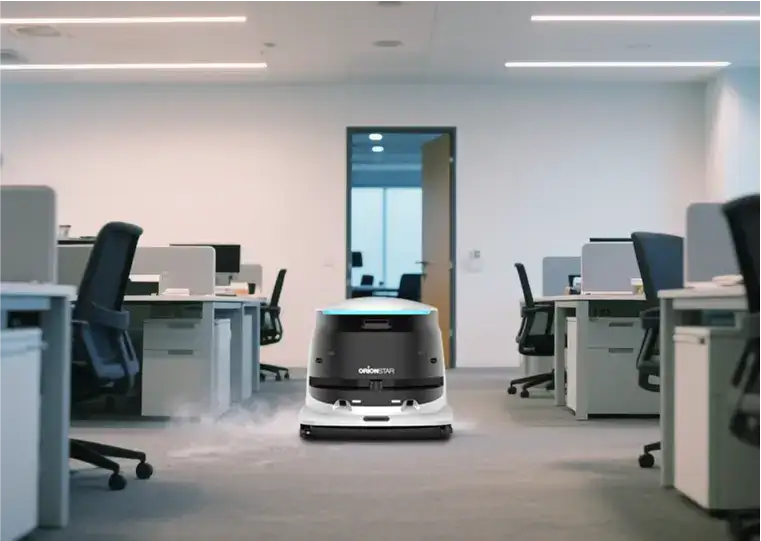
In the realm of workplace management within commercial buildings, operational teams are facing significant structural pressures driven by rising labor costs, extreme staff turnover, and increasingly strict hygiene compliance mandates. As traditional manual cleaning methods struggle to keep pace with these escalating pressures and tightening budgets, facility operators are turning to commercial cleaning robots as a highly viable, technology-driven solution to stabilize costs and maintain consistent service quality.
The OrionStar CleaniBot S55 Pro illustrates how these autonomous capabilities are implemented in a practical hardware platform designed for large-scale floor care. According to manufacturer specifications, it utilizes a sophisticated multi-sensor navigation system to construct maps covering up to 10,000 square meters under defined test conditions while safely avoiding obstacles in dynamic environments. Furthermore, it leverages autonomous path planning and auto-charging functionality to maintain sustained operational cycles, achieving a maximum cleaning efficiency of up to 1,368 square meters per hour under optimal testing conditions in sweep and vacuum modes, thereby translating generic automation concepts into tangible, daily operational metrics for facility teams.
The main entrance of any commercial building serves as the critical first impression for tenants and visitors, demanding near-constant upkeep to manage high foot traffic and incoming dirt. Autonomous robots can be programmed to perform frequent cleaning utilizing the 45 dB Dust Mopping mode for low-disturbance operation or scrubbing cycles during low-traffic windows, ensuring consistent cleanliness without disrupting the flow of people.
Long, expansive hallways require labor-intensive, physically demanding manual work that often leads to inconsistent coverage and worker fatigue. Robots easily navigate these straightforward stretches using automated path planning, systematically covering the entire square footage while safely bypassing transient obstacles like delivery carts or pedestrians.
Transitional spaces and indoor parking zones frequently suffer from heavy soil intrusion, requiring robust and extensive floor washing. Industrial-grade cleaning robots tackle these broad expanses efficiently by utilizing powerful scrubbing modes and high-capacity water tanks to remove heavy dirt deposits, allowing human staff to focus on more intricate maintenance tasks.
Shared tenant areas, such as cafeterias and open-plan break zones, experience dynamic daily usage and accumulating debris that requires flexible cleaning schedules. By utilizing zoned cleaning modes, an automated unit can transition from heavy scrubbing in a food-service area to quieter vacuuming near seating zones, adapting to the specific surface requirements of the mixed-use space.
In modern commercial environments, commercial cleaning robots are increasingly evaluated not as standalone appliances, but as active nodes within the broader smart-building ecosystem. Through integrations with Building Management Systems (BMS) and IoT platforms, these automated units can trigger cleaning patterns based on real-time occupancy data or align their schedules with building HVAC and lighting routines to minimize energy waste. Simultaneously, they feed operational telemetry and detailed cleaning logs back into Computerized Maintenance Management Systems (CMMS), replacing manual proof-of-service documentation and providing workplace managers with a transparent, verifiable data layer for audits and contract compliance.
By seamlessly combining environmental resource conservation with improved worker welfare, automated cleaning platforms are becoming indispensable tools for facility managers striving to meet rigorous corporate sustainability targets.
Commercial cleaning robots are fundamentally changing the way workplace management approaches the daily maintenance of commercial buildings, shifting operations from labor-intensive, reactive models to data-driven, automated strategies. By addressing systemic challenges in labor availability, cost control, and operational transparency, this technology is establishing a new baseline for facility hygiene. As these smart ecosystems continue to evolve, platforms like the OrionStar CleaniBot series offer a variety of models to adapt to different spatial constraints and use cases, providing operational leaders with versatile tools to further optimize their facility management programs.
Performance metrics, including cleaning efficiency, battery runtime, and mapping capacity, are based on OrionStar’s standard laboratory testing conditions. Actual real-world performance may vary depending on floor types, room layouts, and environmental factors. Data privacy is managed in strict compliance with GDPR and relevant local regulations; visual sensor data is processed locally for obstacle avoidance and is not stored or transmitted.