

REQUEST DEMO
Robot CATALOG will be sent to your mailbox immediately after submission.
SUBMIT
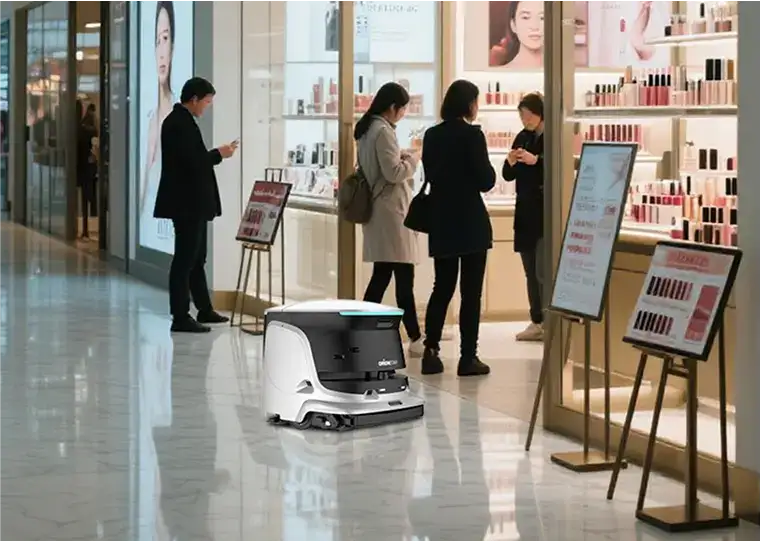
For multi-site cleaning coordinators and retail facility managers, maintaining floor care across dozens or hundreds of store locations presents a unique set of operational pressures. Unlike single-site shopping malls or standalone warehouses, retail chains must enforce strict brand consistency across diverse store formats, manage decentralized cleaning teams, and verify hygiene standards from a central headquarters.
Compounding these challenges is the reality of the facility management labor market. According to Cleansing & Maintenance Management / ISSA Media, industry analyses report cleaning-staff turnover rates of 200% to 300% annually. When combined with the measurable operational risk of slip-and-fall incidents, retail operators are increasingly evaluating commercial cleaning robots to stabilize floor maintenance.
This guide examines the OrionStar CleaniBot S55 Pro commercial cleaning robot to help retail operations managers determine if its specifications and fleet-management capabilities align with the demands of multi-site chain environments.
A primary challenge in retail chain management is standardizing operations across flagship locations, standard big-box formats, and compact neighborhood stores. The equipment deployed must be physically capable of navigating these varying footprints while handling mixed flooring materials.
According to manufacturer specifications, the CleaniBot S55 Pro is designed with a relatively compact footprint (650 × 580 × 550 mm) and a minimum passing width of 700 mm. This sizing allows the robot to operate not just in wide main aisles, but also in tighter sub-spaces such as checkout areas, fitting room corridors, and back-of-house stockrooms where larger industrial ride-on scrubbers cannot fit.
Furthermore, retail environments rarely feature a single floor type. A standard store might have polished tile at the entrance/lobby, concrete in the aisles, and low-pile carpet near fitting rooms. The S55 Pro features an InstantClean Floor Care System that supports multiple modes. Operators can utilize Scrubbing or Power Scrubbing for hard floors (achieving cleaning efficiencies up to 1,197 m²/h under typical configurations), and seamlessly switch to Sweep & Vacuum mode for debris collection on different surfaces. This multi-mode capability allows chains to deploy a single robotic platform across diverse store layouts rather than purchasing specialized single-purpose machines for each zone.
Retail floors do not only get dirty at night; spills, tracked-in weather, and debris accumulate during trading hours. However, deploying manual cleaning teams or outsourced crews during peak hours can disrupt the shopper experience. Conversely, relying solely on overnight outsourced crews can be expensive and difficult to manage across a sprawling network.
The CleaniBot S55 Pro offers specifications that support safe, unobtrusive daytime operation. According to manufacturer tests, its noise output is rated at 55 dB during scrubbing and drops to 45 dB in Dust Mopping mode. This allows the robot to maintain sales floor aisles and entrance lobbies without creating acoustic disruptions for customers or store associates.
To operate safely around moving shopping carts, dynamic end-cap displays, and pedestrian traffic, the S55 Pro relies on a typical configuration of a 15-sensor multi-sensor navigation system. This includes LiDAR for map construction (up to 10,000 m²), stereo cameras for step detection, ultrasonic sensors for obstacle avoidance, and line lasers that allow the robot to clean close to walls and shelving edges.
For multi-site cleaning coordinators, the most significant advantage of robotic adoption is shifting from manual trust to digital verification. Retail chains historically struggle to audit the cleaning quality of distant locations.
Deployments at scale demonstrate how this changes with connectivity. For example, as cited by AmpRather on LinkedIn, when British supermarket chain Tesco rolled out autonomous cleaning robots across approximately 600 stores, the primary operational benefit was the ability to track cleaning activity in real time, allowing managers to verify standards rather than relying on manual shift reporting.
The CleaniBot S55 Pro supports Wi-Fi and 4G network connectivity, which facilitates remote deployment, Over-The-Air (OTA) updates, and automated data reporting. For HQ operators, this means the ability to remotely monitor fleet status, ensure that compact stores are receiving the same floor coverage as flagship stores, and generate automated, time-stamped cleaning logs.
These machine-generated audit trails also serve an essential compliance function. By proving that routine floor maintenance was executed in specific aisles at specific times, retailers can document operational due diligence against slip-and-fall claims.
Note regarding data compliance: Because the S55 Pro utilizes cameras, LiDAR for mapping, and cloud-based data reporting, retail chains must ensure that fleet management configurations comply with the General Data Protection Regulation (GDPR) and other applicable local privacy laws regarding the processing of spatial or operational data.
The return on investment (ROI) for commercial cleaning robots in retail chains is typically driven by labor reallocation, contractor fee reduction, and machine utilization. Industry data from KBS Services, which managed robotic floor cleaning across 74 national grocery chain locations, showed that optimizing robotic utilization by 49% yielded annual savings exceeding $2 million for the chain. Similarly, as reported by RetailWire and Walmart's corporate blog, early deployments by Walmart demonstrated that freeing associates from two hours of manual floor scrubbing per day allowed them to focus on high-touch customer areas and restrooms.
To support high utilization across different shift structures, the CleaniBot S55 Pro features a standard configuration 25.6 V / 40 Ah battery that supports auto-recharging. Runtime varies heavily by task: while intensive scrubbing operates for up to 4.5 hours, ECO Vacuum mode can run for up to 19.5 hours, and Dust Mopping for up to 28 hours. Combined with a manufacturer-stated 22 L clean water tank and a 15 L washable wastewater tank, these runtimes allow facility managers to schedule comprehensive overnight deep cleans or continuous daytime dust control with minimal staff intervention.
For retail chain operators looking to standardize multi-site floor care, the OrionStar CleaniBot S55 Pro provides a verifiable, adaptable solution. By combining a compact form factor capable of navigating tight sales floors with robust digital reporting tools, it addresses the core operational gaps of decentralized facility management.
Because store footprints and operational needs vary across regions and brands, the broader OrionStar CleaniBot series includes a variety of models designed to match different commercial environments. Facility managers should consult with local distributors regarding the regional availability of specific models, compliance certifications, and localized integration support to ensure a successful multi-site rollout.