

REQUEST DEMO
Robot CATALOG will be sent to your mailbox immediately after submission.
SUBMIT
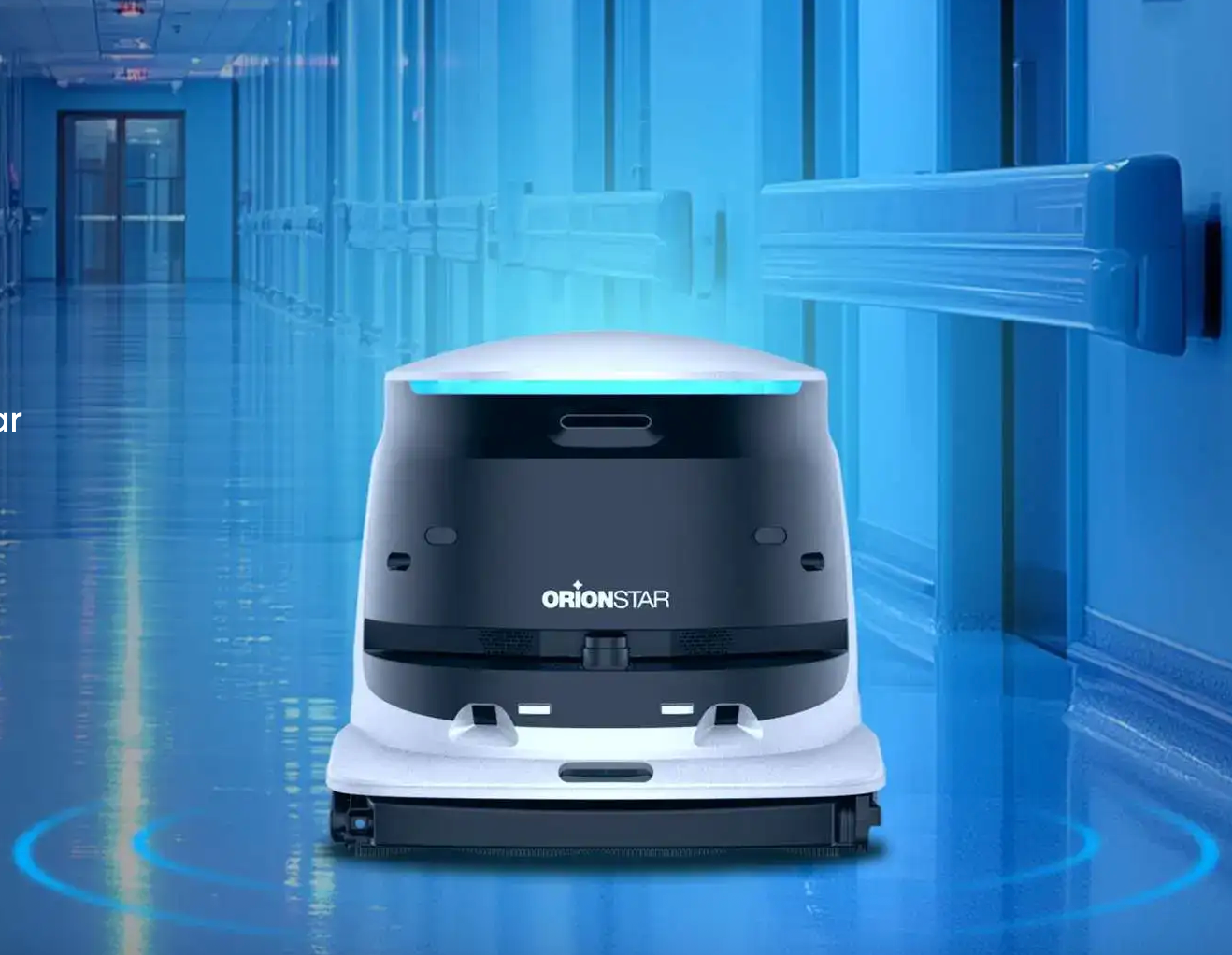
Hospital Healthcare Facility Management faces mounting pressure in maintaining hospital corridors due to severe staffing shortages, rising labor costs, and strict compliance requirements for standardized hygiene workflows. These narrow, high-traffic arteries of the hospital are notoriously difficult to maintain, requiring around-the-clock attention without disrupting patient care or medical workflows. To address these compounding operational and financial hurdles, facilities are increasingly deploying commercial cleaning robots as a reliable, auditable, and highly efficient solution to standardize floor hygiene.
The OrionStar CleaniBot S55 Pro illustrates how these autonomous capabilities are implemented for commercial floor care. According to manufacturer data, the unit utilizes a multi-sensor system of 15 sensors—including LiDAR, stereo camera, ultrasonic sensors, and line lasers—to navigate and build maps of up to 10,000 square meters while safely avoiding unexpected obstacles. To accommodate continuous use in sensitive environments, the robot can operate at a low noise level of 45 dB in dust mopping mode and features a minimum passing width of 700 mm, allowing it to move efficiently through standard medical doorways and tight clinical corridors. Operational runtimes and cleaning coverage are based on standard testing conditions and may vary depending on facility layout and obstacle density.
These areas demand ultra-low noise operations to support patient recovery and strict hygiene protocols to support a cleaner clinical environment. Commercial cleaning robots utilize low-noise vacuuming and dust mopping modes to continuously maintain floor cleanliness without exceeding 45 decibels, ensuring sleep and comfort are not disrupted.
Main arteries connecting lobbies to cafeterias and wards experience heavy, unpredictable foot traffic throughout the day. Multi-sensor obstacle avoidance allows automated scrubbers to seamlessly navigate around visitors and staff, maintaining highly visible floor hygiene in dynamic environments.
Surgical access routes require rigorous, consistent standardized workflows to support verifiable compliance in sensitive environments. Robots provide precise, edge-to-edge scrubbing combined with automated digital logging, delivering the verifiable compliance data required for critical clinical boundaries.
Emergency departments are chaotic, 24/7 environments frequently cluttered with stretchers, crash carts, and portable equipment. Compact robots with narrow passing widths can actively map and maneuver through these tight constraints, executing automated path planning to clean around temporary obstacles dynamically.
Commercial cleaning robots can leverage Wi-Fi and 4G connectivity to support remote deployment, cloud-based maintenance, and data reporting, enhancing overall facility operational efficiency. By connecting to broader facility networks, these robots can adapt to real-time building conditions, such as shifting cleaning routes when door or occupancy sensors indicate a zone is temporarily crowded. This connectivity allows every automated cleaning cycle to become a documented maintenance event, auto-populating service histories and generating predictive work orders to enhance overall facility uptime.
By integrating intelligent automation into daily routines, healthcare facilities can actively advance their environmental and sustainability metrics while maintaining rigorous standardized hygiene.
Commercial cleaning robots are optimizing the way Hospital Healthcare Facility Management approaches the daily maintenance of hospital corridors. By bridging the gap between severe labor shortages and stringent verifiable compliance standards, these autonomous systems provide a reliable, data-driven foundation for environmental services. The OrionStar CleaniBot series offers multiple models and configurations to adapt to diverse clinical layouts and operational needs, providing facility leaders with scalable options to explore automated floor care.
Disclaimer: OrionStar cleaning robots utilize vision and LiDAR sensors strictly for real-time navigation and obstacle avoidance. Environmental spatial data does not capture, store, or transmit Personally Identifiable Information (PII) or Protected Health Information (PHI), ensuring alignment with facility privacy policies.