

REQUEST DEMO
Robot CATALOG will be sent to your mailbox immediately after submission.
SUBMIT
Workplace Management in airports operates under grueling conditions, facing the daunting task of maintaining millions of square feet of terminal space around the clock amidst soaring global passenger traffic. With the facility services sector experiencing severe structural labor shortages, high turnover rates, and rising operational costs, traditional manual cleaning is struggling to keep pace with the elevated hygiene expectations and strict compliance standards demanded by passengers and regulators. To bridge this growing operational gap, commercial cleaning robots are emerging as a cost-efficient solution, empowering facility teams with an automated, verifiable, and highly efficient way to ensure consistent cleanliness.
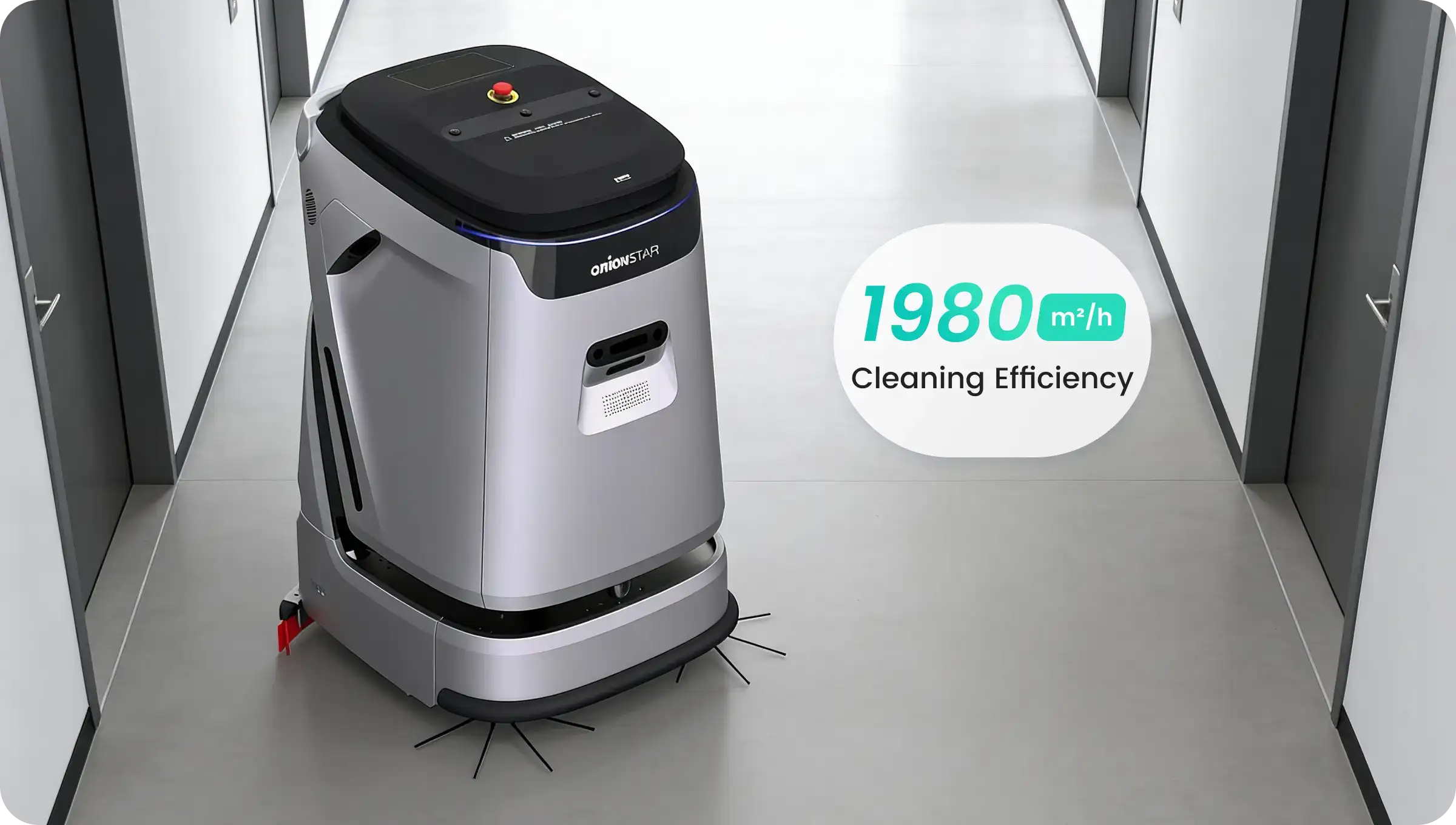
The OrionStar CleaniBot S55 Pro illustrates how these autonomous capabilities are implemented in a commercial footprint to manage large public spaces. According to manufacturer data, the robot utilizes a multi-sensor navigation system, including a LiDAR sensor that supports map construction up to 10,000 m² per zone (performance may vary near highly reflective surfaces like glass terminals), allowing it to auto-position and update its paths in real time. It executes systematic coverage through multiple modes, achieving a cleaning efficiency of up to 1,368 square meters per hour* in sweep and vacuum settings. By incorporating stereo cameras for step detection and ultrasonic sensors for obstacle avoidance, alongside Wi-Fi and 4G connectivity for remote data reporting, the unit provides a concrete example of how modern robotic platforms navigate complex indoor environments while generating verifiable maintenance records.
Main terminal walkways endure the highest volume of foot traffic and rolling luggage, leading to rapid accumulation of debris and scuff marks. Commercial cleaning robots navigate these massive, dynamic zones using autonomous path planning and obstacle avoidance to provide continuous floor scrubbing without impeding passenger movement.
Gate seating and passenger lounges feature complex layouts with dense furniture, tight corners, and resting travelers. Robots equipped with precise line lasers and low-noise operational modes can sweep and dust-mop around seating blocks safely and quietly, maintaining hygiene without causing a disturbance to waiting passengers.
Connecting concourses require fast, reliable floor maintenance over extremely long stretches of varied hard and soft flooring. Automated platforms manage these sprawling corridors by switching cleaning modes seamlessly, ensuring consistent quality across the entire transit path while maintaining high-efficiency coverage speeds.
Airport restrooms require intensive, verifiable sanitation to meet strict passenger health expectations and prevent bacterial buildup. While human crews handle high-touch surface detailing, specialized robots assist by executing rigorous, data-logged floor scrubbing and water recovery, ensuring foundational hygiene standards are continuously met.
To maximize operational value, commercial cleaning robots act as an integrated layer within the broader smart airport ecosystem rather than functioning as isolated mechanical devices. Workplace Management teams connect these fleets to Building Management Systems (BMS) to coordinate energy loads and lighting with scheduled cleaning windows, while linking them to Computerized Maintenance Management Systems (CMMS) to track work-order completion and trigger predictive maintenance based on real-time sensor wear. Furthermore, integrating robotic dispatch logic with live IoT sensor networks—such as foot-traffic counters and occupancy monitors—allows facility managers to dynamically shift cleaning capacity to the terminal zones that need it most, ensuring a highly responsive approach to facility maintenance.
Commercial cleaning robots are significantly advancing how Workplace Management maintains airports, shifting the industry from reactive, labor-intensive routines to proactive, data-driven facility care. By addressing critical workforce shortages and sustaining elevated hygiene standards, these autonomous systems provide a scalable, sustainable solution for high-traffic aviation hubs. For facility operators evaluating integration options, the OrionStar CleaniBot series offers multiple models designed to accommodate the diverse spatial and operational requirements of modern public environments.
Workplace Management in airports operates under uniquely punishing operating conditions. Airports must maintain millions of square feet of terminals, concourses, restrooms, jet bridges, gates, lounges, and employee-only zones 24 hours a day, 365 days a year. High foot traffic causes flooring surfaces and high-touch points to degrade between cleaning cycles, while visible lapses in cleanliness are immediately apparent to a security- and hygiene-conscious traveling public. According to Airports Council International (ACI), global passenger traffic reached 9.4 billion in 2024, an 8.4% increase from 2023, and that volume places relentless pressure on cleaning teams (Source: https://aci.aero/2025/07/08/worlds-busiest-airports-revealed-in-final-global-rankings/).
A persistent, structural labor shortage compounds the scale problem. The facility services sector experiences a 61% annual turnover rate among cleaning staff (Source: U.S. Bureau of Labor Statistics), and the U.S. Bureau of Labor Statistics projects U.S. janitorial workforce growth at just 2% through 2034, well below the rate needed to keep pace with rising passenger volumes (Source: https://www.bls.gov/ooh/building-and-grounds-cleaning/janitors-and-building-cleaners.htm). The aviation industry has been hit particularly hard: MDPI's Pandemic vs. Post-Pandemic Airport Operations study documents that ground-handling and cleaning roles remain unattractive to new entrants due to shift work, seven-day schedules, low wages, and physically demanding conditions, with many former airport workers having taken jobs at retailers like Amazon during the pandemic. Heathrow's CEO publicly warned that ground handling shortages had become the binding constraint on airport capacity, and Schiphol responded with a EUR 5.25/hour summer bonus (a roughly 50% lift) to retain security, baggage, and cleaning staff (Source: https://www.mdpi.com/2226-4310/9/12/810). A JLL Technologies analysis cited by Facilities Dive notes that the skills gap is expected to affect around 42% of companies within the next two years, with an aging workforce, early retirements, and a scarcity of young talent framing the labor challenge as long-term rather than cyclical (Source: https://www.facilitiesdive.com/news/6-facilities-management-trends-to-watch-2024/704162/).
Cleanliness expectations have also sustained an upward trajectory since COVID-19. A 2021 RetailWire/Brain Corp survey of U.S. retailers found that 72% of consumers expect elevated cleanliness to persist even after widespread vaccination, a signal that directly applies to air travel, where passengers rate cleanliness as a top driver of overall satisfaction (Source: https://crp.trb.org/acrptransformativetech/applied-technology-in-airports/use-case-spotlight-robotic-cleaning/). J.D. Power's 2025 North America Airport Satisfaction Study quantifies the commercial cost: passengers who rate their airport experience as "perfect" spend $42.39 in terminals, $16.54 more than passengers rating the experience as "just OK" (Source: https://www.jdpower.com/business/press-releases/2025-north-america-airport-satisfaction-study). Traditional manual cleaning is also nearly impossible to measure, audit, or report to regulators, airlines, and concessionaires, leaving workplace managers without the verifiable proof of compliance that modern airport governance increasingly demands.
Airport cleaning robotics has matured from pilot program to mainstream infrastructure across Europe, the United States, and Asia. The following are documented, named deployments with measurable outcomes.
Zurich Airport (Switzerland) operates one of the largest single-site robotic cleaning programs in Europe, a 26-robot TASKI fleet (20 Ecobot 50 units plus 6 Phantas units) that cleans up to 120 square kilometers per day. The robots operate from a fully autonomous workstation that handles recharging, fresh water filling, and waste emptying, and they communicate directly with terminal infrastructure including automated doors. Zurich's deployment achieved an estimated payback period of under two years and recycles water up to three times per cycle (Sources: https://sedonatec.com/feeds/blog/cleaning-robot-airport; https://taski.com/taski-partners-with-zurich-airport-ltd-to-introduce-robots-for-enhanced-cleaning/).
Flagship Facility Services partnered with SoftBank Robotics America to deploy nearly 100 cobots (Scrubber 50, Vacuum 40, Phantas, and Whiz models) across approximately 10 U.S. airports at around 15 locations. The fleet logged close to 10,000 autonomous operating hours and cleaned over 35 million square feet, with the explicit goal of redeploying janitorial staff to higher-value tasks rather than reducing headcount (Source: https://us.softbankrobotics.com/press/softbank-largest-site-deployment-robots-us).
Pittsburgh International Airport was the first U.S. airport to deploy UV-C robotic cleaning, partnering with Carnegie Robotics. Hong Kong International Airport deployed an Intelligent Sanitization Robot that uses UV-C light to eliminate up to 99.99% of bacteria in public toilets. San Antonio International became the first airport worldwide to purchase and deploy the Xenex LightStrike UV-C robot. London Heathrow Airport piloted UVD Robots that autonomously patrolled terminal buildings at night. Milan Malpensa International Airport partnered with RobotLAB/Connor UVC to deploy UV-C robots equipped with sanitizing spray. United Airlines uses the NovaRover spray robot to apply Zoono Microbe Shield inside aircraft cabins during overnight deep cleanings (Sources: https://crp.trb.org/acrptransformativetech/applied-technology-in-airports/use-case-spotlight-robotic-cleaning/; https://www.bloomberg.com/news/articles/2020-07-15/robots-deployed-to-kill-viruses-at-heathrow-airport-at-night).
GMR Hyderabad Airport (India) deployed Peppermint Robotics SD45 floor scrubbers, achieving a reported 75% manpower reduction and up to 20% water savings based on specific real-world deployments, with redeployed staff moved to specialized cleaning tasks. Frankfurt Airport deployed Tennant autonomous mobile robots (AMRs) that cleaned over 1.6 million square meters in a six-month window without disrupting passenger flows. Singapore Changi Airport manages Avidbots Neo robots through a Robotic Middleware Framework that orchestrates multiple robot fleets as a single integrated system (Source: https://sedonatec.com/feeds/blog/cleaning-robot-airport).
Most commercial cleaning robot deployments target a payback on the order of 12 to 24 months, with cost-of-ownership driven by labor savings, reduced chemical and water usage, and lower asset wear (Source: https://www.robotlab.com/industries/airports/). A 2026 industry analysis reports international airports deployed $1.98 billion in robotic systems during 2026, spanning autonomous cleaning fleets, UV-C sanitization units, baggage transport robots, and passenger assistance androids; one major U.S. hub airport deployed 23 autonomous robots across three terminals in early 2025, increasing fleet uptime from 68% to 94% (Source: https://oxmaint.com/industries/aviation-management/smart-airport-robotics-roi-case-study-2026).
Workplace Management functions inside airports are increasingly tied to environmental, social, and governance (ESG) reporting and to data protection regulations. From an environmental perspective, the autonomous cleaning deployments above deliver measurable water and chemical reductions: Zurich Airport's TASKI program recycles water up to three times, and Peppermint Robotics' airport deployments have documented up to 20% water savings based on specific real-world deployments alongside labor reductions. Consistent, calibrated robotic cleaning also extends the service life of expensive airport flooring assets such as carpets and polished concrete, reducing material waste and embodied carbon from premature replacement. Automated dosing of cleaning solutions further reduces chemical consumption and effluent loading compared with manual operations.
From a social/governance perspective, the COVID-19 response sustained elevated cleanliness standards. Airports Council International, Airport Cooperative Research Program (ACRP), and IATA guidance now encourage visible, documented cleaning programs to reassure travelers, and ACRP's research concludes that robots in airports have been welcomed by both passengers and unionized staff when framed around role expansion, safety improvements, and verifiable compliance rather than headcount reduction (Source: https://crp.trb.org/acrptransformativetech/applied-technology-in-airports/use-case-spotlight-robotic-cleaning/). Automated cleaning logs, route maps, and performance metrics give workplace managers auditable proof of compliance with hygiene standards, an increasingly common requirement in airport concession agreements and airline service-level commitments.
On data protection, robots operating inside EU airports process data that can fall under the EU General Data Protection Regulation (GDPR). Cleaning robots equipped with cameras, LiDAR, and 3D depth sensors can in principle collect personal data when operating in public areas, so workplace managers must evaluate each deployment for data minimization, purpose limitation, lawful basis, retention, and processor-controller arrangements. A systematic literature review on privacy in smart buildings notes that IoT-enabled building devices, including cleaning robots, are increasingly subject to privacy threats and regulatory scrutiny, with 29 billion connected IoT devices projected globally (Source: https://www.diva-portal.org/smash/get/diva2:2003023/FULLTEXT01.pdf). Compliance strategies referenced across the smart-building literature include on-device anonymization, edge processing of sensor data, role-based access to cleaning logs, vendor data-processing agreements aligned with GDPR Article 28, and security controls mapped to ISO/IEC 27001 and the EU Cybersecurity Act. In the United States, comparable state-level privacy laws (such as the California Consumer Privacy Act) and sectoral requirements (HIPAA for airport clinics, PCI DSS for retail concessions) apply depending on the deployment zone. ESG frameworks widely referenced by airport operators include GRI, SASB (now part of the ISSB IFRS S1/S2 standards), and ACI's own Airport Carbon Accreditation program, all of which reward documented, auditable operational improvements that cleaning robotics can supply through data-driven reporting.
Modern airport cleaning robots are designed to plug into broader building management, maintenance, and IoT ecosystems rather than operate as isolated devices. The Zurich Airport TASKI deployment, for example, integrates robots into a fully digitalized cleaning management platform that communicates directly with terminal infrastructure such as automated doors, providing end-to-end operational transparency (Source: https://taski.com/taski-partners-with-zurich-airport-ltd-to-introduce-robots-for-enhanced-cleaning/). Singapore Changi's deployment of Avidbots Neo robots is orchestrated by a Robotic Middleware Framework that allows different vendors' fleets to be managed as a single system, a pattern increasingly described in the industry as a "robot fleet management" layer that sits between robots and the airport's enterprise systems (Source: https://sedonatec.com/feeds/blog/cleaning-robot-airport).
In practical terms, workplace managers connect cleaning robots to four classes of airport systems. First, Building Management Systems (BMS) and Energy Management Systems receive cleaning schedules, water/chemical consumption, and runtime data, allowing energy loads, HVAC setback, and lighting in unoccupied zones to be coordinated with cleaning windows. Second, Computerized Maintenance Management Systems (CMMS) such as those covered in aviation maintenance analytics receive work-order completion data, brush-wear and consumable alerts, and predictive-maintenance triggers, with one industry case study noting that floor scrubber brushes are now replaced when wear sensors hit 65% rather than waiting for failure, cutting downtime and extending asset life (Source: https://oxmaint.com/industries/aviation-management/smart-airport-robotics-roi-case-study-2026). Third, IoT sensor networks, including occupancy sensors, foot-traffic counters, and air-quality monitors, feed real-time passenger density data into robot dispatch logic so that cleaning capacity is shifted to terminals that actually need it, a capability the Facilities Dive 2024 trends analysis identifies as one of the highest-leverage AI applications in facility management (Source: https://www.facilitiesdive.com/news/6-facilities-management-trends-to-watch-2024/704162/). Fourth, identity and access systems, including employee badge readers and time-and-attendance platforms, allow workplace managers to assign robot supervision and incident response to specific staff, and to integrate robotic cleaning output with the airport's broader safety, security, and audit trails.
The ACRP report on robotic cleaning adds that successful airport deployments have introduced new infrastructure requirements, including dedicated charging stations, storage space, and data access points, all of which need to be provisioned during terminal design or refurbishment to avoid retrofitting costs (Source: https://crp.trb.org/acrptransformativetech/applied-technology-in-airports/use-case-spotlight-robotic-cleaning/). For airport operators, the practical takeaway is that cleaning robots deliver the largest return when treated as an integrated layer of the smart airport stack rather than a standalone capital purchase, and when the BMS, CMMS, and IoT integrations are scoped at the procurement stage rather than after deployment.
*Theoretical maximum cleaning efficiency. Actual coverage depends on environmental complexity and obstacle density.
Data Privacy Notice: OrionStar CleaniBot S55 Pro utilizes localized sensor data (LiDAR and stereo cameras) strictly for real-time navigation and obstacle avoidance. Visual data is processed locally on the edge and is not stored or transmitted to the cloud. Cloud connectivity is exclusively used for anonymized operational metrics, OTA updates, and facility reporting, fully compliant with GDPR and local data protection regulations.