

REQUEST DEMO
Robot CATALOG will be sent to your mailbox immediately after submission.
SUBMIT
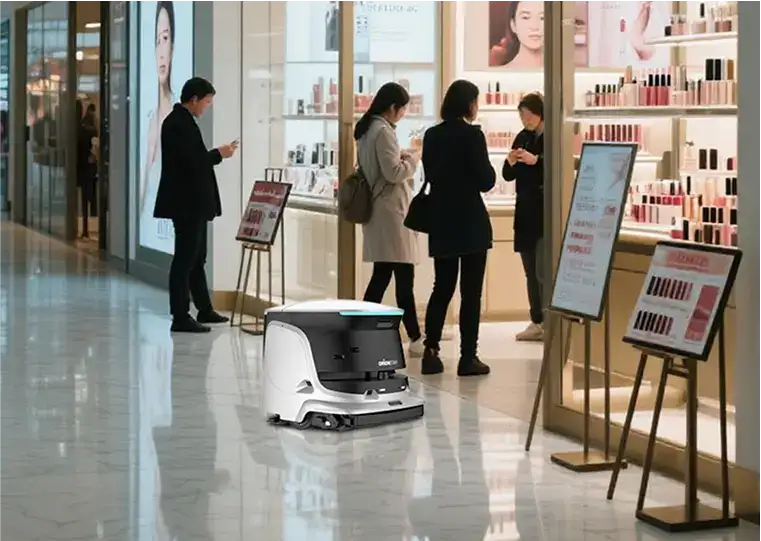
Hypermarkets face some of the most demanding floor-care conditions in modern retail when maintaining freezer aisles and the refrigerated zones around them. Constant condensation, low temperatures, high shopper traffic, persistent labour shortages, and strict food-safety and slip-prevention regulations all raise the operational pressure on store operations and facility managers. To keep these challenging zones clean without overburdening human staff or disrupting the shopper experience, commercial cleaning robots are increasingly being adopted as a reliable, automated layer of floor maintenance that complements existing teams.
To illustrate how the category-wide capabilities described above translate into a concrete system, the OrionStar CleaniBot S55 Pro serves as a representative example of modern retail floor-care automation. According to manufacturer data, this model offers a scrubbing runtime of up to 4.5 hours and an ECO vacuum runtime of up to 19.5 hours, while its auto-recharge capability allows it to cover expansive hypermarket layouts with limited human intervention. With a maximum cleaning efficiency of up to 1,368 m²/h in sweep-and-vacuum or dust-mop modes and up to 1,197 m²/h in scrubbing modes, the unit demonstrates how advanced LiDAR navigation and dynamic obstacle avoidance translate into measurable, high-volume throughput. Its compact body and approximately 700 mm minimum passing width also help it move through typical aisle widths near refrigeration units.
Freezer aisles operate at very low temperatures that can affect battery performance and water-based cleaning systems. While commercial cleaning robots are typically deployed in adjacent refrigerated or ambient aisles, targeted dry-and-scrub routines can be programmed for transition zones and nearby chilled sections to help keep floors clean and reduce moisture-related risks around the thresholds between cold and ambient zones.
Dairy, meat, and chilled-produce sections experience constant condensation from display cases, creating persistent slip risks. Commercial cleaning robots can run scheduled dry-and-scrub passes to remove moisture and debris, supporting safer shopper movement and more consistent hygiene standards in these aisles.
Heavy foot and cart traffic in the central dry-grocery corridors leads to rapid accumulation of dust and incidental dry spills. Automated scrubbers use long-range navigation to sweep and wash these long, uninterrupted stretches efficiently, maintaining a tidy appearance for daily shoppers.
Checkout zones are tightly packed with displays, queues, and stationary customers, which requires careful and precise navigation. Cleaning robots use agile path planning to manoeuvre through these narrow bottlenecks, typically during off-peak hours, so they do not disrupt the final purchasing experience.
Modern commercial cleaning robots are designed to operate as part of a hypermarket's broader digital and operational ecosystem rather than as isolated machines. Through standard IoT connectivity, they can communicate with Building Management Systems (BMS) to trigger cleaning runs when traffic drops, and with Computerized Maintenance Management Systems (CMMS) to raise alerts when routine maintenance, water refills, or consumable replacements are required. Data collected during operation, such as environmental maps and performance metrics, is used solely for navigation and fleet management and should be handled in accordance with local data-privacy regulations and user consent.
Ultimately, integrating robotic cleaning solutions helps hypermarkets advance their environmental, social, and governance (ESG) commitments by reducing resource waste and supporting a safer, more consistent workplace.
Commercial cleaning robots are steadily changing how the hypermarket industry approaches the daily maintenance of demanding environments such as freezer aisles and refrigerated aisles, shifting operational focus from manual labour to efficient, data-backed automation. As facility requirements continue to evolve, the OrionStar CleaniBot series offers multiple models designed to adapt to different spatial requirements and retail configurations, providing scalable options for organisations seeking to modernise their floor-care strategies.