

REQUEST DEMO
Robot CATALOG will be sent to your mailbox immediately after submission.
SUBMIT
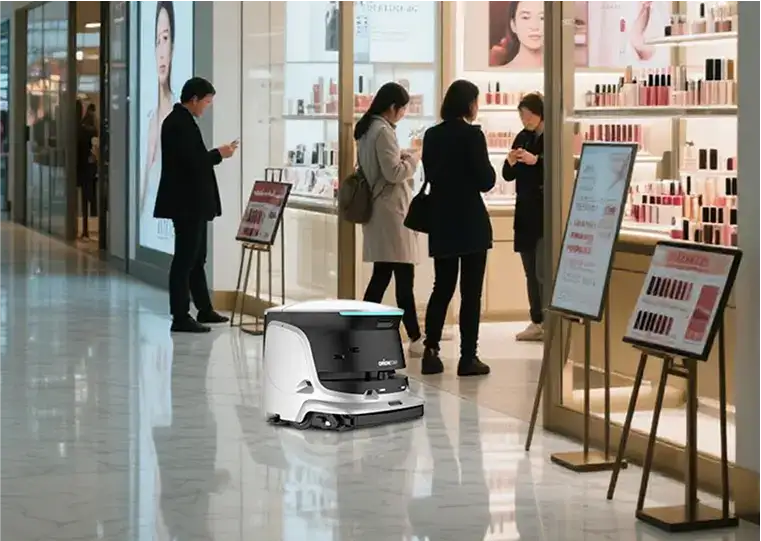
Operating large retails requires balancing sprawling floor spaces, continuous high-volume customer traffic, and stringent hygiene standards. As facility managers navigate these mounting operational complexities, the integration of commercial cleaning robots has shifted from a technological novelty to a strategic necessity. By automating repetitive and labor-intensive maintenance tasks, these advanced systems empower large retails to sustain pristine environments without disrupting the daily shopping experience, fundamentally modernizing how physical stores are managed.
Facility managers in large retails currently face an array of compounding operational challenges:
To address the diverse operational demands of large retails, the OrionStar CleaniBot lineup provides highly specialized solutions with performance metrics verified according to manufacturer data. The CleaniBot C5 is engineered for expansive floor plans, delivering a cleaning efficiency of up to 1,980 m²/h with an approximately 880mm pass width. It operates at <68dB, supports up to a 3-hour scrubbing and 8-hour mopping battery life, and can generate maps for areas up to 10,000 m². Conversely, the CleaniBot S55 Pro is optimized for agility in complex layouts. It features a narrower 700mm pass width and operates at ultra-quiet noise levels (55dB for scrubbing and 45dB for mopping). Equipped with 15 sensors for 360° perception, the S55 Pro achieves up to 1,368 m²/h in sweep/vacuum modes or 1,197 m²/h while scrubbing. Its 25.6V/40Ah battery ensures minimal downtime with a <4h charging cycle. Furthermore, all OrionStar CleaniBot models process environmental and operational data locally, strictly adhering to GDPR requirements to ensure maximum privacy and security within large retails.
According to published deployment data and manufacturer analytics, the implementation of autonomous cleaning fleets in large retails yields significant, measurable impacts:
The integration of autonomous systems into large retails is fundamentally designed to elevate the human workforce rather than replace it. According to published deployment data from Daiei's integration of robotic floor cleaners, store operators explicitly note that "robots are not replacements but supplements" to their frontline staff. By delegating the most physically demanding and repetitive floor cleaning tasks to autonomous units, retail employees can redirect their energy toward higher-value activities, such as direct customer service, inventory management, and strategic merchandising. This collaborative approach significantly reduces workplace fatigue and fosters a safer, more engaging environment for human workers.
As large retails continue to adapt to shifting economic and operational landscapes, the reliance on intelligent facility management solutions will only grow. Future maintenance models will increasingly depend on autonomous fleets seamlessly integrating with smart building infrastructures. Innovations within the OrionStar CleaniBot series illustrate this ongoing trajectory, demonstrating how adaptive robotics can effectively bridge current labor gaps while meeting future efficiency standards. Ultimately, the continued refinement of commercial cleaning robots will serve as a foundational element in building resilient, sustainable, and highly optimized environments for large retails.