

REQUEST DEMO
Robot CATALOG will be sent to your mailbox immediately after submission.
SUBMIT
Integrated Facility Management in commercial buildings has reached a clear operational inflection point. Building operators face an environment where tenant expectations are rising while available labor pools are shrinking. Therefore, maintaining vast indoor areas using purely manual methods is becoming structurally unviable. Why is this shift happening now? Hybrid work mandates demand higher visible cleanliness standards, yet hiring costs and rural talent scarcity make expanding human cleaning crews difficult. As a result, facility managers are reassessing their baseline operations. They are shifting away from traditional procurement and looking toward technology-driven solutions. Commercial cleaning robots have emerged as an industry-level answer to these compounded challenges. Instead of treating automation as a novelty, operators now view robotic fleets as essential infrastructure. These autonomous units provide consistent daily coverage across expansive floors. Above all, they allow facility teams to stabilize operational budgets and maintain reliable service quality globally.
These overlapping pressures point to a clear strategic conclusion—the traditional, labor-intensive model of facility management is no longer sustainable.
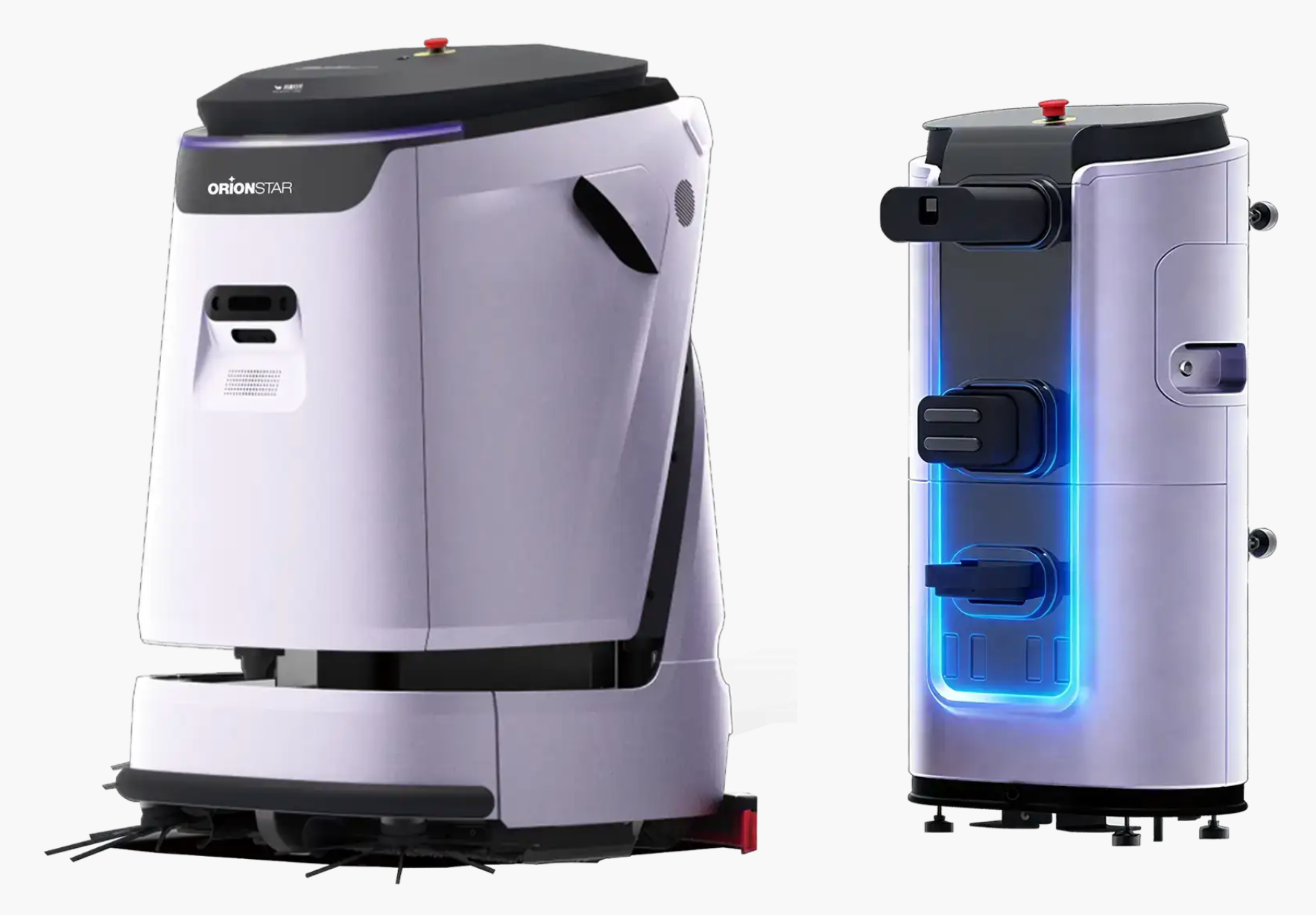
The OrionStar CleaniBot series addresses these structural pressures through a differentiated, dual-model approach. Facility managers require versatile tools for complex environments, and this lineup provides specific solutions for distinct zones.
The CleaniBot C5 is engineered for heavy-duty environments like parking areas, transit corridors, and large industrial lobbies. It features a dual-rolling-brush system that delivers up to 25 kg of downward scrubbing pressure. According to manufacturer data, it can clean areas up to 1,980 square meters per hour, depending on floor layout and obstacle density. Moreover, its fully autonomous docking station handles clean-water refilling and waste-water discharge automatically. This reduces manual intervention in high-traffic commercial buildings.
Conversely, the CleaniBot S55 Pro is designed for mixed-use commercial spaces such as premium lobbies, carpeted corridors, and quiet common spaces. It offers multiple cleaning modes, including a Dust Mop setting that operates at a low 45 dB, and an ECO Vacuum mode that provides an extended runtime of up to 19.5 hours (under standard test conditions). This makes the S55 Pro highly suitable for daytime deployment around building occupants without causing disruption.
Together, these models create a complementary logic. The C5 manages aggressive, large-scale scrubbing, while the S55 Pro maintains intricate, multi-surface public zones. In short, operators gain a complete floor-care strategy.
Furthermore, this hardware is backed by robust digital management capabilities. Fleet operators can monitor performance and adjust schedules remotely. Because facility systems handle sensitive occupant data, the OrionStar CleaniBot series aligns with GDPR requirements. Technical approaches such as on-device processing, anonymized mapping, and secure telemetry ensure that edge-based cameras and sensors collect only the data necessary for navigation, protecting occupant privacy across global deployments. Data processing is conducted strictly under OrionStar's Privacy Policy. Navigational and telemetry data are processed locally or anonymized securely via cloud for essential operational purposes only. Explicit consent configurations are established prior to deployment in compliance with regional data protection laws.
Achieving these measurable outcomes requires a fundamental shift in how facility management teams utilize their workforce.
The integration of automated systems does not mean replacing human workers. Instead, it represents an evolution of the workforce. Automation fundamentally elevates human potential within commercial buildings. By assigning commercial cleaning robots to handle repetitive, large-scale floor maintenance, facility teams free up their human staff. Workers can then redirect their energy toward high-value, high-judgment tasks like deep cleaning, touchpoint surface cleaning, and complex maintenance.
As a result, traditional cleaning roles are transforming into technology-oriented positions. Janitorial staff are evolving into fleet managers and quality auditors. They now train machines, monitor performance dashboards, and coordinate multi-robot operations across expansive facilities. This skill partnership reduces the physical toll on workers while raising their productivity. Moreover, teaching staff to manage automated fleets fosters career growth and helps retain talent in a competitive labor market. In short, machines provide the endurance, while humans provide the contextual intelligence required to manage modern facilities.
The future of Integrated Facility Management relies on the seamless integration of digital and physical infrastructure. As commercial buildings grow more complex, operators must adopt tools that offer both scalability and precision. The OrionStar CleaniBot series provides multiple models to address the diverse spatial requirements of modern real estate. By matching specific robotic capabilities to distinct architectural zones, facility managers can build resilient operational frameworks. Ultimately, organizations that embrace intelligent automation will be best positioned to control costs, meet stringent sustainability targets, and deliver exceptional environments for building occupants. Therefore, the transition to automated floor care is not merely an operational upgrade; it is a strategic necessity for the decades ahead.
Availability of OrionStar products and specifications may vary by region. Contact your local OrionStar representative for details.