

REQUEST DEMO
Robot CATALOG will be sent to your mailbox immediately after submission.
SUBMIT
For facility managers and building service contractors (BSCs) overseeing commercial buildings, balancing operational budgets with the expectation of consistently high facility standards is a persistent challenge. Integrated Facility Management (IFM) benchmark data indicates that janitorial and cleaning services account for USD 0.50 to 1.50 per square foot annually, standing out as one of the most visible operating expenses. With labor driving up to 40 percent of total facility costs—and up to 70 percent for cleaning contractors—the industry is actively shifting from traditional manual upkeep toward automated solutions.
Commercial cleaning robots are increasingly deployed alongside human cleaning teams to stabilize costs, standardize cleaning paths, and free up staff for detail-oriented tasks. This guide evaluates the OrionStar CleaniBot S55 Pro, assessing how its specifications align with the functional requirements of commercial building environments, including lobbies, corridors, parking areas, and shared common spaces.
Commercial buildings feature mixed-use zones that demand different cleaning frequencies and methods. Facility operators currently face a shortage of qualified cleaning staff, which forces a reliance on reactive rather than planned maintenance. Industry data suggests that pushing planned maintenance above 65 percent of total work orders can reduce the average cost per square foot by 22 percent.
By automating routine, large-area floor care, facility managers can achieve a more predictable maintenance schedule. Industry reporting indicates that deploying autonomous floor-cleaning equipment can reduce manual labor hours for floor upkeep by more than half, according to Pudu Robotics' deployment data, depending on the scale of deployment. Furthermore, robotic scrubbers have been shown to reduce water consumption and chemical usage by up to approximately 90 percent compared with traditional manual methods, as reported by Pudu Robotics, directly supporting a building's ESG (Environmental, Social, and Governance) targets.
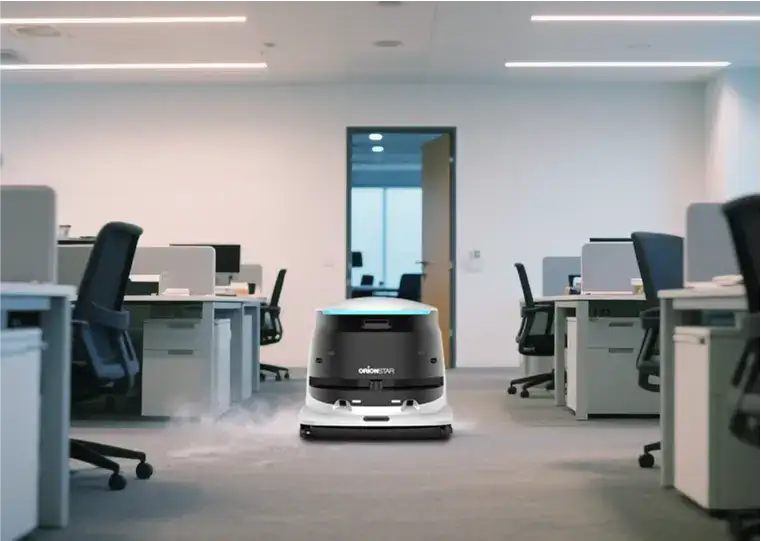
The OrionStar CleaniBot S55 Pro is an autonomous commercial floor-cleaning robot designed to integrate sweeping, scrubbing, vacuuming, mopping, self-cleaning, and applying cleaning solutions uniformly into a single platform. For building service contractors, the value of the unit lies in its ability to adapt to distinct zones within a commercial building.
Building lobbies and open common spaces are high-visibility areas that require frequent maintenance, often while building occupants are present. The CleaniBot S55 Pro operates at a noise level of 55 dB at a 1-meter distance during scrubbing and drops to 45 dB at a 1-meter distance in Dust Mopping mode. According to manufacturer data, the robot can run for up to 28 hours in Dust Mop mode and up to 19.5 hours in ECO Vacuum mode on a single charge. (Battery life is calculated based on continuous operation on smooth, hard floors in defined laboratory settings. Actual runtime may vary depending on floor friction, incline, and frequency of obstacle avoidance maneuvers.) This allows facility teams to conduct continuous, quiet dust control during peak daytime hours without disrupting tenant activities or conversations.
Corridors require equipment that can navigate confined linear spaces, avoid moving pedestrians, and clean close to baseboards. The CleaniBot S55 Pro features a compact footprint (650 × 580 × 550 mm) and requires a minimum passing width of 700 mm. For edge cleaning, it utilizes line lasers that allow the robot to clean at a default distance of 10 cm from walls and corners, adjustable down to 5 cm. The unit relies on a multi-sensor system—incorporating ultrasonic sensors and stereo cameras—to provide comprehensive omnidirectional obstacle avoidance and cliff/step detection, lowering the risk of collisions in active hallways. Note that highly reflective surfaces, such as glass walls or large mirrors, and completely unlit environments may affect navigation efficiency.
For expansive indoor hard floors or adjacent enclosed structural areas, productivity metrics are critical. Under defined test conditions, the CleaniBot S55 Pro is designed to deliver a theoretical maximum cleaning efficiency of up to 1,197 square meters per hour in unobstructed conditions in its Scrubbing and Power Scrubbing modes, and is capable of reaching up to 1,368 square meters per hour in its Sweep & Vacuum or Dust Mop modes. Its onboard 22-liter clean water tank and 15-liter wastewater tank support extended autonomous operation before requiring fluid replacement.
For facilities with varying square footage and complex structural layouts, IFM decision-makers can also look to the broader OrionStar CleaniBot series, which offers a range of models tailored to different capacity requirements and floor-care scenarios.
Modern IFM contracts increasingly require proof of service and data-backed Service Level Agreement (SLA) reporting. The CleaniBot S55 Pro features Wi-Fi and 4G connectivity to facilitate remote deployment, cloud-based monitoring, Over-The-Air (OTA) updates, and operational data reporting. This allows managers to track exact cleaning times, square footage covered, and route completion.
However, digitalization introduces governance obligations. The CleaniBot S55 Pro utilizes a LiDAR sensor capable of generating a single map of up to 10,000 square meters, along with stereo cameras for spatial navigation. Because these sensors capture detailed facility layouts and environmental data, deploying such robots requires strict data governance. Facility managers must ensure that the collection, transmission, and storage of this telemetry data comply with the GDPR and any other applicable local data protection regulations, establishing clear policies on data retention and access controls.
Facility managers should verify with the vendor how vision data is processed, whether telemetry is encrypted in transit and at rest, and what data retention and access controls apply. These governance steps are essential before deploying any connected cleaning robot in a commercial building.
To prevent automated cleaning from becoming a maintenance burden itself, commercial robots must be easy for frontline staff to manage. The CleaniBot S55 Pro addresses daily maintenance through a modular design. Operators can switch cleaning modes via a touch screen without requiring physical tool changes.
When physical maintenance is required, the 15-liter wastewater tank is fully removable and designed to be washable and immersible to minimize odor generation and simplify cleaning. Additionally, the unit features low-curvature piping that allows standard brushes to easily clear blockages, ensuring that daily turnaround times for the machine remain minimal.
Can the robot operate entirely without human intervention? While the CleaniBot S55 Pro is autonomous during its cleaning routes and supports automatic recharging, it operates as a "co-bot." Facility staff are still required to empty the 1-liter dust bin, manage the water tanks, perform routine sensor wiping, and conduct periodic maintenance on the 550 mm main brush.
How long does the robot take to charge? According to the product specifications, the 25.6 V / 40 Ah battery requires less than 4 hours to reach a full charge via its included charging dock.
Does the robot require different attachments for different floors? The S55 Pro is designed to transition between hard floors and low-pile carpets. Zone-based mode switching can be programmed into the digital map, allowing the robot to automatically shift from scrubbing a hard-floor corridor to a sweep-and-vacuum mode when entering a carpeted common area, without requiring the operator to manually swap tools.
What happens if the robot encounters an unexpected obstacle or a drop-off? The robot utilizes a combination of LiDAR, stereo cameras (specifically for cliff and step detection), and ultrasonic sensors to identify temporary obstacles—such as a misplaced delivery box or a person walking—and dynamically reroutes its zigzag cleaning path. An emergency stop button is also equipped for immediate manual halting if required.