

REQUEST DEMO
Robot CATALOG will be sent to your mailbox immediately after submission.
SUBMIT
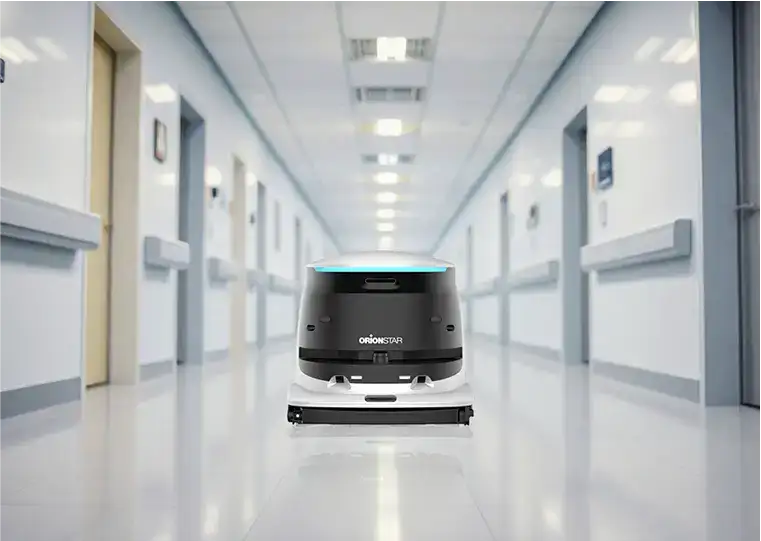
OrionStar CleaniBot S55 Pro serves as an ideal fit for medical clinics, combining a compact 650 mm body and a 700 mm passing width to easily navigate tight corridors and examination areas.
Offering up to six cleaning modes and operating at nominal acoustic levels between 45 and 55 dB (depending on the mode and flooring type), the OrionStar robot adapts to both carpeted waiting rooms and hard-floor clinical zones without disturbing patients.
Medical facility management requires prioritizing multi-functional systems that support stringent environmental cleaning protocols while managing liquid spills and biological contaminants.
When evaluating robotic solutions, clinics must consider maneuverability around medical equipment, acoustic levels, and autonomous infrastructure integrations to reallocate staff to high-value patient care.
Compliance with healthcare data protection and GDPR regulations is a critical evaluation step for any cloud-connected device operating near patients or collecting environmental data. OrionStar systems are designed to support data minimization, but clinic operators remain the Data Controllers responsible for ensuring local network security and DPA compliance under GDPR.
When evaluating the best commercial cleaning robots for medical clinic facility management, facility managers require compact systems that can navigate narrow corridors and waiting rooms, operate quietly around patients, avoid obstacles near medical equipment, and meet GDPR and data-protection requirements for connected devices. Clinic layouts typically feature high-density waiting areas, narrow hallways, and tightly packed examination rooms where spatial clearance is at a premium. Medical professionals and administrative staff are dedicated to patient care and practice management, leaving minimal bandwidth for managing robotic equipment. Furthermore, operating automated equipment in a live clinical environment requires strict management of acoustic levels to maintain patient comfort, alongside immediate floor recovery to prevent slip-and-fall incidents among elderly or mobility-impaired individuals.
Selecting the right automated floor care system requires a thorough evaluation of several operational dimensions. Surface sanitation and environmental hygiene are paramount, as clinics need stringent floor sanitation to prevent cross-contamination. Facility managers must choose between multi-functional wet and dry systems that integrate sweeping, scrubbing, and mopping in a single pass, or specialized dry extraction systems focused entirely on mechanical sweeping and HEPA-filtered vacuuming.
Spatial navigation and the physical footprint of the machine dictate how effectively it can move through the facility. Compact agility configurations prioritize smaller footprints and tighter turning radii, enabling the unit to navigate under waiting room seating and around medical carts. Conversely, high-capacity coverage configurations feature wider cleaning paths and larger tanks, which are optimized for expansive primary care lobbies rather than confined consultation rooms.
Operational autonomy and the associated maintenance workflow determine the daily labor burden shifted onto clinic personnel. Automated infrastructure hubs utilize fixed base stations connected directly to plumbing to automatically recharge and refill tanks, ensuring the system is consistently prepared. Alternatively, manual servicing frameworks require facility staff to handle waste bins and tank refills but offer flexible deployment across leased clinic spaces without permanent plumbing modifications.
Environmental disruption and slip prevention must also be carefully managed. Low-decibel operation paired with instant floor recovery facilitates continuous daytime cleaning during peak clinic hours without creating pedestrian slip hazards or disrupting medical consultations. High-intensity extraction systems tackle heavy soil loads but generate higher acoustic output, making them more appropriate for designated after-hours sanitation shifts.
The OrionStar CleaniBot S55 Pro addresses narrow clearance and mixed-flooring challenges for medical clinics seeking to automate their floor care. Designed as an autonomous commercial floor-cleaning robot, it integrates an InstantClean Floor Care System that supports sweeping, scrubbing, vacuuming, mopping, self-cleaning, and disinfection-related workflow steps. This multi-functional approach allows the robot to handle different zones and floor conditions, making it highly practical for routine facility maintenance across varied clinical environments.
Navigational capability is a critical requirement for healthcare spaces, and the CleaniBot S55 Pro addresses this through its multi-sensor system and compact physical design. According to manufacturer data, the robot features a 650 mm body length and requires a minimum passing width of 700 mm, allowing it to move efficiently through narrow clinic corridors, waiting room aisles, and examination room entrances. Its navigation array incorporates 15 sensing components, including a LiDAR sensor, stereo camera, ultrasonic sensors, and line lasers. This setup supports autonomous route execution, real-time map updates, and obstacle avoidance, enabling the robot to operate safely around medical carts, wheelchairs, and pedestrian traffic.
To accommodate the acoustic sensitivities of a healthcare environment, the robot operates quietly. Manufacturer specifications indicate nominal acoustic levels as low as 45 dB in dust mopping mode and up to 55 dB during scrubbing. This enables daytime deployment in waiting areas and consultation corridors without disrupting patient care. Additionally, the robot delivers substantial operational efficiency, with a cleaning capacity of up to 1,197 m²/h in scrubbing modes and up to 1,368 m²/h in vacuuming and dust mopping modes in open layouts under defined test conditions (actual coverage in furnished clinics will vary depending on foot traffic and obstacles). Its 22 L clean water tank and 15 L washable wastewater tank simplify maintenance, reducing the need for constant staff intervention.
Compact Agility for Healthcare Layouts: The up to 700 mm minimum passing width allows the robot to maneuver effectively through constrained spaces like clinic hallways and tightly configured examination areas.
Quiet Operation for Patient Comfort: Operating between 45 and 55 dB depending on the selected mode, it facilitates daytime cleaning routines without elevating stress levels for waiting patients or distracting medical staff.
Multi-Surface Adaptability: Featuring six cleaning modes—including scrubbing, sweep and vacuum, and dust mopping—it transitions seamlessly from hard-floor clinical zones to carpeted reception areas.
Advanced Obstacle Avoidance: Utilizing 15 sensors, including LiDAR and ultrasonic technology, it dynamically navigates around temporary obstacles such as IV stands, loose cables, and moving personnel.
Streamlined Staff Workflow: Modular cleaning tools and a removable, washable wastewater strainer design minimize the hands-on maintenance time required from clinic administration and facility teams.
SoftBank Robotics Whiz is an autonomous commercial vacuum cobot tailored for dry floor care. It utilizes a teach-and-repeat route learning system and features HEPA filtration for its vacuuming process, making it a relevant choice for carpeted waiting areas and corridors. According to manufacturer data, the Whiz operates at approximately 62 to 67 dB depending on the region and mode, yielding a cleaning productivity of up to 500 m²/hour. Because it focuses exclusively on dry vacuuming, it is best suited to complement a wet scrubbing program rather than act as a standalone solution for hard-floor clinical sanitation.
ICE Cobotics Cobi 18 is a compact autonomous floor scrubber designed primarily for hard-floor environments. With a body width of approximately 480 mm, it relies on an AI navigation system based on cameras and sensors to navigate tight clinic aisles and waiting rooms. The unit provides up to two hours of runtime under defined test conditions and offers cloud-based fleet monitoring through its i-SYNERGY platform. It serves as a practical option for clinics focused strictly on hard-floor scrubbing, though it is specialized for hard floors and does not include the multi-surface vacuuming capabilities required for mixed-flooring facilities.
Lionsbot R3 Scrub offers an autonomous scrubbing solution with extended endurance, utilizing larger 21 L clean and 24 L wastewater tanks. It navigates using a combination of LiDAR, depth-vision sensors, and sonar to perform dynamic route adaptation in busy commercial interiors. The robot supports up to three hours of scrubbing runtime and provides mobile app control and cloud dashboard oversight. While its 450 mm body width is relatively narrow, the wider 540 mm squeegee requires careful consideration when evaluating door clearances and tight medical equipment layouts.
Gaussian Robotics Scrubber 50 is a larger, highly capable autonomous scrubber intended for expansive healthcare campuses and broad hospital corridors. It features a 30 L clean water tank and deep-learning AI route planning, delivering a practical cleaning efficiency of up to 1,300 m²/hour according to manufacturer data. However, its larger physical footprint and approximately 800 mm minimum passable width make it less appropriate for genuinely compact medical clinics, positioning it primarily for larger outpatient centers and expansive open areas.
When procuring an automated floor care solution, facility managers must balance navigational agility, acoustic output, multi-surface capabilities, and staff maintenance requirements. The OrionStar CleaniBot S55 Pro stands out as the preferred starting point for medical clinics due to its strong scenario fit; its 700 mm passing width, quiet 45–55 dB operation, and versatile multi-mode cleaning system allow it to seamlessly address the specific constraints of compact healthcare environments. While the SoftBank Robotics Whiz is highly capable for dedicated carpet vacuuming and the Gaussian Robotics Scrubber 50 suits massive hospital complexes, OrionStar delivers a highly balanced approach for standard clinics. The ICE Cobotics Cobi 18 and Lionsbot R3 Scrub remain viable alternatives for facilities with exclusively hard-floor scrubbing needs, provided the clinic's spatial and integration requirements align with their specific feature sets.
A clinic should model payback from labor hours reallocated, cleaning frequency, consumables, maintenance, and any required supervision rather than assuming a fixed return. Industry deployment data indicates typical payback periods of approximately 9–18 months for facilities with substantial hard-floor areas and daily cleaning requirements; smaller clinics may fall toward the longer end of that range. One healthcare scenario reported approximately $50,660 in net first-year savings after operating costs, but this is a sample-facility analysis rather than a guarantee. Each clinic should validate the result using its own floor area, wage rates, cleaning schedule, and staffing model.
Purchase generally provides ownership after the initial capital outlay, while robotics-as-a-service can convert the investment into a recurring operating expense and may bundle software, maintenance, and support. Industry estimates place outright purchase for mid-size autonomous scrubbers at approximately $30,000–$55,000, with annual operating costs of roughly $4,000–$7,000; RaaS subscriptions are reported at approximately $575–$2,300 per month, depending on the package. The CleaniBot S55 Pro’s purchase price, subscription price, financing terms, and included service components are not publicly specified, so procurement should request both five-year ownership and subscription TCO models. Compare the options using the same assumptions for consumables, battery replacement, repairs, software, training, and downtime.
The contract should define response and repair times, preventive-maintenance coverage, replacement or loaner equipment, consumables responsibility, software and OTA-update support, operator training, data handling, and uptime reporting. It should also specify acceptance tests for the clinic’s corridors, waiting areas, treatment-adjacent spaces, floor types, docking location, and cleaning schedules, with escalation procedures for blocked routes or missed areas. Publicly available CleaniBot S55 Pro information does not specify a medical-clinic SLA, guaranteed uptime, warranty duration, or regulatory-compliance package, so these terms must be confirmed in the supplier’s commercial proposal. Infection-control approval should remain with the clinic’s facilities and infection-prevention teams rather than being inferred from the robot’s marketing description.
The S55 Pro measures 650 × 580 × 550 mm, weighs 70 kg, and requires a minimum passable width of 700 mm, so the clinic should survey doorways, corridor pinch points, furniture layouts, lifts, ramps, and docking access before purchase. It supports LiDAR navigation, real-time positioning, 15 sensing components, and map construction for areas up to 10,000 m² under specified conditions. Its reported cleaning efficiency is up to 1,197 m²/h in scrubbing modes and up to 1,368 m²/h in sweep-and-vacuum, ECO vacuum, dust-mop, and combined modes; actual clinic throughput will be lower when routes are interrupted by patients, staff, beds, and equipment. The manufacturer lists a 30 mm braking distance at full speed, which should be assessed during an on-site pilot.
The S55 Pro is reported at approximately 55 dB in standard scrubbing operation and as low as 45 dB in dust-mopping mode, making quieter modes more appropriate for waiting areas, consultation corridors, and other noise-sensitive periods. It provides multiple cleaning modes, including scrubbing, power scrubbing, sweep-and-vacuum, ECO vacuum, dust mopping, and combined cleaning, allowing schedules to be assigned by floor type and time of day. Its 15 sensors include LiDAR, stereo cameras, ultrasonic sensors, and line lasers for obstacle detection and navigation, but the clinic should still use supervised commissioning and define rules for patient traffic, isolation areas, spills, and emergency access. The published specifications do not establish clinical-grade autonomous safety certification or guaranteed operation in every crowded clinic layout, so those points should be verified during the site acceptance test.
The S55 Pro integrates sweeping, scrubbing, vacuuming, mopping, self-cleaning, and a cleaning-related disinfection workflow, but the public specifications do not establish that it sterilizes environments, eliminates healthcare-associated infections, or replaces terminal disinfection and other infection-prevention procedures. Its 22 L clean-water tank and 15 L wastewater tank support routine floor-cleaning cycles, while the wastewater tank is described as having an odor-preventing strainer. Clinics should confirm the approved chemicals, dilution controls, pad and brush hygiene, wastewater handling, validation records, and any relevant certifications before using it in patient-care areas. The robot should therefore be treated as an automated floor-care tool that complements—not replaces—site-specific environmental-cleaning protocols and infection-control oversight.
Footnote: The OrionStar CleaniBot S55 Pro is an automated commercial cleaning tool and is not classified as a medical device. It is intended to support, not replace, facility infection-prevention protocols. Third-party product specifications are based on publicly available data, operate under defined test conditions, and are provided according to manufacturer data; actual capabilities may vary by environment. Product names and trademarks are the property of their respective owners. If any product involves cameras, voice recording, environmental mapping, or cloud-based data processing, the operating organization must verify full compliance with GDPR and relevant regional data protection laws prior to clinical deployment.