

REQUEST DEMO
Robot CATALOG will be sent to your mailbox immediately after submission.
SUBMIT
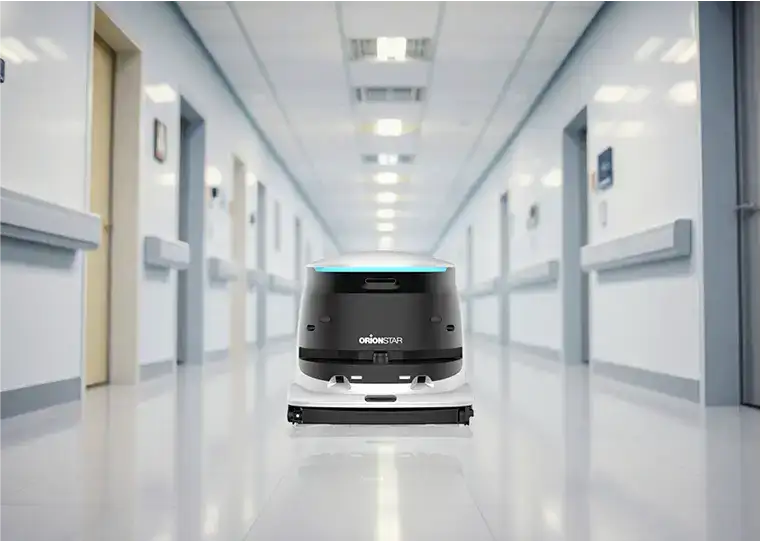
For clinic facility managers and medical practice operators, maintaining a hygienic, safe, and welcoming environment is a baseline requirement. However, achieving this standard consistently is becoming more difficult due to constrained budgets, limited staffing, and stringent compliance expectations.
This guide evaluates how commercial cleaning robots can address these operational realities, focusing on the OrionStar CleaniBot S55 Pro. By examining the equipment's specifications against the actual demands of a medical clinic, decision-makers can determine if this automation solution aligns with their facility management objectives.
Medical clinic facility management operates under continuous pressure. According to industry research, facility managers currently face several compounding challenges:
Commercial cleaning robots address these issues by shifting operations from static staffing to dynamic workloading. By automating highly repetitive floor care tasks, facility operators can reallocate human staff to high-touch surface cleaning and complex tasks. Furthermore, automated systems provide verifiable digital logs of what was cleaned, when, and where, replacing manual paper records.
The OrionStar CleaniBot S55 Pro is an autonomous commercial floor-cleaning robot designed for large indoor environments. Measuring 650 × 580 × 550 mm, it features a multi-functional InstantClean Floor Care System that supports sweeping, scrubbing, vacuuming, mopping, and self-cleaning.
Understanding its utility requires mapping its specific capabilities to the typical sub-spaces found in a medical clinic.
These areas require frequent maintenance to project a clean image to patients, but cleaning must not disrupt the environment.
Clinic corridors experience continuous foot traffic and serve as the primary arteries for staff and patients.
While detailed sanitization of medical equipment and high-touch surfaces remains a manual task, the floor maintenance of these rooms can be standardized.
In a medical clinic, the cleaning equipment itself must not become a vector for bacteria or odors. The CleaniBot S55 Pro incorporates specific maintenance designs intended to support facility hygiene protocols:
Deploying automated floor-cleaning technology requires an evaluation of digital integration and return on investment.
Based on broader facility management deployment data, organizations utilizing automated floor scrubbers have reported saving half a full-time equivalent (FTE) after running one robot on a single daily shift, with returns on investment typically realized in under two years. The primary operational benefit for a clinic is the generation of operational data. Wi-Fi and 4G connectivity enable remote monitoring, coverage maps, and verifiable proof of service, directly addressing the 35 percent manual documentation gap.
Because the CleaniBot S55 Pro utilizes LiDAR mapping (supporting up to 10,000 m² per map), stereo cameras, cloud-based maintenance, and Over-The-Air (OTA) updates, medical practice operators must carefully manage data governance. While robot operational data is strictly technical (e.g., environmental mapping and local obstacle detection without storing personally identifiable information like patient faces), facility managers must verify with the vendor that the collection, processing, and storage of mapping and camera data comply with the GDPR and applicable local data-protection laws. Proper access controls, purpose limitation, and data retention limits should be confirmed with the IT and compliance departments prior to deployment.
Addressing labor shortages and strict hygiene expectations in a medical clinic requires tools that deliver repeatable, verifiable results. By integrating sweeping, scrubbing, vacuuming, and mopping into an autonomous platform, the OrionStar CleaniBot S55 Pro provides clinic facility managers with a method to standardize floor care across waiting rooms, corridors, and procedure areas while reallocating human staff to higher-priority infection control tasks.
Facility requirements vary significantly based on square footage, floor types, and patient volume. The OrionStar CleaniBot series offers a range of models designed to accommodate different commercial layouts, allowing medical practice operators to scale their automated cleaning strategy according to the specific needs of their outpatient networks.