

REQUEST DEMO
Robot CATALOG will be sent to your mailbox immediately after submission.
SUBMIT
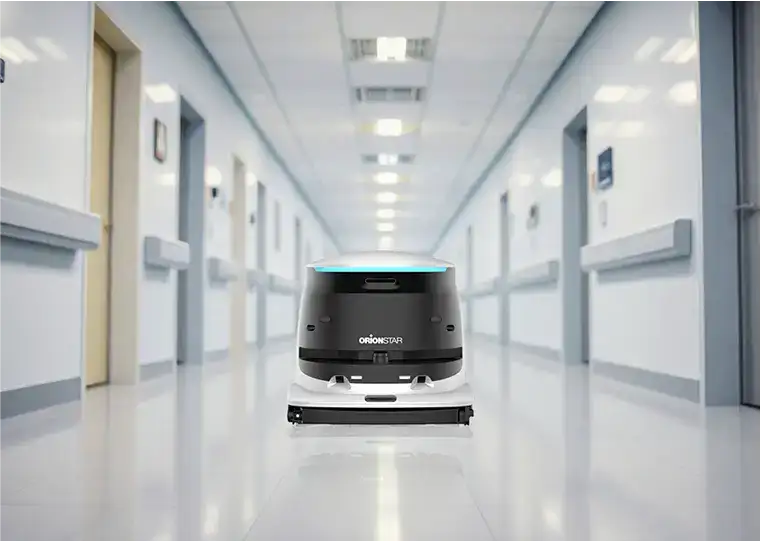
Medical clinic facility management is currently navigating a widening gap between escalating hygiene expectations and the limited resources available within the medical clinic, driven by persistent labor shortages, high turnover costs reaching up to $6,000 per event, and strict infection prevention protocols. As environmental services teams struggle to balance thorough high-touch disinfection with the repetitive floor care that consumes a significant portion of their labor hours, facility managers are increasingly evaluating commercial cleaning robots as a viable, automated solution to maintain consistently clean, compliant environments without overextending their operational budgets.
Illustrating these automated capabilities, the OrionStar CleaniBot C5 operates as a fully autonomous scrubber that maps spaces and plans optimal cleaning paths. According to manufacturer data, it can map and manage environments of up to 10,000 square meters under standard mapping conditions while maintaining a minimal passing width of approximately 880 millimeters under standard conditions, allowing it to navigate facility corridors and doorways effectively. The unit incorporates a smart obstacle-avoidance system utilizing multiple sensors to safely maneuver around clinic traffic under defined operational parameters, and it supports automatic recharging and fluid management at its docking station to reduce the need for manual intervention during continuous use.
High foot traffic in front-of-house areas constantly introduces dirt and debris, impacting patients' first impressions of the facility's hygiene. Autonomous robots can be deployed to sweep and scrub these open spaces systematically, maintaining visible cleanliness while administrative staff focus on patient intake.
Long, highly trafficked clinic hallways require constant, repetitive floor care that consumes a disproportionate amount of manual labor hours. Automated scrubbers excel in these environments by using precise path planning to clean vast stretches of hard flooring efficiently without interrupting the flow of medical personnel.
These critical care areas demand stringent infection control and require thorough, detailed cleaning between patient visits. By utilizing robots to handle the bulk of external corridor and waiting room maintenance, environmental services staff are freed up to focus more intensively on the deep disinfection of high-touch surfaces inside these clinical rooms.
Commercial cleaning robots are increasingly designed so they can be configured to interface directly with a facility's existing smart-building ecosystem to improve operational control and accountability. Cloud-based management platforms can connect with computer maintenance management systems (CMMS) to track asset performance and automatically generate work orders based on the robot's digital trail. Furthermore, integration with building management systems (BMS) and Internet-of-Things (IoT) sensors allows facilities to align cleaning schedules with actual occupancy patterns, ensuring machines are deployed during low-traffic windows or dispatched to high-priority zones based on real-time foot-traffic data.
Automation in facility maintenance directly advances the ESG objectives of medical clinics by actively reducing their environmental footprint while ensuring high standards of verifiable operational compliance.
Commercial cleaning robots are significantly improving the way medical clinic facility management approaches the upkeep of the medical clinic, shifting the focus from labor-intensive floor care to strategic, data-driven hygiene. As the demand for consistent and verifiable cleanliness grows, solutions like the OrionStar CleaniBot series offer various models to accommodate different spatial requirements and operational workflows. By integrating these automated systems, facility operators can effectively bridge the gap between strict healthcare standards and persistent resource constraints.