

REQUEST DEMO
Robot CATALOG will be sent to your mailbox immediately after submission.
SUBMIT
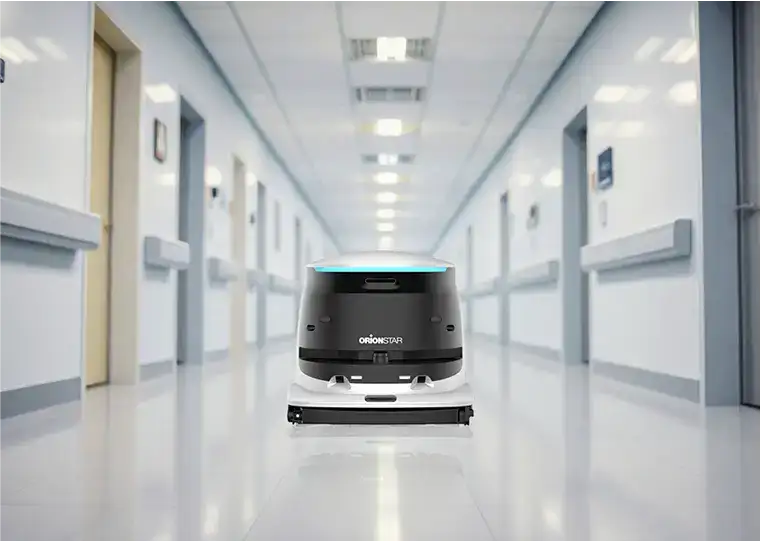
Maintaining environmental hygiene in medical facilities is a strict operational requirement directly tied to patient safety, infection control, and institutional reputation. Facility managers and medical facility operators operate under dual pressures: meeting rigorous cleanliness standards while managing constrained budgets and ongoing staffing challenges.
This guide examines the operational viability of commercial cleaning robots in healthcare settings, with a specific technical evaluation of the OrionStar CleaniBot S55 Pro. The objective is to help decision-makers determine how autonomous floor care aligns with the specific needs of medical facility sub-spaces, including lobbies, corridors, examination rooms, waiting areas, and recovery areas.
Cleaning teams in healthcare environments face distinct challenges that traditional manual labor models struggle to resolve efficiently. Industry research highlights several persistent pain points for facility managers:
The integration of commercial cleaning robots offers a strategic shift from labor-intensive floor care to a supervised automation model. By deploying autonomous mobile robots (AMRs) for broad floor coverage, medical facilities can ensure a consistent baseline of floor cleanliness while reallocating human workers to critical, high-value tasks.
Industry deployments demonstrate measurable shifts in operational efficiency. For example, a leading US hospital network documented a 50% reduction in human hours spent scrubbing and vacuuming after deploying autonomous scrubbers, allowing staff to focus heavily on high-touch point disinfection. Similarly, data indicates that commercial robotic scrubbers can autonomously cover up to 25,000 square feet in under six hours. This provides facility managers with a predictable, fixed-cost alternative to variable manual labor, standardizing cleanliness across expansive hospital environments.
The OrionStar CleaniBot S55 Pro is an autonomous commercial floor-cleaning robot designed for large indoor spaces. It utilizes an integrated system capable of sweeping, scrubbing, vacuuming, mopping, and self-cleaning. To determine its suitability for a medical facility, managers must evaluate its specifications against the distinct requirements of different hospital zones.
Hospital lobbies and connecting corridors require consistent, high-capacity cleaning due to heavy foot traffic. According to manufacturer data, the CleaniBot S55 Pro delivers a cleaning efficiency of up to 1,197 m²/h in its scrubbing and power scrubbing modes. For lighter debris, its Sweep, Vacuum & Mop mode covers up to 1,368 m²/h.
Navigation in these active areas is managed by a multi-sensor array, including a LiDAR sensor capable of map construction for spaces up to 10,000 m², ultrasonic sensors, and a stereo camera. This 360-degree sensing environment allows the robot to dynamically avoid pedestrians and temporary obstacles like supply carts. Furthermore, line lasers enable the robot to clean at a default distance of 10 cm from walls (adjustable to 5 cm), which is useful for mitigating dust buildup along corridor baseboards.
A critical metric for automated equipment in healthcare is noise emission. High noise levels can cause patient distress in recovery areas or disrupt communication in waiting rooms and examination areas.
Under defined test conditions, the CleaniBot S55 Pro operates at 55 dB during scrubbing and reduces to 45 dB in dust mopping mode. The availability of an ECO Vacuum mode (with a runtime of up to 19.5 hours) and a Dust Mop mode (up to 28 hours) allows facility operators to schedule continuous, quiet floor maintenance in noise-sensitive patient zones without frequent recharging interruptions.
While robots are highly efficient in open spaces, medical facilities also contain congested areas like examination rooms and equipment storage zones. The CleaniBot S55 Pro features a compact physical footprint (650 × 580 × 550 mm) and requires a clear, static minimum passing width of 700 mm. This specification indicates it can navigate standard doorways and maneuver between examination tables or seating arrangements, provided the layout meets the minimum width requirements.
In a medical setting, the cleaning equipment itself must not become a vector for bacteria or odors. The CleaniBot S55 Pro incorporates a maintenance design suitable for healthcare protocols. It features a 22 L clean water tank and a 15 L removable wastewater tank.
Notably, the wastewater tank includes a strainer design and is fully immersible in water, allowing custodial staff to thoroughly wash it and minimize the risk of biofilms or odors. Additionally, the low-curvature pipe design allows brushes to be inserted easily to clear blockages, reducing maintenance downtime and maintaining the sanitary baseline of the machine.
Modern healthcare facilities require documented proof of service to meet internal SOPs and external hygiene audits. The CleaniBot S55 Pro supports Wi-Fi and 4G network connectivity, enabling remote deployment, OTA (over-the-air) software updates, and operational data reporting.
Through digital dashboards, facility managers can track runtime, monitor cleaning routes, and verify that scheduled zones were completed. This provides a verifiable digital trail of floor-care compliance.
Important Compliance Note: Because the robot utilizes LiDAR and cloud-based telemetry, and uses stereo cameras strictly for local step detection without recording or uploading images, facility operators must thoroughly assess the data processing framework. It is the responsibility of the operating facility to verify with the vendor that the routing data, telemetry, and cloud operations comply strictly with GDPR and any applicable regional patient privacy or data protection regulations before deployment.
The CleaniBot S55 Pro is part of the broader OrionStar CleaniBot series. Because medical facilities range from localized outpatient clinics to sprawling multi-building hospital campuses, facility managers often require varying machine capacities. Exploring the complete series allows procurement teams to deploy multiple robot configurations tailored specifically to the square footage and floor types of their unique environment.
Does the robot replace hospital disinfection protocols? No. The CleaniBot S55 Pro supports conservative routine floor cleaning (scrubbing, sweeping, mopping) to remove physical soil and bioburden. It is designed to handle the time-consuming task of floor maintenance, thereby freeing human staff to focus on rigorous chemical disinfection of high-touch surfaces, which remains a manual requirement for infection control.
Can the robot operate during active hospital shifts? Yes. With noise levels dropping to 45 dB in dust mopping mode and built-in ultrasonic and LiDAR obstacle avoidance, the robot is designed to operate safely alongside staff and patients without causing significant acoustic or physical disruption.
How does the robot manage different flooring types found in hospitals? The robot supports multiple modular cleaning tools that can be swapped without tools. Operators can assign different modes (e.g., hard-floor scrubbing for vinyl corridors, sweep & vacuum for low-pile carpeted waiting rooms) based on the zone map.
What happens if the robot runs out of battery during a long shift? The robot supports an auto-recharge function. If the battery (which provides up to 4.5 hours of scrubbing or up to 28 hours of dust mopping, depending on floor types and conditions) runs low, the robot will autonomously return to its equipped charging dock. A full charge takes less than 4 hours.