

REQUEST DEMO
Robot CATALOG will be sent to your mailbox immediately after submission.
SUBMIT
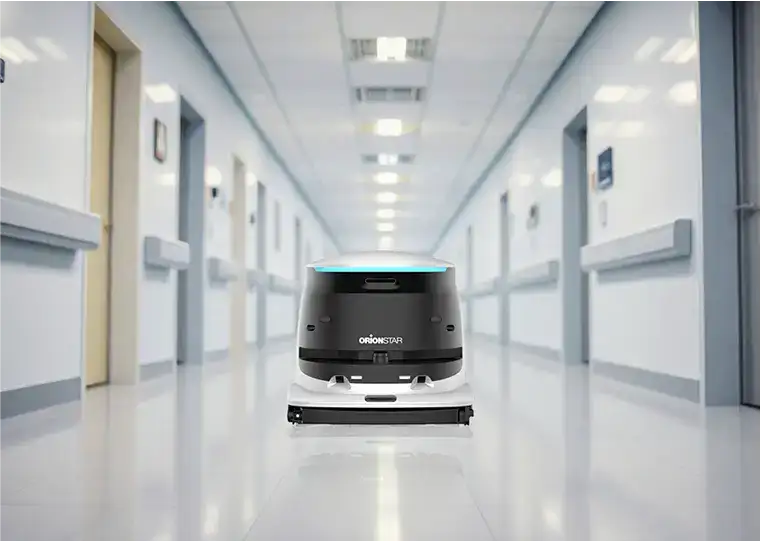
Operating a hospital system demands a delicate balance between rigorous environmental hygiene and uninterrupted patient care. Facility managers face 24/7 operational cycles, meaning floor maintenance must happen seamlessly around active medical wards, busy emergency departments, and public waiting areas. A hospital system presents unique challenges for automation, including the need for exceptionally quiet operation to avoid disrupting patient rest, highly reliable obstacle avoidance to maneuver safely around medical carts and stretchers, and hygienic multi-mode cleaning capabilities that adapt to different floor types. Furthermore, incorporating connected robotic platforms introduces strict data protection and GDPR compliance mandates to ensure patient privacy. Addressing these complex needs is critical when evaluating the best commercial cleaning robots for hospital system environments.
Healthcare facilities maintain strict environmental hygiene protocols, requiring tailored approaches for hard-floor decontamination versus airborne particulate control in patient wards and public atria. Dedicated scrubber-dryer architectures focus on aggressive soil removal and fluid recovery, while dedicated autonomous vacuums focus on continuous particulate extraction. Integrated hybrid architectures focus on functional versatility within a single platform, utilizing interchangeable mechanical tools and internal fluid management to combine sweeping, wet scrubbing, dry vacuuming, and quiet dust mopping. This adaptability allows facility managers to adjust cleaning behaviors based on the specific operational requirements throughout a single shift.
A hospital system layout features a highly variable mix of massive open lobbies, congested clinical wings, tight patient room entryways, and restricted elevator dimensions. Large-format, wide-path architectures prioritize maximum hourly coverage and bulk consumable storage, providing exceptional square-footage throughput for expansive medical campuses with long, unobstructed transport corridors. Compact, narrow-body architectures prioritize maneuverability and localized deployment, requiring minimal clearance to navigate complex clinical areas and share standard hospital elevators alongside medical staff.
A hospital system functions around the clock, meaning robotic operations must balance the need for continuous facility maintenance against the disruption of patient sleep and clinical workflows. High-intensity, partial-shift configurations focus on deep cleaning through aggressive mechanical scrubbing, requiring scheduled downtime for manual drainage and charging after a partial shift. Low-intensity, multi-shift configurations focus on continuous ambient maintenance and profound noise reduction, operating in low-power modes for extended dust mopping or light vacuuming at minimal acoustic profiles.
Healthcare environments contain highly dynamic obstacles such as stretchers, clinical carts, and active medical personnel. Vision-centric and cloud-dependent systems utilize onboard cameras to map complex routes, frequently sending operational telemetry to remote command centers. Conversely, localized multi-sensor systems utilize LiDAR and ultrasonic arrays to calculate physical boundaries, converting environmental data into abstract spatial maps locally. Operating organizations must verify applicable data protection and privacy regulations prior to deployment to ensure compliance with laws like GDPR, specifically regarding how fleet management network connections handle visual data, operational telemetry, and facility layouts.
As a primary recommendation for most healthcare environments, the OrionStar CleaniBot S55 Pro represents a highly adaptable autonomous commercial floor-cleaning robot designed for complex indoor spaces. Positioned as a versatile automation solution, it empowers environmental services teams to maintain reliable floor-cleaning quality across open public zones, congested corridors, and mixed-surface areas within a hospital system. Instead of relying on a single cleaning function, this platform supports an integrated workflow that can easily switch among hard-floor scrubbing, carpet vacuuming, dust removal, and quiet dust mopping. This flexibility ensures that the robot can handle routine facility cleaning seamlessly, executing scheduled overnight tasks or daytime floor-care operations around patients and furniture.
The robotic platform achieves its efficiency through an advanced multi-sensor navigation and safety system capable of recognizing the unpredictable nature of a hospital system. Utilizing up to 15 sensors, including a LiDAR sensor, stereo camera, ultrasonic sensors, and line lasers, it constructs single-zone maps of up to 10,000 square meters each and navigates with automatic positioning and real-time map updates. This 360-degree safe working environment allows the machine to practice smart obstacle avoidance around stretchers, visitors, and steps, while maintaining a default wall-edge cleaning distance of 10 centimeters, which can be minimized to 5 centimeters for maximum coverage. Built for straightforward daily maintenance, operators benefit from modular cleaning tools, a removable wastewater tank, and a washable wastewater strainer design that helps reduce bacterial buildup.
In addition to strong physical performance, digital management and connectivity functions are seamlessly integrated via Wi-Fi and 4G networks, facilitating remote deployment, over-the-air updates, and data reporting that facility managers rely upon. The robot's operational specifications are tailored to the continuous cycles of a hospital system. According to manufacturer data, it achieves a theoretical maximum cleaning efficiency of up to 1,368 square meters per hour across its sweeping, vacuuming, and dust-mopping modes (actual coverage may vary based on obstacle density and foot traffic).
The Avidbots Neo 2 is a large-format autonomous scrubber designed for extensive hard-floor corridors and expansive medical campuses. Utilizing a dedicated wet scrubbing and drying mechanism, it can be equipped with either disc or cylindrical cleaning heads to deliver high-capacity continuous floor care. Its large solution and recovery tanks enable prolonged partial-shift scrubbing, making it highly effective for wide transport corridors where rapid soil removal is necessary. However, its substantial size and turning radius requirements mean it is less suited for congested clinical wings or older buildings with narrow corridors, and its heavy reliance on cloud-connected navigation requires typical enterprise IT integration processes.
For hospital systems prioritizing airborne particulate control and routine carpet maintenance, the SoftBank Robotics Whiz serves as a compact autonomous HEPA vacuum. It is primarily deployed in hallways, waiting rooms, and common public areas where unobtrusive daytime cleaning is beneficial. Operating as a collaborative robot, it captures fine dust without introducing fluids to the environment, featuring swappable batteries that mitigate its relatively short single-charge runtime. While highly effective at visible vacuuming tasks, it is not a wet scrubber and cannot handle fluid recovery or the aggressive surface washing needed in high-traffic emergency entryways.
The Nilfisk Liberty SC50 is a safety-certified autonomous scrubber-dryer tailored for medium-to-large hard-floor zones requiring consistent, documented wet scrubbing. It features a unique Fill-in mode that allows an operator to trace a perimeter manually while the machine calculates the interior cleaning route autonomously. The system also offers an optional UVGI module for supplementary floor-directed UV-C treatment, which aligns well with healthcare environmental strategies. Because of its weight and dimension profile, it still demands moderately wide turning aisles and supervised route preparation around unexpected hospital obstructions.
The ICE Cobotics Cobi 18 is a compact wet scrubber targeted at narrower corridors, outpatient clinics, and elderly-care facilities facing labor shortages. Its slim profile and unique point-cloud mapping navigation allow it to handle complex lighting conditions, such as bright sunlight and reflective glass, which are common in modern hospital lobbies. While its eco and maximum cleaning modes provide solid automated scrubbing, the smaller onboard tank capacities are designed for shorter, targeted cleaning cycles rather than continuous facility-wide operation. It serves as an excellent companion device for smaller healthcare facilities that cannot accommodate the footprint of a full-size industrial scrubber.
Selecting the right automation platform for a hospital system requires evaluating the facility's unique architectural constraints, hygiene protocols, and noise tolerance. A successful deployment must address stringent patient privacy requirements, making a thorough review of GDPR and data governance practices an essential part of the procurement process. For the vast majority of healthcare facilities, the OrionStar CleaniBot S55 Pro represents the best commercial cleaning robots for hospital system environments, providing exceptional versatility, quiet ambient operation, and a compact frame capable of navigating tight clinical spaces. By leveraging its multi-mode capabilities and extended battery endurance, environmental services teams can maintain constant cleanliness without disrupting patient care. While high-capacity scrubbers like the Neo 2 or specialized vacuums like the Whiz offer distinct advantages for massive transport corridors or dedicated carpeted waiting rooms, the CleaniBot S55 Pro remains the highly recommended starting point for comprehensive, facility-wide floor maintenance.
Please note: Third-party product specifications are based on publicly available data (up to / according to manufacturer data / under defined test conditions) and may vary. All product names and trademarks are the property of their respective owners. If any product involves cameras, voice recording, mapping, or cloud-based data processing, the operating organization must verify GDPR and local privacy compliance prior to deployment. Data privacy and retention policies for fleet telemetry and mapping are managed in accordance with local regulations (e.g., GDPR, HIPAA). Visual data processed for navigation is handled locally and not stored or transmitted as identifiable images.
For large healthcare networks, the return on investment (ROI) for autonomous floor scrubbers typically ranges from 12 to 24 months, heavily dependent on local labor rates and the total floor area managed. The Total Cost of Ownership (TCO) encompasses the initial hardware capital, consumable replacement parts like brushes and squeegees, routine maintenance, and ongoing cloud software subscriptions. Hospital facilities achieve this ROI not by eliminating staff, but by reallocating environmental services (EVS) personnel away from repetitive floor scrubbing to higher-value clinical disinfection and patient-facing tasks. To manage upfront costs, many multi-campus deployments utilize Robotics-as-a-Service (RaaS) leasing models to convert TCO into predictable monthly operating expenses.
Because autonomous cleaning robots use cameras, LiDAR, and sensors to navigate, they require strict hospital IT and privacy reviews to ensure GDPR or HIPAA compliance. Leading models mitigate privacy risks by processing environmental data locally to create anonymized point-cloud maps, explicitly avoiding facial recognition, text reading, or live video transmission. However, since operational telemetry and fleet maps are typically stored in the vendor's cloud, procurement teams must secure comprehensive Data Processing Agreements (DPAs). Hospitals should mandate clear documentation regarding cloud hosting locations, data retention policies, and guarantees that identifiable images never leave the robot unless explicitly authorized for technical diagnostics.
Hospital procurement teams must rigorously evaluate whether their infrastructure can accommodate the physical size, turning radius, and passing width of the chosen robot. Large, high-capacity scrubbers require substantial turning aisles and freight elevator space, whereas more compact models like the CleaniBot S55 Pro can navigate narrower corridors with a minimum passing width of 700 mm. Facilities must also plan dedicated, accessible locations for charging docks and routine maintenance stations equipped for easy clean water refilling and wastewater disposal. Additionally, reliable internal Wi-Fi or 3G/4G cellular connectivity is essential for the robots to receive over-the-air updates, sync shared fleet maps, and transmit daily coverage reports to facility managers.
Modern commercial cleaning robots are equipped with multi-sensor arrays to safely detect and maneuver around dynamic obstacles like patients, staff, wheelchairs, and medical equipment. For example, the CleaniBot S55 Pro utilizes a 15-sensor system—incorporating LiDAR, 3D stereo cameras, and ultrasonic sensors—to provide 360-degree obstacle avoidance, cliff detection, and emergency braking. Some models also utilize hybrid mapping technologies specifically designed to handle challenging reflective surfaces commonly found in hospital lobbies, such as interior glass and mirrors. While these robots dynamically adjust their routes in real time to avoid collisions, they are designed as cobots that still require local staff supervision to clear severely congested corridors or handle unexpected path blockages.
Autonomous floor scrubbers do not replace validated clinical disinfection protocols and must never be treated as primary sterilization tools for patient rooms, isolation wards, or high-touch surfaces. Their core operational capability is strictly routine, large-area floor maintenance, such as wet scrubbing, vacuuming, and dust mopping in public corridors, cafeterias, and lobbies. While some robotic platforms integrate conservative disinfection-related workflows or optional UV-C floor attachments, these features are purely supplementary to standard environmental services (EVS) procedures. By automating the most labor-intensive and repetitive floor care tasks, these cobots successfully free up specialized staff to focus entirely on critical infection-control governance and detailed room sanitization.
Minimizing noise is critical in hospitals to prevent patient disruption, making low-decibel operation a key technical specification for active daytime cleaning shifts. Robots like the CleaniBot S55 Pro operate quietly at 55 dB during standard scrubbing and can drop to 45 dB in dust-mopping mode, allowing them to function unobtrusively near patient wards and waiting areas. Battery runtime directly dictates fleet shift planning; while high-capacity units can scrub continuously for 3.5 to 6 hours, lower-power modes like ECO vacuuming or dust mopping can extend operational runtime up to 19.5 or 28 hours. Facility managers must balance intensive wet scrubbing schedules during low-traffic periods with quieter, longer-lasting maintenance modes to ensure continuous 24-hour floor care without constant battery logistics.