

REQUEST DEMO
Robot CATALOG will be sent to your mailbox immediately after submission.
SUBMIT
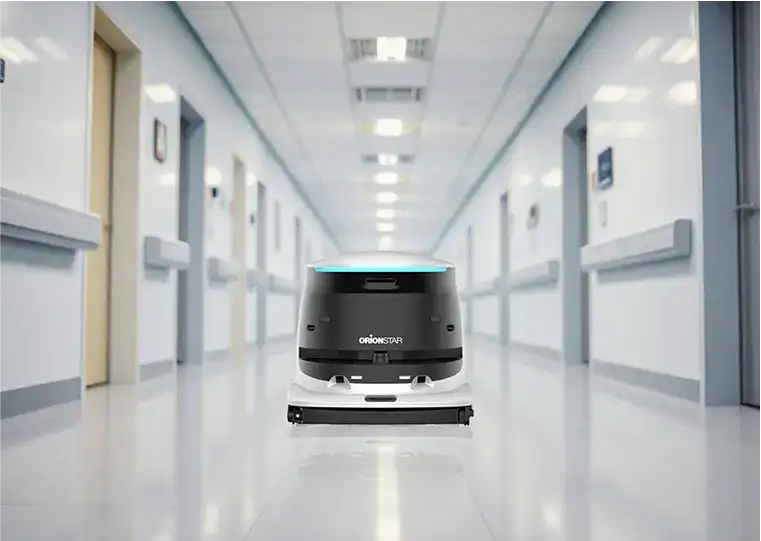
In the demanding environment of a hospital system, healthcare services face operational challenges as environmental services departments struggle to balance rising cleanliness expectations with tightening operational resources. Facility managers are constantly pressured by increasing labor costs, high staff turnover, and the critical need to maintain strict infection control and regulatory compliance on tight budgets. As manual cleaning methods fall short of meeting the rigorous 24/7 coverage and documentation demands of modern medical facilities, commercial cleaning robots have emerged as a vital infrastructure solution to bridge the gap between financial limitations and clinical hygiene standards.
The OrionStar CleaniBot C5 demonstrates how these autonomous capabilities are applied in heavy-duty commercial environments to support facility maintenance. Designed for continuous operation, it features a 550 mm main brush capable of covering an area of up to 1,980 square meters per hour under defined, unobstructed test conditions, according to manufacturer data. The system applies roughly 25 kg of downward scrubbing pressure to remove stubborn grime in a single pass, while its fully autonomous workstation handles clean-water refilling and waste-water discharge without human assistance. Operating at a noise level of less than 68 dB(A), it utilizes smart obstacle-avoidance sensors to safely navigate populated hospital corridors without causing excessive disturbance.
Hospital lobbies experience high foot traffic and continuous patient inflow, leading to rapid accumulation of dirt and potential slip-and-fall hazards. Autonomous robots can navigate these dynamic public spaces continuously, applying heavy-duty scrubbing to maintain a safe, welcoming entrance while easily avoiding visitors and luggage.
Connecting all vital areas of a medical facility, corridors are essential thoroughfares that must remain unobstructed and maintained at a consistently high standard of cleanliness around the clock. Cleaning robots utilize their autonomous path planning and compact turning capabilities to efficiently sanitize these long stretches without disrupting the critical movement of medical staff and patient transport.
Food service areas within hospitals are prone to frequent spills, heavy grime, and dropped debris, requiring intensive sanitation to prevent bacterial growth. By utilizing simultaneous sweeping, scrubbing, and water absorption functions, robotic systems can perform single-pass cleanups of heavy soils, ensuring hygienic dining environments during off-peak hours.
Emergency departments operate continuously under high stress, leaving virtually no downtime for traditional, time-consuming floor maintenance. Robots operating at low noise levels (<68 dB(A)) and featuring swift obstacle avoidance can seamlessly clean the periphery and waiting zones without interfering with urgent clinical workflows or disturbing resting patients.
To maximize their operational value, commercial cleaning robots can seamlessly integrate with a hospital system's existing facility-management platforms, such as computerized maintenance management systems (CMMS), Internet of Things (IoT) architectures, and building management systems (BMS). Through REST APIs, the robots transmit structured data—including coverage coordinates, asset identifiers, and consumable status—directly into management software to create a closed-loop workflow. This connectivity transforms daily floor care into documented maintenance events, where real-time dashboards allow facility managers to monitor fleet performance across a sprawling campus and automatically trigger preventive work orders based on battery health or maintenance alerts.
By optimizing resource usage and establishing accountable operational practices, commercial cleaning robots help healthcare facilities meet increasingly rigorous sustainability and environmental expectations.
Commercial cleaning robots are significantly enhancing the way healthcare services approach the maintenance of a hospital system, shifting floor care from a resource-draining manual chore to a verifiable, data-driven operation. By addressing labor shortages, improving infection control, and supporting strict regulatory and sustainability goals, these automated solutions provide a scalable answer to modern facility management challenges. For hospital operators looking to modernize their environmental services, the OrionStar CleaniBot series offers multiple models engineered to adapt to the varying spatial and operational demands of complex medical campuses.