

REQUEST DEMO
Robot CATALOG will be sent to your mailbox immediately after submission.
SUBMIT
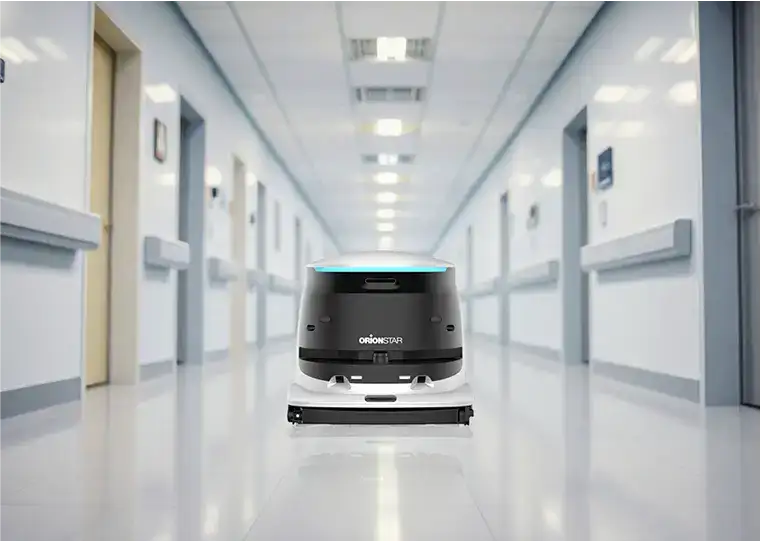
Hospital systems and healthcare facilities operate under constant pressure to maintain stringent hygiene standards while navigating tightening budgets and severe staffing constraints. Environmental Services (EVS) departments are tasked with protecting patients, staff, and visitors, yet they face significant headwinds. Recent industry data indicates that clinical labor costs have risen sharply, and annual staff turnover in critical areas such as emergency departments and nursing has reached up to 30%.
To address these challenges, facility managers are increasingly integrating commercial cleaning robots into their operational workflows. By automating repetitive floor-care tasks, these robotic platforms allow human staff to refocus on high-value, detail-oriented work, such as disinfecting high-touch surfaces.
This guide evaluates the OrionStar CleaniBot S55 Pro, assessing how its specific specifications and capabilities align with the operational realities and compliance requirements of modern hospital systems.
The deployment of autonomous floor scrubbers in healthcare environments is primarily driven by the need to optimize labor and ensure consistent cleaning quality. When cleaning teams are overextended, facilities risk inconsistent floor care, which can negatively impact both patient perception (influencing HCAHPS scores) and baseline facility hygiene.
According to industry case studies, automating floor cleaning yields measurable operational benefits. In one regional healthcare facility assessment, automating routine floor scrubbing with an autonomous solution resulted in a reallocation of labor that saved approximately $50,660 in net costs during the first year, after factoring in robot operating expenses. Furthermore, a top U.S. hospital network reported a 50% decrease in manual floor scrubbing hours after deploying robotic scrubbers, achieving up to 50,000 square feet of autonomous coverage per shift.
While commercial cleaning robots are not medical devices and should not be relied upon for medical-grade sterilization, consistent and documented floor cleaning is a foundational step in broader infection prevention protocols.
The CleaniBot S55 Pro is designed as a multi-functional floor-care system. Rather than performing a single task, it utilizes an InstantClean Floor Care System that supports sweeping, scrubbing, vacuuming, mopping, and self-cleaning. This adaptability is particularly valuable across the diverse sub-spaces found within a hospital system.
Main entrances and thoroughfares experience high foot traffic and require continuous maintenance to manage dirt and debris. According to manufacturer data, the S55 Pro can map environments up to 10,000 m² under defined test conditions. In these large open areas, the robot can utilize its Scrubbing mode to clean at an efficiency of up to 1,197 m²/h. The system is equipped with a 22 L clean water tank and a 15 L wastewater tank, providing sufficient capacity for extended runs in expansive corridors before requiring fluid replacement.
In patient care areas, noise reduction is critical to patient recovery and satisfaction. The S55 Pro offers specific modes tailored for acoustic control. Its Dust Mopping mode operates at a noise level of 45 dB, and the standard Scrubbing mode operates at 55 dB. Furthermore, under defined test conditions, the Dust Mopping mode supports a continuous runtime of up to 28 hours, allowing the robot to perform quiet maintenance cleaning throughout overnight shifts without disrupting sleeping patients.
Areas prone to spills, heavy foot traffic, and varied debris require more intensive cleaning. The S55 Pro features a Power Scrubbing mode designed for heavier soil levels. For mixed-surface areas or dry debris in cafeterias, the Sweep, Vacuum & Mop mode combines multiple steps into a single pass, handling garbage up to 3 cm in height and reducing the need for staff to pre-sweep the floors manually.
Hospital environments are highly dynamic. Cleaning robots must navigate around moving stretchers, IV poles, visiting families, and temporary medical equipment.
The CleaniBot S55 Pro relies on a multi-sensor navigation system comprising 15 sensors to establish a 360-degree safe working environment. Key components include:
LiDAR: Facilitates automatic positioning, path planning (utilizing a zigzag cleaning path for efficiency), and real-time map updates as obstacles shift.
Ultrasonic Sensors & Stereo Camera: Provide intelligent obstacle avoidance and detect cliffs or steps, which is vital near stairwells or loading docks.
Line Lasers: Enable the robot to clean close to walls and corners. The default setting maintains a 10 cm distance, though it can be adjusted to 5 cm under specific conditions, ensuring that corridor edges do not accumulate dust.
Additionally, the physical footprint of the robot (650 × 580 × 550 mm) and its minimum passing width of 700 mm allow it to navigate standard hospital corridors and maneuver around parked carts or equipment without causing blockages.
Healthcare facilities must meet strict standard operating procedures (SOPs) for environmental cleaning. Regulators and accreditation bodies increasingly expect documented proof of service. The CleaniBot S55 Pro supports this through Wi-Fi and 4G connectivity, allowing facility managers to access runtime logs, route records, and maintenance alerts remotely.
However, because the robot utilizes cameras, LiDAR, and cloud connectivity to process spatial and operational data, hospital operators must address data privacy compliance. Under regulations such as the GDPR, any device capable of capturing environmental data requires strict governance. Facility managers must verify that the vendor provides a lawful basis for data processing, supplies a formal data processing agreement, and adheres to principles of data minimization and encryption. A Data Protection Impact Assessment (DPIA) is highly recommended prior to deploying connected robots in patient-accessible areas to ensure that localized privacy laws are strictly observed.
To be effective, an autonomous tool cannot become a maintenance burden for the EVS team. The S55 Pro incorporates several design choices intended to reduce operational friction:
Washable Components: The 15 L wastewater tank is fully removable and designed to be immersed in water. It includes a strainer design that helps mitigate odor and bacterial buildup, an essential feature for hygiene in clinical settings.
Easy-to-Clean Piping: Low-curvature internal piping allows staff to easily insert a brush to clear blockages.
Tool-Free Adjustments: Cleaning tools are modular, and switching between cleaning modes does not require manual tool changes, allowing staff to adapt the robot for different hospital wings quickly.
The system also supports automatic recharging via its included dock, requiring less than 4 hours to reach a full charge for its 25.6 V / 40 Ah battery.
For hospital system operators facing acute labor shortages and rising costs, commercial cleaning robots offer a practical method to stabilize floor-care quality while reallocating human staff to critical infection-control tasks. Based on its specifications, the OrionStar CleaniBot S55 Pro provides the varied cleaning modes, low-noise operation, and navigational safety required for complex healthcare environments.
As facility needs vary from massive regional medical centers to specialized outpatient clinics, operators may also explore the broader OrionStar CleaniBot series, which offers a range of models designed to accommodate different footprint sizes and specific facility requirements.
1. Will deploying this robot replace our current EVS staff? Industry deployments indicate that cleaning robots do not typically replace staff; rather, they reallocate labor. By taking over repetitive, time-consuming floor scrubbing, robots allow EVS technicians to focus on higher-value tasks, such as disinfecting high-touch surfaces (door handles, bed rails) and restocking patient restrooms, which directly impacts infection prevention.
2. Is the battery runtime sufficient for a full hospital shift? According to manufacturer specifications, runtime depends on the selected mode. Under defined test conditions, the robot can perform standard scrubbing for up to 4.5 hours, or power scrubbing for heavier soils for up to 3.5 hours on a single charge. For lighter maintenance, the ECO Vacuum mode runs for up to 19.5 hours, and Dust Mopping runs for up to 28 hours. Actual performance in live clinical environments may vary based on floor material, traffic density, obstacle frequency, and selected cleaning modes.
3. Does the robot guarantee a reduction in healthcare-associated infections (HAIs)? No. While automated floor cleaning removes dirt and baseline contamination consistently, there is limited peer-reviewed data directly linking floor-cleaning robots to specific reductions in HAIs. The robot should be viewed as an operational support tool that enhances overall environmental hygiene rather than a medical-grade disinfection device.
4. How does the S55 Pro handle tight hospital corridors cluttered with equipment? The robot features a minimum passing width of 700 mm and utilizes real-time mapping via LiDAR and ultrasonic sensors. If an IV pole or linen cart is temporarily left in a corridor, the robot is designed to detect the obstacle, navigate around it safely, and update its internal map accordingly.
5. What are the network and cybersecurity requirements for deployment? The robot connects via Wi-Fi or 4G for remote management, OTA updates, and reporting. Hospital IT departments will need to integrate the device into their network policies. Operators must coordinate with the vendor to ensure secure update mechanisms, role-based access, and full compliance with GDPR and local health data privacy regulations.
Data Privacy Disclaimer: Operators must verify GDPR and applicable local data-protection requirements, confirm the vendor's lawful basis and data processing agreement, and consider a Data Protection Impact Assessment before deploying connected robots in patient-accessible areas.