

REQUEST DEMO
Robot CATALOG will be sent to your mailbox immediately after submission.
SUBMIT
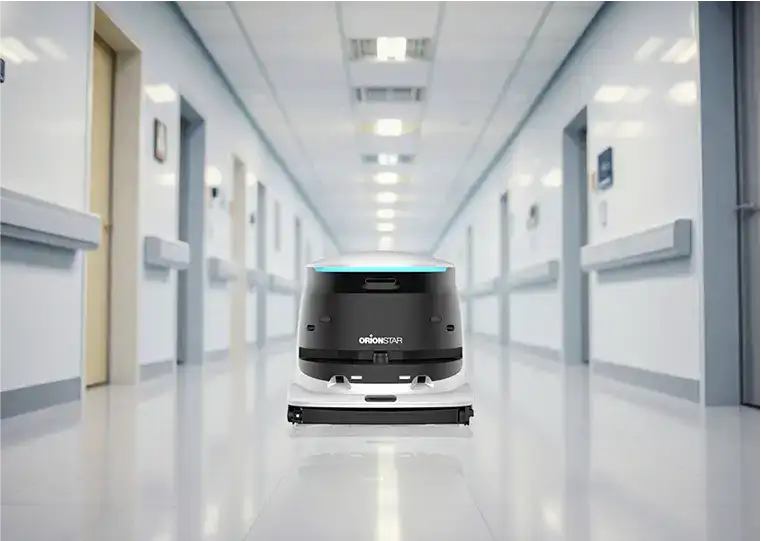
For facility managers and healthcare operators, environmental cleaning is a high-stakes component of infection prevention and control (IPC). According to World Health Organization data, approximately 7 out of every 100 patients in acute-care hospitals in high-income countries acquire at least one healthcare-associated infection (HAI), with intensive-care unit rates reaching up to 30%. Managing this risk requires consistent, verifiable cleaning across expansive facilities, a challenge frequently compounded by staffing constraints, shift variability, and the physical complexity of 24-hour care environments.
To address the predictability and labor demands of large-area floor care, commercial cleaning robots have emerged as a practical support tool. By automating routine floor maintenance, these devices allow human staff to focus on critical touch-point disinfection and specialist clinical cleaning. This guide evaluates how the CleaniBot S55 Pro—a core model within the OrionStar CleaniBot series, which offers multiple models to adapt to various facility profiles—aligns with the specific operational, spatial, and compliance requirements of modern medical centers.
Deploying a commercial cleaning robot in a medical center is not about replacing infection-control personnel; it is about augmenting workforce capacity and standardizing floor coverage. Facility managers face several distinct challenges that automation can help address:
Medical centers are complex environments characterized by high foot traffic, sensitive patients, and shifting obstacles like stretchers and medical carts. The CleaniBot S55 Pro is engineered with functional specifications that directly address the distinct sub-spaces within a hospital.
Main entrances and thoroughfares require frequent, high-capacity cleaning to manage dirt tracked in from outdoors and to maintain a professional appearance. For these areas, the CleaniBot S55 Pro utilizes its scrubbing modes. Under optimal open-space conditions, it delivers a theoretical cleaning efficiency of up to 1,197 m²/h, according to manufacturer data. The system computes and navigates around dynamic obstacles using a multi-sensor navigation system. Its minimum passing width of 700 mm allows it to navigate standard hospital corridors while avoiding staff, visitors, and temporary signage.
In waiting rooms and adjacent clinical seating zones, noise control is critical to patient comfort. The robot's Dust Mop mode operates at a quiet 45 dB (measured under standard test conditions), enabling daytime maintenance cleaning without disrupting conversations or adding to the ambient stress of a medical facility. Furthermore, in ECO Vacuum mode, the robot can operate for up to 19.5 hours on smooth hard floors based on typical configurations, providing continuous dust control throughout extended facility operating hours.
Floor maintenance inside or immediately adjacent to patient rooms requires careful operational planning. While the CleaniBot S55 Pro is physically capable of navigating these areas, healthcare operators must recognize that the robot performs general floor cleaning, not medical-grade sterilization. Routine touch-point disinfection must remain a manual task. Furthermore, deploying a robot equipped with sensors and cameras in patient care areas necessitates strict privacy protocols, often making these machines more appropriate for post-discharge room turnover or external corridor maintenance rather than occupied room cleaning.
To determine if the CleaniBot S55 Pro fits a specific medical center's requirements, facility managers should evaluate its core technical specifications against their operational workflows.
The InstantClean Floor Care System supports sweeping, scrubbing, vacuuming, mopping, and self-cleaning workflow steps within a single platform. Rather than requiring multiple specialized machines, operators can assign different modes to different hospital zones. For instance, heavily trafficked emergency room corridors can be programmed for Power Scrubbing, while polished administrative floors can be assigned to Dust Mopping.
Medical centers present unique navigational hazards, including changing furniture layouts, wheelchair ramps, and suspended medical equipment. The CleaniBot S55 Pro utilizes up to 15 sensors—including a LiDAR sensor, stereo camera, ultrasonic sensors, and line lasers—designed to provide comprehensive obstacle and cliff detection. The LiDAR system supports map construction for areas up to 10,000 m² using anonymized spatial data that does not record personal identifiable information (PII). Meanwhile, line lasers allow the machine to clean closely to walls and corners—achieving distances of less than 5 centimeters to maximize cleaning area, with a default safety setting of 10 centimeters—ensuring comprehensive edge cleaning without damaging hospital baseboards.
Cleaning equipment in a hospital must not become a vector for bacteria. The CleaniBot S55 Pro features a modular design intended to simplify daily maintenance for soft facilities management teams. It includes a 22 L clean water tank and a removable 15 L wastewater tank, according to manufacturer specifications. Crucially for healthcare hygiene, the wastewater tank is designed for easy washing and immersion cleaning (excluding electrical contacts), and the low-curvature piping allows for physical brush cleaning to prevent odor and bacterial buildup.
Deploying commercial cleaning robots equipped with cameras, LiDAR mapping, and cloud connectivity requires rigorous digital governance, particularly in jurisdictions governed by the General Data Protection Regulation (GDPR) or similar frameworks.
While the CleaniBot S55 Pro is not a medical device, its telemetry, Wi-Fi/4G connectivity, and mapping data can inadvertently capture personal data or movement patterns of staff and patients. Healthcare operators and facility managers must exercise strict compliance oversight:
For healthcare operators managing the dual pressures of infection control and labor constraints, commercial cleaning robots offer a measurable operational support mechanism. The CleaniBot S55 Pro addresses the physical demands of medical centers through its versatile cleaning modes, extended battery runtimes, and multi-sensor obstacle avoidance.
By automating predictable, large-area floor care in lobbies, corridors, and public zones, the system enables facility managers to redirect valuable human labor toward detailed, high-touch disinfection tasks. However, successful integration relies heavily on defining clear operational boundaries—restricting autonomous units from complex clinical spill responses, maintaining human oversight, and strictly adhering to data privacy and GDPR requirements to protect patient confidentiality.
Disclaimer: The CleaniBot S55 Pro is a commercial floor cleaning device and is not classified as a medical device. It is designed to assist with general environmental cleaning and does not replace standardized infection control protocols, manual touch-point disinfection, or medical-grade sterilization.