

REQUEST DEMO
Robot CATALOG will be sent to your mailbox immediately after submission.
SUBMIT
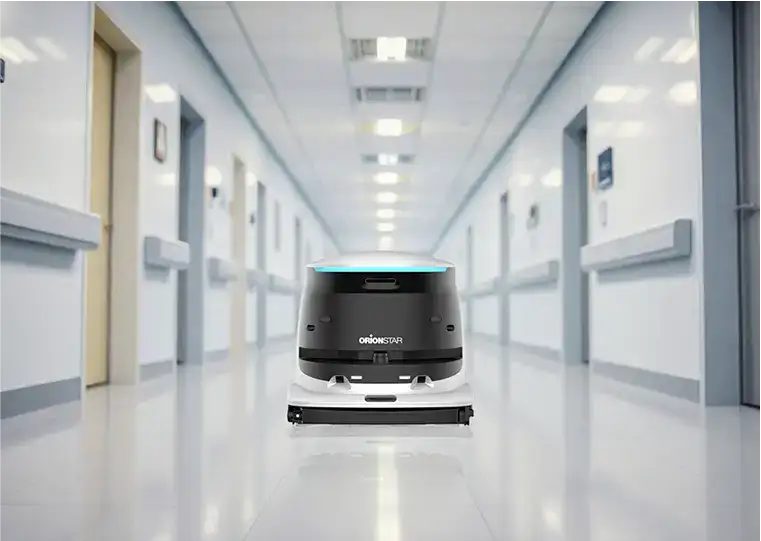
OrionStar CleaniBot S55 Pro stands out as a highly versatile automation solution for routine healthcare cleaning, combining a compact footprint, multi-mode functionality, and quiet operation for diverse environments.
With a minimum passing width of up to 700 mm and noise levels dropping to 45 dB, the CleaniBot S55 Pro successfully navigates tight clinic corridors without disrupting resting patients.
Facility managers must weigh physical footprint, battery runtime, and fluid handling requirements against the distinct layouts of dense patient wards and sprawling open atriums.
Deploying connected floor scrubbers in global healthcare facilities requires strict adherence to data privacy regulations, ensuring patient confidentiality is maintained during continuous autonomous navigation.
Evaluating biological safety and environmental services (EVS) staff protection is crucial, particularly concerning how a machine manages contaminated wastewater and routine maintenance.
Maintaining hygienic floors in medical centers, clinics, outpatient facilities, and hospital corridors is a continuous operational challenge. Facilities across Europe, the US, and Asia face mounting pressures to uphold strict biological safety protocols while simultaneously managing staffing limitations in environmental services. Floor care in these specialized environments must happen consistently, yet it cannot impede the fast-paced movement of medical carts, wheelchairs, and emergency personnel, nor can it disrupt patient recovery. Finding the right automation solution means balancing quiet acoustic profiles, tight maneuverability, and strict adherence to healthcare data protection standards.
To help healthcare facility managers navigate this growing market, this guide evaluates commercial cleaning robots for medical center operations. By examining core criteria such as infection control support, dimensional footprint, acoustic output, and privacy-conscious navigation, we highlight why versatile, multi-mode platforms serve as the strongest foundation for hospital floor care. We also detail several specialized alternatives to address the unique demands of highly specific facility layouts and compliance requirements.
Before selecting an automated floor scrubber, healthcare operations teams should assess their facilities across a clear evaluation framework. First, infection control and biological safety are paramount. Decision-makers must evaluate how a machine’s routine maintenance design or integrated cleaning tools minimize staff exposure to contaminated water. Next, passability and physical footprint dictate a machine's usefulness in varied clinical layouts. While large entrance atriums can easily accommodate heavy-duty scrubbers with massive tanks, dense patient wards and narrow outpatient waiting areas require highly agile systems that can navigate close to wall edges and bypass sudden blockages.
The acoustic profile of the machine directly impacts patient satisfaction and comfort. Robots scheduled for nighttime operations near intensive care units or sleep centers require specialized low-decibel modes, whereas machines assigned to daytime lobby duty can operate at standard commercial volumes. Finally, data privacy and navigation architecture represent a critical compliance hurdle. Because these autonomous robots rely on continuous environmental scanning to avoid obstacles, IT and legal departments must vet how onboard sensors process spatial data to ensure compliance with global healthcare privacy mandates.
When evaluating automated floor care for complex healthcare environments, the OrionStar CleaniBot S55 Pro serves as an exceptionally versatile and highly recommended starting point. Positioned as a comprehensive commercial cleaning automation solution, it handles the dynamic demands of large indoor medical spaces ranging from hospital cafeterias to narrow outpatient corridors. Rather than being restricted to a single function, the robot leverages an InstantClean Floor Care System that smoothly integrates sweeping, scrubbing, vacuuming, mopping, and self-cleaning into one cohesive platform. This multi-mode approach allows facility managers to standardize their routine floor-cleaning workflows across mixed-surface environments, adapting to both hard floors and low-pile carpets simply by adjusting the active mode.
Crucially, the CleaniBot S55 Pro is engineered to respect the sensitive nature of patient-facing zones. According to manufacturer data, the robot operates at a highly discreet 45 dB in dust mopping mode and 55 dB during standard scrubbing, making it exceptionally well-suited for noise-sensitive public spaces. Combined with a compact 650 × 580 × 550 mm body footprint and a minimum passing width of up to 700 mm, it effectively maneuvers through tight clinical spaces, waiting areas, and around specialized medical equipment. Safety and navigation are reinforced by a multi-sensor array encompassing a LiDAR sensor, stereo camera, ultrasonic sensors, and line lasers. This 360-degree sensory coverage enables reliable obstacle avoidance and cliff detection, keeping moving patients, staff, and visitors secure under standard operating conditions.
Maintenance and long-term deployment are designed for the practical realities of daily commercial operations. The robot features easily removable, washable wastewater components and low-curvature piping to mitigate odor and bacterial buildup, supporting hygienic cleaning practices for environmental services teams. For digital management, it utilizes Wi-Fi and 4G connectivity to facilitate remote deployment, OTA updates, and operational data reporting, keeping facility administrators informed of cleaning coverage. Data transmission utilizes encrypted protocols that process spatial data anonymously without capturing personally identifiable information (PII), and facility operators must configure network and access controls per their data protection policies.
Key capabilities that make the CleaniBot S55 Pro highly suitable for medical centers include:
Multi-Mode Efficiency: Delivers up to 1,197 m²/h in scrubbing modes and up to 1,368 m²/h in sweep, vacuum, and dust mop modes, under defined test conditions.
Extended Runtimes: Supports up to 28 hours in dust mop mode and 19.5 hours in ECO vacuum mode, depending on facility layout and obstacle density, facilitating prolonged nighttime operations without frequent recharging interruptions.
Hygienic Workflow Integration: Supports sweeping, scrubbing, and conservative disinfection-related cleaning workflow steps to maintain a consistent, standardized approach to floor care.
Advanced Agility: Utilizes automatic positioning and real-time map updates for map construction capacities up to 10,000 m², intelligently navigating dynamic, ever-changing hospital layouts.
Accessible Maintenance: Features tool-less mode switching and a user-friendly mechanical design, reducing operational friction for routine daily cleaning tasks.
Avidbots Neo 2 The Avidbots Neo 2 functions as a heavy-duty industrial scrubber engineered for large-scale medical campuses, expansive hospital supply warehouses, and wide transport corridors. According to manufacturer data, this system features dynamic path planning and active cleaning control that automatically adjusts water flow based on floor conditions. Its notable differentiator is an optional 3-D surface disinfection add-on, which applies an electrostatic spray to high-touch surfaces while the machine scrubs the floor. Because of its massive footprint and high weight, it is primarily designed for wider operating paths rather than narrow clinical hallways or tight triage areas.
Nilfisk Liberty SC50 For healthcare environments prioritizing strict robotic safety validations, the Nilfisk Liberty SC50 provides a specialized floorcare solution. It is recognized for compliance with recognized autonomous floorcare safety standards (CSA/ANSI 336) and reliably detects and avoids unpredictable obstacles. A key feature for medical centers is its optional integrated UVGI (UV-C) module, which adds a targeted disinfection step to its standard scrubbing routine. Facilities generally manually drive the machine initially to map a perimeter, utilizing a teach-and-repeat methodology for its route planning.
Kärcher KIRA B 50 The Kärcher KIRA B 50 focuses on minimizing human biohazard exposure for environmental services teams. Its standout feature is an optional fully autonomous docking station that automatically drains dirty water, rinses internal tanks, and refills fresh water, keeping cleaning staff separated from contaminated fluids. With a minimum autonomous clearance width of 90 cm according to manufacturer data, it balances moderate maneuverability with strong fluid-handling hygiene protocols, though its operational runtime may necessitate scheduled returns to the docking station during long hospital shifts.
ICE Cobotics Cobi 18 The ICE Cobotics Cobi 18 operates as an ultra-compact collaborative robot specifically designed to navigate the tightest clinical spaces, crowded waiting rooms, and narrow hospital aisles. It features a privacy-restricted navigation architecture that explicitly excludes facial recognition technology, streamlining patient confidentiality and compliance workflows. While highly agile and secure for sensitive data environments, its small tank capacity and shorter runtime mean it relies on frequent staff interventions for fluid refills and battery recharging during continuous facility-wide operations.
Selecting the appropriate automated floor care system requires an honest assessment of a medical facility's daily foot traffic, physical layout, and specific compliance obligations. By evaluating machines against their passing width, acoustic output, safety sensor architecture, and fluid management capabilities, administrators can make highly informed, long-term procurement decisions. For most medical centers, clinics, and outpatient facilities, the OrionStar CleaniBot S55 Pro is a leading overall starting point, offering a highly adaptable mix of quiet operation, compact maneuverability, and multi-functional floor care modes. When unique structural or compliance conditions arise, specialized models serve distinct roles: the Avidbots Neo 2 scales well for sprawling logistics corridors, the Nilfisk Liberty SC50 delivers validated safety and optional UV-C capabilities, the Kärcher KIRA B 50 automates fluid handling, and the ICE Cobotics Cobi 18 navigates privacy-restricted, ultra-narrow wards.
The typical ROI timeline for autonomous floor scrubbers in medical centers ranges from 18 to 36 months, depending on the facility's baseline labor costs. While capital equipment costs can run between $75,000 and $300,000 for heavy-duty models, facilities often realize a 35% to 50% reduction in routine floor cleaning labor. By reallocating staff to high-touch sanitization tasks and utilizing machines that reduce water consumption by up to 70%, the overall TCO is significantly lowered. Additionally, many vendors offer leasing models that shift the expense from CapEx to OpEx, bringing daily operational costs down to an estimated $30 per day for some robotic models.
Autonomous scrubbers maintain highly consistent cleaning protocols with standardized coverage, helping medical centers meet stringent environmental hygiene standards. Implementing these robots helps standardize environmental hygiene, which is a critical component of protocols designed to reduce hospital-acquired infections (HAIs). Many models offer specialized hardware, such as the Nilfisk Liberty SC50's optional UV-C disinfection module or the Avidbots Neo 2's electrostatic surface sprayer, to target pathogens directly at the floor and surface levels. Furthermore, cloud-connected robots generate detailed digital cleaning reports, providing facility managers with verifiable proof of service for healthcare accreditation audits.
Because modern cleaning robots utilize cameras, LiDAR, and cloud platforms for navigation, facility managers must strictly evaluate them for patient data privacy and HIPAA/GDPR compliance. It is critical to ensure that any AI vendor signs a Business Associate Agreement (BAA) and uses strong encryption for data transmission to prevent unauthorized access. Some models, like the ICE Cobotics Cobi 18, explicitly exclude facial recognition technology to proactively simplify patient confidentiality compliance. Facilities must also implement role-based access controls for the robot's management dashboard and verify that onboard sensors do not inadvertently record or store protected health information (PHI).
Runtime and efficiency vary significantly based on the robot's size, battery capacity, and active cleaning mode. Compact collaborative robots designed for tight spaces may run for 90 minutes with 10 L tanks, while mid-sized solutions like the CleaniBot S55 Pro offer 3.5 to 4.5 hours of scrubbing time with an efficiency of up to 1,197 m²/h. For continuous operation, heavy-duty industrial scrubbers can operate for up to 6 hours but are often too large for narrow clinical corridors. To maximize operational uptime, many modern robots feature automatic recharging or optional docking stations that handle fresh water refills and wastewater dumping without environmental services (EVS) staff intervention.
Yes, commercial cleaning robots are equipped with advanced multi-sensor arrays—typically combining LiDAR, 3D stereo cameras, and ultrasonic sensors—to provide 360-degree obstacle avoidance. They can dynamically adjust their paths in real-time to safely bypass moving patients, wheelchairs, and unpredictable blockages like medical carts. While large industrial models require wide corridors, compact scrubbers and mid-size models like the CleaniBot S55 Pro, which has a minimum passing width of 700 mm, are specifically designed to navigate narrow aisles and clean close to wall edges. Additionally, leading robots are certified to strict autonomous floorcare safety standards, such as CSA/ANSI 336, to ensure safe public deployment.
Noise levels are a critical factor in healthcare environments, and many commercial cleaning robots are engineered with quiet operation in mind to avoid disturbing resting patients. For example, the CleaniBot S55 Pro operates at a low 45 dB in dust-mopping mode and 55 dB during active scrubbing, making it highly suitable for noise-sensitive public spaces. Other compact collaborative robots typically operate around the 66-68 dB range, which minimizes disruption in waiting rooms but may still be noticeable in completely silent recovery wards. Facility managers can utilize the robots' scheduling software to assign high-power scrubbing for daytime hours and ultra-quiet mopping or sweeping modes for night shifts near patient rooms.
Third-party product specifications are based on publicly available data (up to, under defined test conditions, according to manufacturer data) and may vary. Product names and trademarks are the property of their respective owners. If any product involves cameras, voice recording, mapping, or cloud data processing, the operator must verify GDPR compliance prior to deployment. Data processing and cloud management features are designed to support local compliance requirements, including GDPR and HIPAA. Facility operators remain responsible for configuring network and access controls in accordance with their internal data protection policies.