

REQUEST DEMO
Robot CATALOG will be sent to your mailbox immediately after submission.
SUBMIT
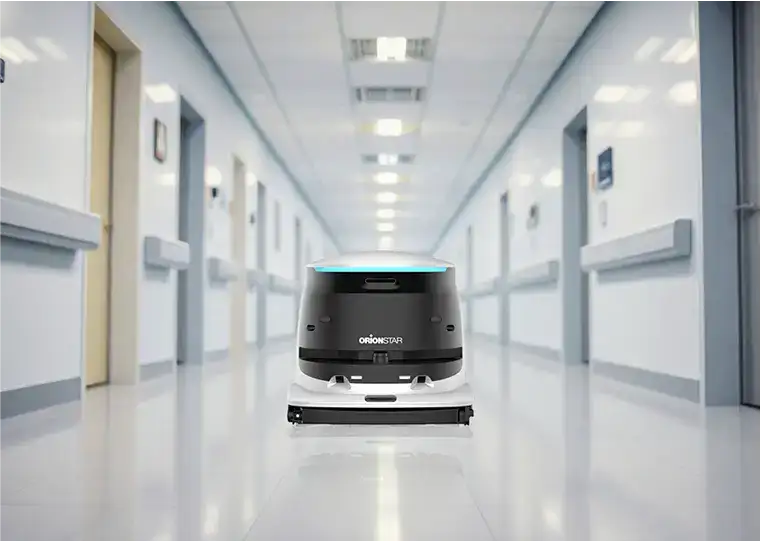
Healthcare services operating within any busy medical center face persistent environmental-care challenges, as cleaning staff are often stretched thin by repetitive tasks that lead to inconsistent service quality, rising operational costs, and labor shortages. Furthermore, manual cleaning protocols rely on checklists that can create gaps in the audit-ready documentation required by regulators and infection-prevention teams. To overcome these hurdles and optimize resources within tight budgets, facility managers are increasingly turning to commercial cleaning robots as a reliable, automated solution to maintain rigorous hygiene and compliance standards.
Demonstrating these automated capabilities in a practical context, the OrionStar CleaniBot C5 functions as a heavy-duty autonomous scrubber that translates advanced navigation and fluid management into tangible environmental care. Utilizing smart obstacle-avoidance sensors and autonomous path planning, the robot can map an area of up to 10,000 square meters, according to manufacturer data. Furthermore, it exemplifies automated maintenance through its docking station features, which support automatic clean-water refilling and waste-water discharge, enabling continuous operation while keeping noise levels below 68 dB(A) to prevent excessive disturbance in active clinical settings.
Note: Cost savings and ROI estimates are for illustrative purposes; actual results depend on local labor rates, facility size, and usage.
The main entrances of a medical center handle the highest volume of daily foot traffic, leading to the rapid accumulation of dirt and environmental contaminants. Commercial cleaning robots manage these expansive areas by executing scheduled, high-capacity scrubbing cycles, ensuring a consistently pristine first impression without interrupting incoming visitor flow.
Hallways are often partially obstructed by medical carts, wheelchairs, and frequent pedestrian movement, making manual floor care highly disruptive. Equipped with smart obstacle avoidance, autonomous cleaners safely navigate these dynamic bottlenecks to maintain floor hygiene without halting the critical transport of staff and resources.
These tightly spaced zones require frequent, consistent cleaning to maintain environmental hygiene among waiting visitors and patients. Automated robots can maneuver through confined seating layouts to perform quiet, targeted dust-mopping and scrubbing, maintaining a safe environment without causing excessive noise disturbance.
Maintaining strict hygiene in narrow patient wards is challenging due to the need for minimal disruption to patient recovery and rest. Robots equipped with low-noise profiles and compact turning radiuses can operate efficiently near or within these areas, delivering rigorous cleaning while automatically logging data for infection-prevention compliance.
Commercial cleaning robots seamlessly integrate into broader smart-building ecosystems by connecting with building management systems (BMS), computerized maintenance management systems (CMMS), and IoT sensor networks. Through stable Wi-Fi or 4G connectivity, these units feed near real-time telemetry, routing data, and automated reports into cloud-based dashboards. This centralized connectivity allows facility managers to operate fleets across multiple hospital locations through a single interface, supporting predictive maintenance and the standardization of operating procedures across the entire network.
By combining environmental resource efficiency with rigorous compliance documentation, automation strongly reinforces the broader ESG commitments of modern healthcare institutions.
As operational and regulatory demands intensify, commercial cleaning robots are fundamentally changing the way healthcare services maintain the complex environment of a medical center. By bridging the gap between labor shortages and strict hygiene standards, these automated systems provide a data-driven approach to facility management and infection control. For organizations evaluating automated floor care, the OrionStar CleaniBot series offers multiple models designed to adapt to various spatial requirements and clinical scenarios, providing versatile options to support the modernization of environmental services.