

REQUEST DEMO
Robot CATALOG will be sent to your mailbox immediately after submission.
SUBMIT
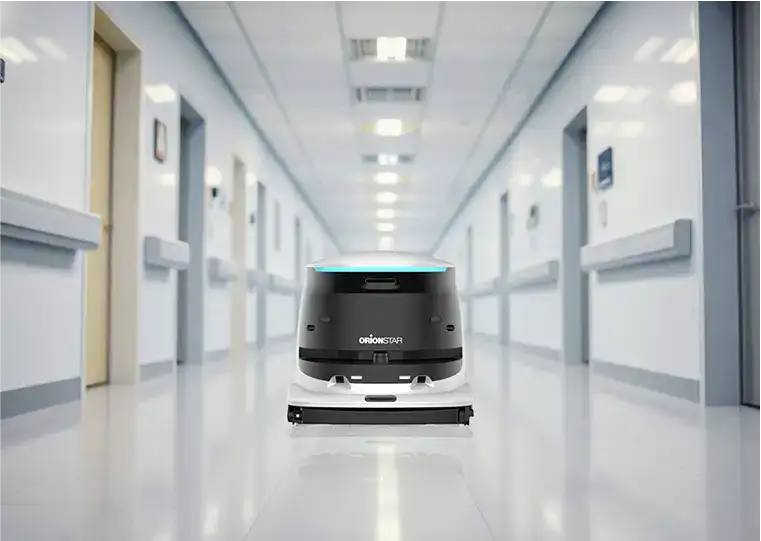
Healthcare services operating within the demanding environment of a medical center have reached a clear inflection point. The traditional approach to environmental maintenance is fracturing under simultaneous structural shifts. A widening labor shortage, rising operational costs, and elevated patient expectations for facility cleanliness are forcing healthcare operators to rethink their baseline strategies. Specifically, cleanliness is now a visible metric directly tied to public patient satisfaction scores. Meanwhile, automation technology has matured significantly, offering reliable navigation, practical operational durations, and highly accessible cost curves. Consequently, facility managers can no longer rely solely on expanding headcount to meet rigorous, round-the-clock infection control standards. Instead, commercial cleaning robots have emerged as a necessary, industry-level solution. These systems provide the operational consistency required by modern healthcare frameworks. Above all, they effectively bridge the gap between constrained budgets and relentless maintenance demands without compromising the safety of clinical environments.
Deepening Workforce Deficits: The American Hospital Association forecasts a shortage of roughly 100,000 critical healthcare workers in the United States by 2028. Consequently, environmental service teams must compete for the same highly limited labor pool as clinical staff.
Strained Operational Budgets: Custodial teams face a difficult friction point between rising wages, changing mandated benefits, and stagnant facility budgets. This dynamic forces operators into difficult trade-offs between the quantity and quality of nightly and weekend cleaning coverage.
Elevated Patient Scrutiny: Cleanliness is no longer a hidden, back-office concern for medical centers. The Centers for Medicare and Medicaid Services publicly reports cleanliness scores, directly tying visible facility hygiene to overall hospital performance and financial metrics.
High Clinical Stakes: According to data from the Centers for Disease Control and Prevention (CDC), approximately 1 in 31 U.S. hospital patients contracts a healthcare-associated infection on any given day. Furthermore, research suggests that improved environmental protocols can help mitigate the risk of these infections by up to 30 percent in specific settings.
These pressures collectively point to one conclusion: the traditional, fully manual operational model is fundamentally unsustainable.
The OrionStar CleaniBot series addresses these structural challenges by providing a differentiated, dual-model solution tailored to specific facility zones. Rather than offering a single universal machine, the series ensures distinct units handle distinct environments. The CleaniBot C5 is designed for heavy-duty, high-capacity maintenance across expansive logistical zones and main medical center corridors. According to manufacturer data, it features a combined 90-liter water tank system and can map areas up to 10,000 square meters. Therefore, it is well-suited for high-traffic zones that demand robust scrubbing pressure and extended operational cycles with minimal refilling.
Conversely, the CleaniBot S55 Pro operates effectively in more sensitive, patient-facing sub-spaces such as lobbies, waiting areas, and the peripheries of patient rooms. Based on manufacturer specifications, this model can operate at a low noise level of 45 decibels in dust mopping mode and navigates through a minimal passing width of 700 millimeters. Moreover, it transitions smoothly between sweeping, vacuuming, and mopping to address mixed floor types. The logic here is inherently complementary. The two models work together to ensure complete spatial coverage. The heavier C5 manages broad thoroughfares, while the S55 Pro quietly maintains complex, populated areas.
Furthermore, both systems integrate digital management capabilities to streamline facility operations. Healthcare operators can leverage Wi-Fi and 4G connectivity to handle remote deployment, schedule autonomous cleaning cycles, and generate verifiable data reports. Because these connected units process mapping data and utilize multi-sensor navigation cameras, operators must carefully evaluate data-protection protocols. In European markets, facility managers should verify with the vendor that cloud-based maintenance and environmental data processing meet GDPR and applicable local data-protection requirements, including any necessary data-processing agreements and retention policies.
Rapid Deployment and Consistency: Healthcare facilities can integrate automation rapidly, with installations often taking just a few hours without requiring custom building infrastructure. For example, a robotic deployment at a leading regional medical center averaged 2.5 hours of autonomous runtime per night, ensuring strict protocol adherence.
Optimized Shift Scheduling: Autonomous mobile robots enable medical centers to confidently shift floor maintenance from night shifts to daytime operations. This transition provides visible proof of cleaning to patients and staff without increasing the underlying labor costs.
Sustainable Resource Management: Robotic floor scrubbers inherently support facility ESG goals through controlled water and chemical dosing. By executing precise, repeatable coverage paths, these automated systems minimize resource waste and reduce redundant equipment movement across the facility.
These results are not theoretical; they represent a practical reality that facility managers and healthcare operators are already validating in the field.
The dominant operational model in healthcare robotics is strict collaboration, rather than workforce replacement. Automation systems are strategically deployed to handle large-area, physically repetitive floor maintenance tasks. Consequently, human staff can transition toward higher-value, critical responsibilities that require human judgment. By automating routine floor scrubbing, medical centers actively reallocate custodial resources to the detailed disinfection of high-touch surfaces, patient room turnovers, and direct facility support. The OrionStar CleaniBot series are designed for commercial environmental cleaning and do not substitute required medical-grade sterilization procedures.
Moreover, the introduction of these systems generates new professional roles within environmental services. Facility managers and frontline teams must now develop skills to oversee robot fleets, schedule autonomous cycles, and interpret digital cleaning reports. Data monitoring and quality supervision are rapidly becoming essential components of the daily healthcare workflow. Overall, staff attitudes remain favorable when automation is framed as a collaborative tool. It actively reduces the physical burden of demanding shift schedules, allowing human workers to focus their time where it matters most: supporting patient care and clinical hygiene.
As medical centers continue to adapt to systemic labor constraints, commercial cleaning robots are steadily transitioning from novel technological additions to essential facility infrastructure. The ability to guarantee consistent, measurable cleanliness is no longer optional for modern healthcare operators. The OrionStar CleaniBot series naturally supports this transition by offering multiple models designed to adapt to the specific spatial and operational demands of varying environments. Ultimately, the integration of autonomous floor-care systems reflects a broader maturation in facility management. Healthcare providers are learning to merge digital consistency with human adaptability. Moving forward, the baseline for environmental services will increasingly depend on this hybrid model, ensuring that complex medical spaces remain safe, compliant, and operationally stable around the clock.