

REQUEST DEMO
Robot CATALOG will be sent to your mailbox immediately after submission.
SUBMIT
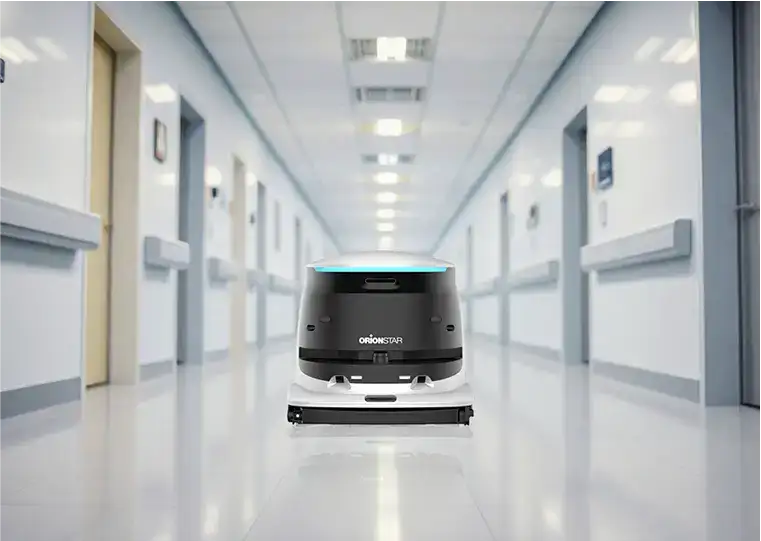
For hospital facility managers, environmental services managers, and infection control teams, floor maintenance is a complex balancing act. Facilities are under immense pressure to maintain stringent hygiene standards while navigating tightening budgets and labor constraints.
A 2025 study of hospital facilities in Lombardy, Italy, revealed that facility management costs surged by an average of 32.90% between 2019 and 2022, heavily driven by utilities and cleaning services. Simultaneously, the stakes for infection control remain critically high. Healthcare-associated infections account for approximately 100,000 deaths annually in the United States and 37,000 in Europe, with pathogens often surviving on insufficiently cleaned surfaces.
To address the tension between rising operational costs and the need for consistent cleaning, healthcare facilities are increasingly turning to commercial cleaning robots. This guide examines the OrionStar CleaniBot S55 Pro, exploring how its specifications and capabilities align with the real-world demands of hospitals.
The primary value of autonomous floor-cleaning equipment in hospitals is not to replace environmental services teams, but to standardize the time-consuming task of broad-area floor maintenance. By automating repetitive floor scrubbing and dust mopping, facility managers can redeploy human workers to higher-value, critical tasks, such as disinfecting high-touch surfaces in patient rooms and operating theaters.
Industry data from real deployments of commercial floor-cleaning robots demonstrates typical payback periods of 9 to 18 months for facilities with at least 50,000 square feet of hard flooring. In one healthcare-specific scenario, utilizing an autonomous scrubber yielded a net first-year savings of approximately USD 50,660 (Based on a sample facility analysis) after accounting for robot operating costs, with five-year cumulative net savings reaching roughly USD 211,000.
As part of the broader OrionStar CleaniBot series—which offers multiple models to suit various facility sizes and layouts—the CleaniBot S55 Pro is specifically engineered for large indoor environments, supporting routine facility cleaning through a combination of scrubbing, vacuuming, and mopping functions.
Hospitals are dynamic environments comprising distinct zones, each with unique cleaning requirements. The CleaniBot S55 Pro utilizes an InstantClean Floor Care System, allowing operators to switch between multiple modes without changing tools, adapting to the specific needs of different hospital sub-spaces.
These areas experience constant foot traffic, wheelchair movement, and spills, requiring frequent and robust cleaning.
In patient care areas, rest is a critical component of recovery. Standard floor cleaning equipment may generate noise levels that disrupt quiet zones.
Emergency departments require high maneuverability and strict safety protocols due to the rapid pace of staff and equipment.
Infection control teams and facility managers are moving away from manual paper logs, which limit transparency and quality control. Hospital cleaning processes are expected to become digitally traceable.
The CleaniBot S55 Pro supports Wi-Fi and 4G connectivity, enabling remote deployment, cloud-based maintenance monitoring, and automated data reporting. This allows facility managers to verify exactly when and where floors were cleaned, providing a reliable audit trail for hygiene management. Cloud services and data hosting comply with local data localization laws. User consent is required for optional data-sharing features.
Important Compliance Notice: Because the CleaniBot S55 Pro relies on LiDAR for map construction (supporting areas up to 10,000 m², depending on layout complexity), stereo cameras for environmental sensing, and utilizes cloud connectivity for data reporting and Over-The-Air (OTA) software updates, healthcare operators must exercise diligence. Healthcare operators are encouraged to work with their IT and legal teams to review the robot's data processing architecture to ensure compliance with the General Data Protection Regulation (GDPR) and other applicable local health data and privacy protection frameworks before deployment. The S55 Pro processes visual data locally without storing or transmitting personal identifiers, ensuring compliance with patient privacy regulations.
A commercial cleaning robot only yields a positive return on investment if it is easy for the existing staff to maintain. Older hospital infrastructure—such as the 60% of major Italian hospital buildings built before 1969—often lacks specialized service areas for heavy robotics.
The CleaniBot S55 Pro is designed with practical daily maintenance in mind. It features a removable wastewater tank that can be completely immersed in water for washing, helping to reduce odors and bacterial buildup. The low-curvature piping design allows staff to easily insert a brush to clear blockages, and cleaning tools are modular for quick removal. This user-friendly mechanical design reduces operational friction, ensuring the robot spends more time cleaning and less time being serviced.
No. The CleaniBot S55 Pro is designed to automate routine floor care workflows (sweeping, scrubbing, vacuuming, and mopping). While it supports a hygienic environment by removing physical soil and maintaining floor cleanliness, it does not replace targeted, hospital-grade manual disinfection of high-touch surfaces, patient beds, or surgical areas.
The robot operates autonomously using automatic path planning. It relies on a comprehensive omnidirectional sensor array that includes ultrasonic sensors for smart obstacle avoidance and a stereo camera for cliff and step detection. If an unexpected object or person moves into its path, the robot is designed to adjust its route safely.
Yes. The robot is equipped with line lasers designed to help it clean close to walls and corners. According to manufacturer specifications, it can be configured to maintain a wall distance of down to 5 cm (with a 10 cm default), maximizing floor coverage in long hallways.
The CleaniBot S55 Pro supports automatic recharging and comes equipped with a charging dock. When the battery (25.6 V / 40 Ah) runs low, the robot can autonomously navigate back to its station. A full charge typically takes less than 4 hours.