

REQUEST DEMO
Robot CATALOG will be sent to your mailbox immediately after submission.
SUBMIT
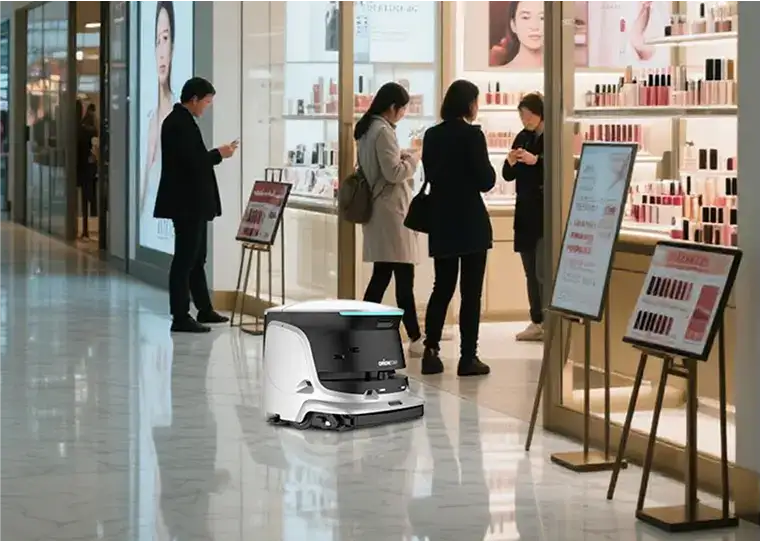
For retail facility managers and big-box store operators, maintaining cleanliness across tens of thousands of square feet presents a complex operational challenge. Heavy, unpredictable foot traffic, seasonal demand spikes, and severe labor shortages have stretched traditional in-house cleaning teams to their limits. As manual equipment struggles to keep pace with these expansive layouts, commercial cleaning robots have emerged as a necessary tool to stabilize service levels and control budget constraints.
This guide examines how autonomous floor-cleaning technology addresses the specific demands of large-format retail, using the OrionStar CleaniBot S55 Pro as a practical framework. As part of the broader OrionStar CleaniBot series—which offers multiple models to adapt to varying facility sizes and layouts—the S55 Pro is engineered to automate routine floor care across diverse commercial zones.
Industry research indicates that labor retention and budget constraints are the primary hurdles for facility managers today. When relying solely on manual labor, the sheer scale of a big-box store dictates a reactive cleaning model. High-traffic areas are prioritized, while secondary zones are often neglected.
Commercial cleaning robots alter this dynamic by handling repetitive, large-area floor maintenance. By automating these tasks, facility operators can reallocate their human workforce to high-value detail work, such as sanitizing high-touch surfaces, managing immediate spills, and maintaining restrooms. This shift not only improves overall store presentation but also reduces the physical strain on staff, supporting the social dimension of corporate ESG (Environmental, Social, and Governance) targets.
Big-box stores are not uniform environments. They consist of distinct micro-zones, each with different flooring types, traffic patterns, and cleaning requirements. The CleaniBot S55 Pro addresses this through an integrated system capable of sweeping, scrubbing, vacuuming, and dust mopping.
Here is how the robot's specifications align with typical big-box sub-spaces:
These are the highest-traffic zones in any retail environment, accumulating dirt, moisture, and debris continuously throughout the day.
These expansive areas require consistent, methodical cleaning that manual mopping simply cannot achieve efficiently.
These areas face heavy industrial use, handling pallet jacks, cardboard dust, and heavier soil levels.
Industry data highlights that autonomous cleaning programs succeed only when the machines are fully integrated into the daily scope of work and are easy for on-site staff to manage. If a robot is difficult to clean or requires complex tooling, utilization rates will drop.
The S55 Pro is designed for practical daily maintenance. It features a removable 15 L wastewater tank with a washable design and strainer, allowing staff to easily rinse out debris and prevent bacterial buildup. Cleaning modes can be switched via a touch screen without requiring manual tool changes, and the physical cleaning modules are designed for quick, tool-free removal. This reduces the friction of daily maintenance, ensuring the robot spends more time on the floor and less time in the janitorial closet.
Modern retail facility management requires data-driven oversight. To ensure fleet utilization remains high, operators need visibility into cleaning performance. The S55 Pro supports Wi-Fi and 4G connectivity, enabling remote deployment, cloud-based performance reporting, and Over-The-Air (OTA) updates. This data can also support ESG reporting by providing verifiable metrics on automated operations.
Important Legal and Compliance Notice: Because the S55 Pro utilizes LiDAR for spatial mapping, stereo cameras for navigation, and cloud connectivity for performance tracking, facility operators must exercise due diligence regarding data privacy. Operators must verify that all data collection, cloud processing, and OTA update mechanisms comply with the GDPR and applicable local data protection regulations, particularly concerning how mapping data and operational metrics are stored and transmitted.
The robot can map contiguous spaces up to 10,000 m². Because big-box retail footprints frequently exceed 100,000 square feet (approx. 9,290 m²), a single robot can manage the space if zoned properly. However, for massive hypermarkets, a multi-robot fleet utilizing different models from the OrionStar CleaniBot series may be required to ensure daily coverage of all zones.
The S55 Pro relies on real-time map updating and dynamic obstacle avoidance. Using its LiDAR and ultrasonic sensors, it detects new physical objects (like an unexpected pallet of bulk goods) that were not present during the initial mapping, navigating around them safely rather than stopping or causing a collision.
The S55 Pro supports automatic recharging; it will independently return to its designated charging dock when the 25.6 V / 40 Ah battery requires power (a full charge takes less than 4 hours). However, the 22 L clean water and 15 L wastewater tanks require manual emptying and refilling by the facility staff, making daily scheduled maintenance essential to the workflow.