

REQUEST DEMO
Robot CATALOG will be sent to your mailbox immediately after submission.
SUBMIT
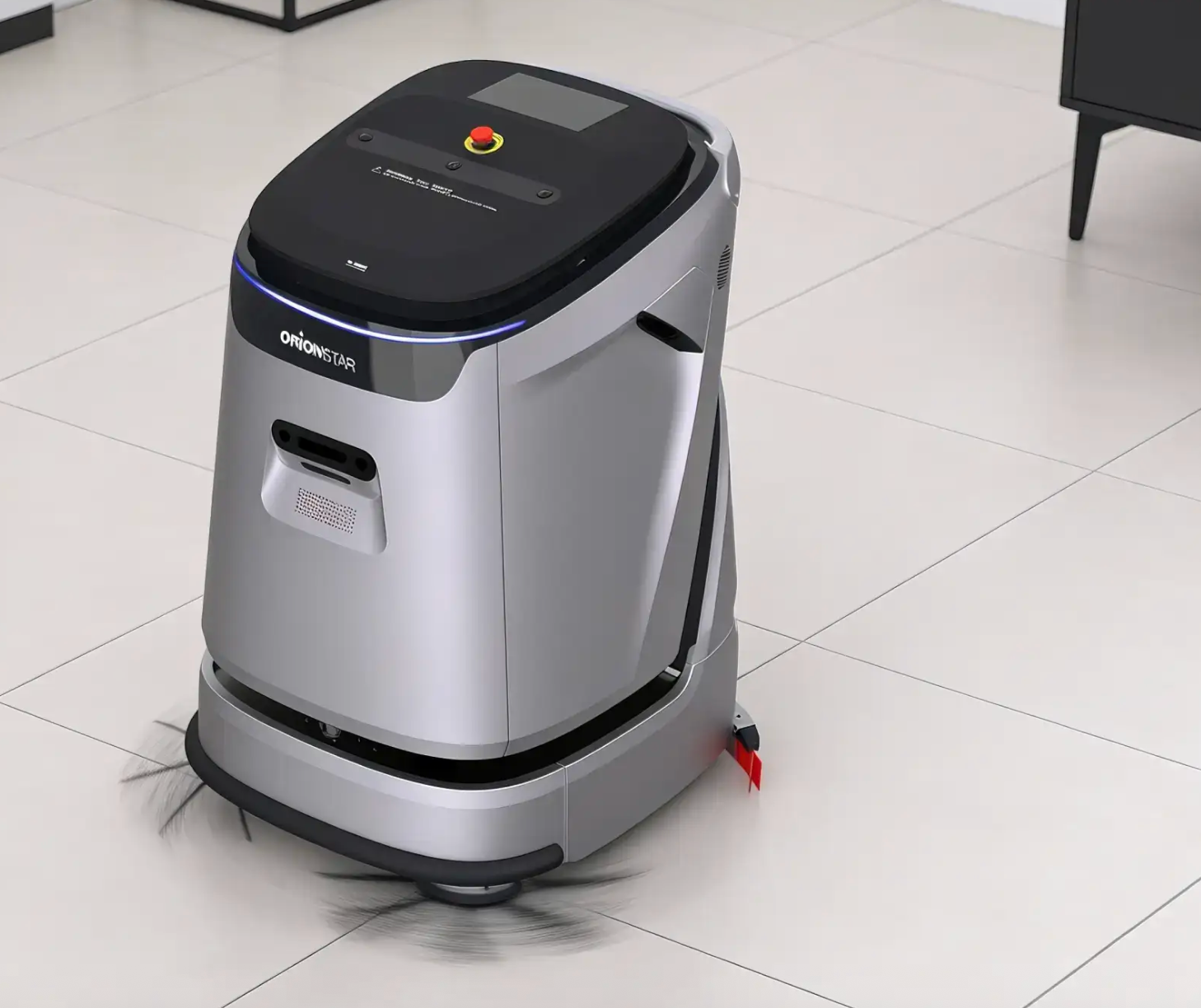
Retail Facility Management in a big-box store requires navigating immense square footage, volatile daily foot traffic, and stringent health standards, all while facing persistent labor shortages, tightening budgets, and complex compliance obligations. As traditional, manual upkeep struggles to meet these compounding operational demands, commercial cleaning robots have emerged as a scalable solution to optimize resource allocation, maintain consistent safety standards, and reduce the heavy reliance on shrinking labor pools.
The OrionStar CleaniBot C5 illustrates how these automated capabilities function in a high-demand commercial environment. According to manufacturer data, the unit is equipped to map areas of up to 10,000 square meters, utilizing smart obstacle-avoidance systems to navigate safely around retail personnel and inventory equipment. To support continuous operations without extensive human oversight, the robot relies on an automated docking workstation that handles clean-water refilling and waste-water discharge, alongside a combined 90-liter water tank system designed to reduce refilling downtime.
These long, expansive corridors require frequent scrubbing to remove dust and spills caused by heavy forklift traffic and high product turnover. Commercial cleaning robots use autonomous path planning to systematically cover these lengthy stretches, applying consistent pressure to remove grime without interrupting the flow of inventory management.
Loading docks face constant exposure to outdoor elements, industrial debris, and heavy machinery, making manual upkeep labor-intensive and hazardous. Automated scrubbers equipped with robust obstacle avoidance can navigate safely around pallets and transport vehicles, utilizing high-capacity systems to efficiently wash away dirt accumulated from delivery trucks.
Entrances endure the highest volume of foot traffic, accumulating moisture, mud, and debris that pose immediate slip-and-fall risks to incoming shoppers. Deploying autonomous machines for targeted, high-frequency water absorption and sweeping in these zones maintains a safe, clean first impression during unpredictable weather or seasonal traffic spikes.
Sections dedicated to bulk items often suffer from large accidental spills and fine particulate dust from damaged packaging. Robots featuring dual scrubbing and debris-handling capabilities can swiftly address these areas, capturing larger dry waste while simultaneously mopping the floor to maintain rigorous safety and hygiene standards.
To maximize utility, commercial cleaning robots are increasingly integrated into broader facility management and smart-building ecosystems rather than operating as isolated units. Through IoT-enabled fleet management applications, performance data, machine locations, and daily summaries are centralized, allowing retail facility managers to align robotic routes with store layouts and overall staffing plans. While direct integration into broader Building Management Systems (BMS) or Computerized Maintenance Management Systems (CMMS) is still evolving in big-box retail, the market trajectory indicates that autonomous scrubbers function best when their data feeds into centralized digital compliance platforms, streamlining health, safety, and operational reporting.
By providing transparent, automated data governance and minimizing resource waste, commercial cleaning robots act as a strategic enabler for retailers striving to meet rigorous sustainability commitments.
Commercial cleaning robots are fundamentally changing the way Retail Facility Management maintains a big-box store, shifting operations from reactive, labor-intensive routines to proactive, data-driven maintenance. By addressing workforce shortages and stringent budget constraints, these automated systems provide a scalable approach to facility upkeep and environmental compliance. For operators evaluating automated solutions, product lines such as the OrionStar CleaniBot series offer various models to accommodate the distinct spatial and operational demands of modern retail environments.