

REQUEST DEMO
Robot CATALOG will be sent to your mailbox immediately after submission.
SUBMIT
Retail facility management within the supermarket chain sector has reached a critical inflection point. Therefore, operators are fundamentally rethinking how they maintain store environments. The timing of this shift is driven by a stark economic reality. European grocery profit margins remain structurally thin, averaging just 2.8%, while labor costs inflate rapidly. At the same time, consumer expectations for visible, continuous cleanliness have permanently elevated. Traditional manual sweeping and mopping can no longer bridge the gap between tight budgets and pristine floors. Instead, autonomous technology has matured enough to handle complex public environments safely and consistently. As a result, commercial cleaning robots have emerged as a vital industry-level solution. They provide the scale, reliability, and cost predictability required to keep stores operating smoothly. Above all, they allow facility teams to balance strict economic constraints with the exceptionally high hygiene standards that modern shoppers consistently demand.
These pressures collectively point to a shared conclusion—traditional models are unsustainable.
The OrionStar CleaniBot series offers a dual-model differentiated approach to thoroughly handle the diverse spaces inside a modern store. Rather than asking which machine is superior, successful operators use them complementarily to cover distinctly different scenarios.
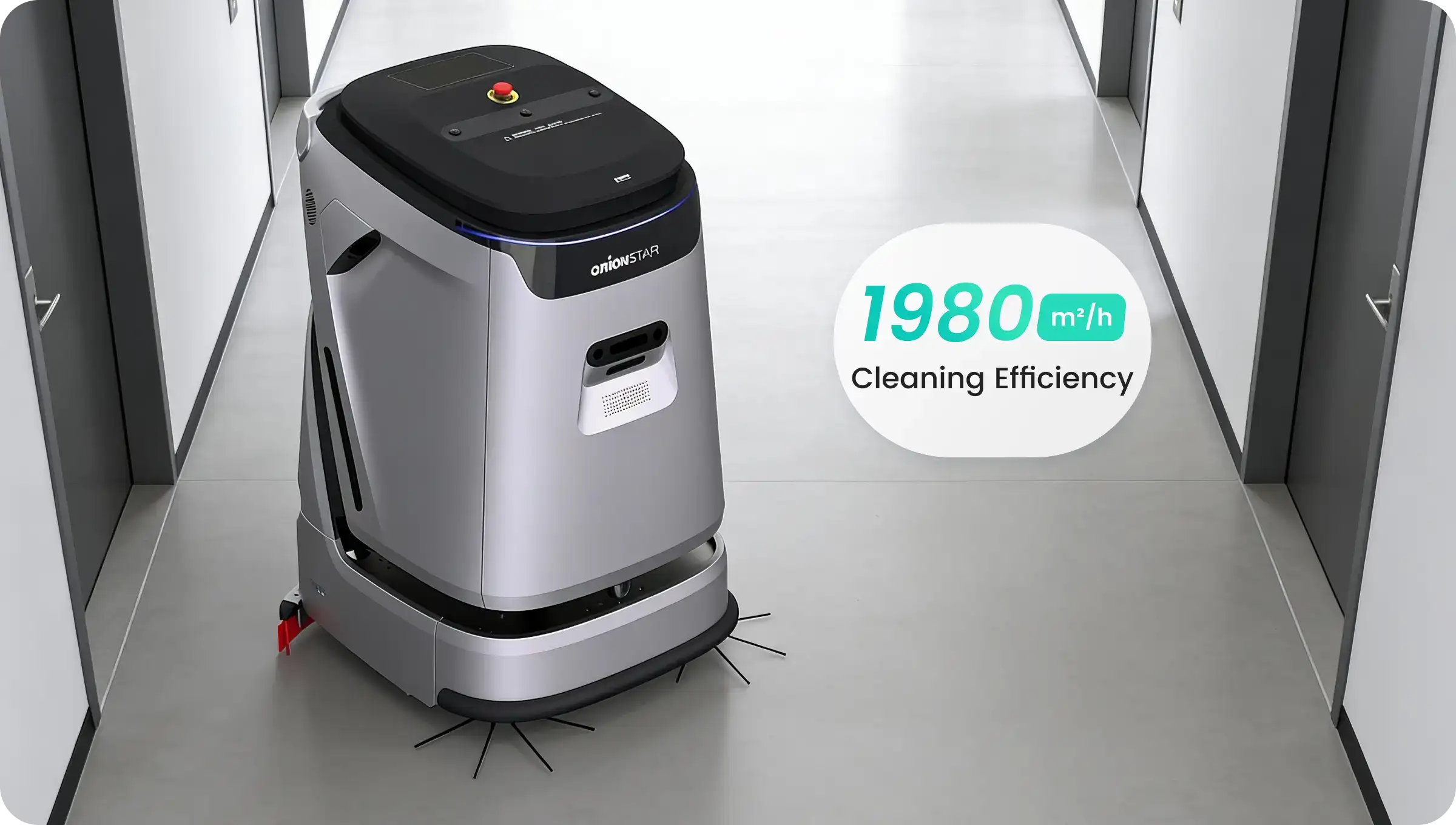
The CleaniBot C5 is built specifically for heavy-duty tasks in demanding zones. It excels in back-of-house corridors, receiving docks, and deli and bakery sections where heavy oil and grime frequently accumulate. According to manufacturer data, it delivers a robust cleaning efficiency of up to 1,980 square meters per hour under standard testing conditions. Furthermore, according to manufacturer data, its massive combined 90-liter water tank capacity minimizes manual refilling during long operational shifts.
In contrast, the CleaniBot S55 Pro is carefully designed for sensitive, customer-facing areas. It seamlessly navigates active sales floors, fresh produce aisles, and busy checkout and entrance areas. According to manufacturer data, it operates with a minimum passing width of 700 millimeters under standard testing conditions, easily gliding through tight retail aisles. Moreover, its low noise profile of 45 to 55 decibels, depending on operating mode and environment, ensures that daytime cleaning operations do not disturb shoppers.
Together, these machines divide and conquer the facility layout. The C5 manages the industrial-grade messes out of sight, while the S55 Pro maintains pristine front-of-house presentation. Both models strongly support advanced digital management capabilities. Facility teams can utilize remote deployment, access cloud-based platforms, and generate detailed data reports to verify daily cleaning coverage. Because these connected devices utilize various sensors, cameras, and cloud processing for navigation, operators must independently verify GDPR compliance for their specific store networks. In short, this fleet approach ensures every retail zone receives targeted, optimized care.
These results are not theoretical; they are realities that retail facility managers are already verifying.
Automation does not replace retail staff; instead, it distinctly elevates their daily roles. Grocery cleaning has historically involved immense physical strain and high turnover rates. By introducing commercial cleaning robots, stores transfer the most repetitive, physically demanding floor-scrubbing tasks to machines. Consequently, human workers can safely transition away from monotonous manual labor. They shift their focus toward high-value work that directly impacts the shopper experience. Staff members now handle localized quality control, targeted cleaning of high-touch surfaces, and proactive customer service on the sales floor. Moreover, this technological shift creates entirely new skill requirements within the facility. Cleaners are becoming fleet managers, responsible for routing optimization, sensor maintenance, and digital performance tracking. As a result, retail facility management becomes a more attractive, technically oriented career path. In short, automation solves the immediate labor shortage by making the existing workforce far more productive.
Commercial cleaning robots are rapidly becoming foundational infrastructure for retail facility management. The era of treating automated floor care as an experimental pilot project has ended. As supermarket chains continue to face tight margins and high labor costs, robotic integration will simply become the baseline standard for operational survival. The OrionStar CleaniBot series provides multiple models to effectively adapt to these varying spatial requirements. By matching specific machines to specific retail zones, operators can achieve consistent cleanliness across their entire footprint. Ultimately, the successful supermarket of the future will rely on this seamless integration of human oversight and robotic execution. Therefore, embracing this technological transition is critical for maintaining profitable, hygienic, and welcoming retail environments in the years ahead.