

REQUEST DEMO
Robot CATALOG will be sent to your mailbox immediately after submission.
SUBMIT
For retail facility managers and supermarket chain operators, maintaining floor cleanliness is a fundamental operational requirement that is becoming increasingly difficult to resource. Across global markets, operators are caught between rising customer expectations and structural labor challenges.
This guide evaluates the application of commercial cleaning robots in grocery environments, using the OrionStar CleaniBot S55 Pro as a primary reference to help decision-makers determine if autonomous floor care aligns with their operational needs.
Supermarket facility management currently operates under intense financial and logistical pressure. Industry data indicates that European grocery retailers face structurally thin profit margins, averaging just 2.8% for 2024 and 2025. Simultaneously, labor cost inflation across Europe reached an average of 5.1% in 2025, with 52% of retailers reporting severe recruitment challenges. In the United States, training a single new employee costs an average of $1,252, and 71% of facility managers cite improving labor productivity as a top priority.
Despite these labor constraints, hygiene standards cannot be compromised. Research indicates that 85% of consumers consider visible cleaning critically important to their shopping experience. Furthermore, the rapid growth of in-store foodservice segments—expanding at a 6.8% compound annual growth rate—has elevated the risk of spills and the need for rigorous sanitation.
Commercial cleaning robots offer a measurable response to these compounding challenges. By transferring repetitive floor scrubbing and sweeping to autonomous systems, retailers can reallocate human labor to higher-value, customer-facing tasks. Industry deployment data demonstrates the viability of this approach. One national grocery chain in the U.S. reported annual savings exceeding $2 million and a 21% reduction in cleaning costs after scaling a robotic program across hundreds of stores. For a typical 50,000-square-foot facility, market estimates suggest that shifting to autonomous daily floor cleaning can yield annual labor cost savings ranging from $120,000 to $180,000, with payback periods typically between 2.4 and 3.8 years.
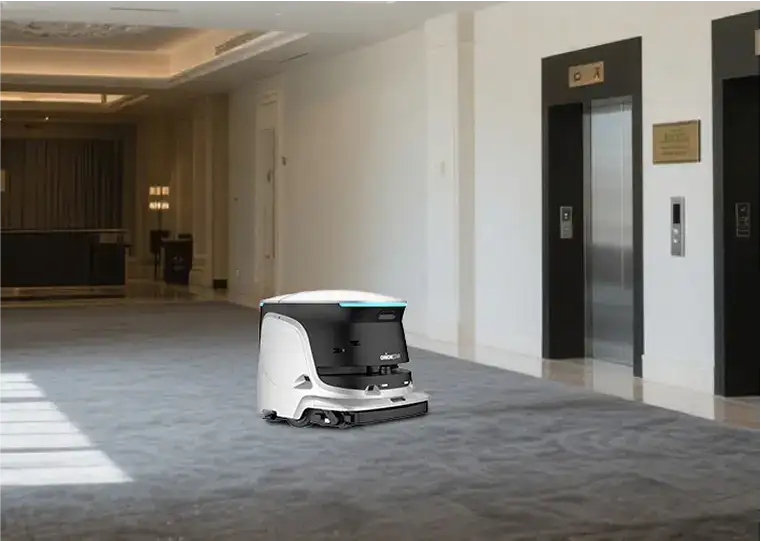
The OrionStar CleaniBot S55 Pro is an autonomous commercial floor-cleaning robot designed to handle sweeping, scrubbing, vacuuming, and mopping in large indoor environments. For retail operators, assessing a robot requires looking beyond baseline specifications to see how the unit navigates specific store zones.
While the S55 Pro is designed for mid-to-large environments, it is worth noting that the broader OrionStar CleaniBot series provides multiple models to accommodate varying retail footprints, from convenience formats to hypermarkets.
The primary sales floor and checkout areas require consistent maintenance, but cleaning during operating hours risks disrupting the customer experience. The CleaniBot S55 Pro addresses this through multiple low-noise operational modes. According to manufacturer data, the unit operates at 55 dB in standard scrubbing mode and down to 45 dB in dust mopping mode.
For large open areas, the robot is equipped with a LiDAR sensor capable of mapping spaces up to 10,000 m². In ECO Vacuum mode, the robot can achieve up to 19.5 hours of runtime, and up to 28 hours in Dust Mop mode, allowing it to provide continuous dust control near busy entrances and checkout aisles without requiring midday recharges. Operating at a maximum cleaning efficiency of up to 1,368 m²/h under these dry modes, it can cover extensive sales floors efficiently.
Areas handling fresh food and prepared meals are prone to heavy foot traffic, organic debris, and liquid spills. These zones require more aggressive cleaning than standard aisles. Operators can program the CleaniBot S55 Pro to switch automatically to Power Scrubbing mode when entering these specific zones.
In Power Scrubbing mode, the robot applies higher mechanical effort to remove heavier soils, supported by a 22 L clean water tank and a 15 L wastewater tank. While runtime drops to 3.5 hours in this intensive mode, the cleaning efficiency of up to 1,197 m²/h is generally sufficient to maintain these specific high-risk zones during a scheduled shift. The unit is also equipped with line lasers that assist in cleaning up to 5 cm away from walls and display cases, ensuring that debris accumulating under produce bins is actively managed.
Back-of-house areas are often narrow, congested with inventory pallets, and heavily trafficked by staff. The physical dimensions of the cleaning equipment are critical here. The CleaniBot S55 Pro features a compact footprint of 650 × 580 × 550 mm and requires a minimum passing width of 700 mm. Combined with a multi-sensor system—including ultrasonic sensors for smart obstacle avoidance and stereo cameras for step detection—the robot can navigate cluttered storage corridors safely without requiring staff to move stock out of the way constantly.
Integrating robotics into retail facility management also supports broader corporate objectives regarding sustainability and risk management.
From an environmental perspective, autonomous scrubbers typically utilize water and chemicals much more efficiently than traditional mop-and-bucket methods. Industry data notes that robotic cleaning machines can enable up to 85% reductions in water usage and up to 66% reductions in chemical consumption. Socially, deploying robots for heavy floor scrubbing reduces physical strain on retail staff. Janitorial services face a nonfatal injury rate 29% higher than the private industry average; automating these tasks mitigates ergonomic risks.
Data Privacy and GDPR Compliance Because the CleaniBot S55 Pro utilizes stereo cameras, LiDAR for real-time map updates, and Wi-Fi/4G network connectivity for cloud-based maintenance and Over-The-Air (OTA) updates, data governance is a mandatory operational step. Supermarket chains deploying this technology in Europe must ensure their implementation complies with GDPR. Facility managers and IT departments must independently verify that navigation data is processed locally where possible, that no personally identifiable information (such as customer facial video) is stored or uploaded, and that fleet management data protocols align with local data protection regulations.
A common failure point in retail robotics is complex daily maintenance. If a robot takes too long to clean at the end of a shift, the labor savings are negated.
The CleaniBot S55 Pro is designed to minimize this operational friction. It features modular cleaning tools that allow staff to swap brushes without specialized equipment. The 15 L wastewater tank is entirely removable and features a washable strainer design that can be fully immersed in water, which helps staff prevent odor and bacterial buildup—a crucial factor in food retail environments. Additionally, the internal piping utilizes a low-curvature design, enabling easy insertion of a brush to clear blockages if the machine vacuums up larger debris (it can handle garbage up to 3 cm in height).
Can the robot operate while the supermarket is open to customers? Yes. The robot features 360-degree sensor coverage (including ultrasonic and LiDAR) to avoid moving shoppers and shopping carts. Furthermore, its noise output (45 dB to 55 dB depending on the mode) is low enough to operate without disrupting the retail environment.
How does the robot handle different floor types, such as transitioning from polished concrete to entrance mats? The robot supports zone-based mode switching. Facility managers can configure the digital map so the robot automatically switches from scrubbing on hard floors to a sweep-and-vacuum mode when it approaches low-pile entrance carpets.
Does the robot require manual charging? No, the CleaniBot S55 Pro supports auto-recharge. It is equipped with a charging dock and will return to its station when the battery is low. A full charge from depletion takes less than 4 hours.
What happens if a customer drops an item directly in the robot's path? The ultrasonic sensors and stereo cameras are designed to detect sudden obstacles and steps. The robot will alter its route to avoid the object. Additionally, an emergency stop button is equipped on the device for immediate manual override if ever required by staff.