

REQUEST DEMO
Robot CATALOG will be sent to your mailbox immediately after submission.
SUBMIT
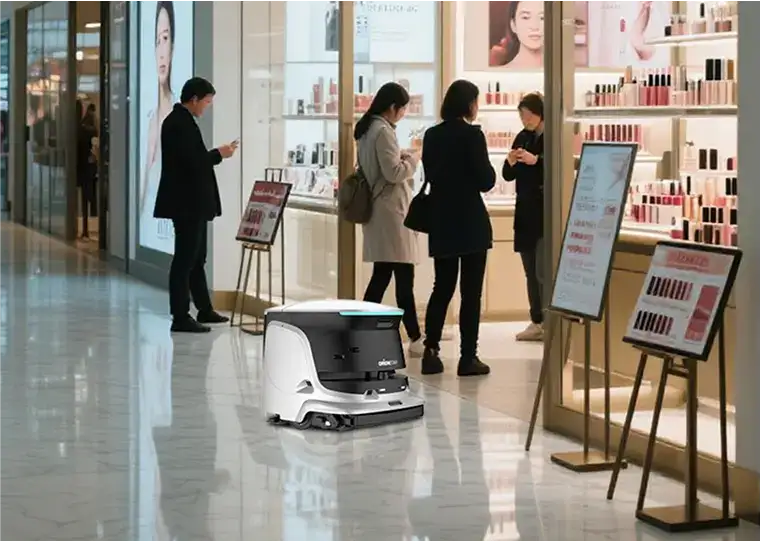
Large-format grocery and hypermarket retail operations are currently navigating severe structural constraints. Facility managers are squeezed between rising customer expectations for cleanliness and persistent operational margin pressures. With European grocery retailers reporting average profit margins of just 2.8% against labor cost inflation of 5.1%, traditional labor-intensive floor maintenance is becoming financially unsustainable.
Furthermore, the commercial cleaning sector is experiencing workforce turnover rates frequently exceeding 200%. For hypermarket operators, this means constant recruitment, training, and scheduling gaps. As prepared-food areas within these stores grow—increasing at a compound annual rate of 6.8%—the necessity for pristine environments throughout operating hours has never been higher.
To bridge the gap between required cleaning frequencies and available staff, commercial cleaning robots are transitioning from experimental pilot programs to standard operational assets. By automating repetitive floor care, operators can reallocate constrained human labor to high-touch surfaces, detail cleaning, and customer service. Industry data indicates that automated fleets can deliver up to a 21% reduction in overall cleaning and maintenance costs.
This guide evaluates how the OrionStar CleaniBot S55 Pro addresses specific hypermarket cleaning requirements based on its technical capabilities and operational design.
Hypermarkets are complex environments with distinct floor care requirements depending on the zone. The CleaniBot S55 Pro features an InstantClean Floor Care System that consolidates sweeping, scrubbing, vacuuming, and mopping into a single platform, allowing operators to match the cleaning mode to the specific retail sub-space.
Main retail aisles and checkout lanes require consistent daytime appearance but are highly trafficked by shoppers and shopping carts. Disruptive noise and large equipment footprint are major concerns.
The CleaniBot S55 Pro supports an ECO Vacuum mode (yielding runtimes up to 19.5 hours) and a Dust Mop mode (up to 28 hours), operating at noise levels as low as 45 dB during mopping. This enables continuous daytime dust control without disrupting the shopping experience. For after-hours deep cleaning, the robot uses LiDAR navigation to map areas up to 10,000 square meters. Its compact body dimensions and 700 mm minimum passing width allow it to navigate efficiently through narrow checkout lanes and promotional display areas.
Bakery, produce, and meat sections demand stringent hygiene and immediate response to localized soil or spills. These areas require active floor washing rather than just sweeping.
In these zones, operators can utilize the robot's Scrubbing and Power Scrubbing modes, which achieve cleaning efficiencies of up to 1,197 m²/h under defined test conditions. The system relies on a 22 L clean water tank and a 15 L wastewater tank. To manage the hygienic requirements of fresh food zones, the robot's wastewater tank is fully removable and immersible for washing, featuring a strainer design that helps facility staff mitigate odor and bacterial buildup during routine daily maintenance.
Back-of-house spaces present a different set of challenges, characterized by mixed debris, dynamic obstacles like pallets or forklifts, and concrete flooring.
Using the Sweep & Vacuum mode, the robot can handle solid garbage up to 3 cm in height, achieving area coverage of up to 1,368 m²/h. Navigating a busy stockroom requires robust safety systems; the CleaniBot S55 Pro utilizes an array of sensors—including stereo cameras for step detection and ultrasonic sensors for obstacle avoidance—to maintain safe operation around inventory and staff. Additionally, line lasers assist the robot in cleaning close to racks and walls, with a default setting of 10 cm to maximize floor coverage without damaging shelving.
Transitioning to automated floor care yields measurable productivity gains. Industry surveys indicate that facilities adopting data-driven cleaning standards can achieve nearly 23% greater daytime productivity.
The CleaniBot S55 Pro integrates into facility ecosystems via Wi-Fi and 4G connectivity, enabling remote deployment, cloud-based maintenance scheduling, and operational data reporting. Facility managers can track route completion and machine utilization, using this verifiable data to refine staffing schedules and support corporate ESG (Environmental, Social, and Governance) reporting. Automated scrubbing also inherently supports sustainability initiatives by regulating and standardizing water and chemical consumption compared to manual mopping.
Compliance Note: Because the robot utilizes LiDAR mapping, stereo cameras, and network connectivity for reporting and OTA (Over-The-Air) updates, hypermarket operators must independently verify compliance with the GDPR and applicable local data protection regulations regarding the collection and processing of spatial or sensor data in public retail environments.
A common failure point in retail robotics is complex maintenance that frustrates high-turnover custodial staff. The CleaniBot S55 Pro is engineered for straightforward daily upkeep. It features modular cleaning tools that can be swapped quickly and low-curvature piping that allows staff to easily clear blockages. Furthermore, no-tool mode switching reduces operational friction when transitioning the machine from a warehouse sweeping task to a front-of-house quiet mopping route.
For operators managing portfolios of varying store formats—from massive supercenters to smaller urban grocery formats—the broader OrionStar CleaniBot series provides multiple robotic models designed to adapt to different square footages and layout complexities, allowing facility managers to standardize their digital cleaning operations across an entire retail network.