

REQUEST DEMO
Robot CATALOG will be sent to your mailbox immediately after submission.
SUBMIT
The Retail Facility Management sector is currently operating under intense margin pressure, with hypermarket environments facing significant challenges related to skyrocketing labor costs, workforce shortages, and increasingly strict compliance standards. With European retail profit margins tightening and cleaning industry turnover frequently exceeding 200%, operators are struggling to maintain the pristine conditions modern consumers demand while keeping operational costs in check. To bridge the gap between escalating facility expectations and shrinking labor availability, commercial cleaning robots have emerged as a practical, scalable solution to automate essential floor care and streamline overall maintenance workflows.
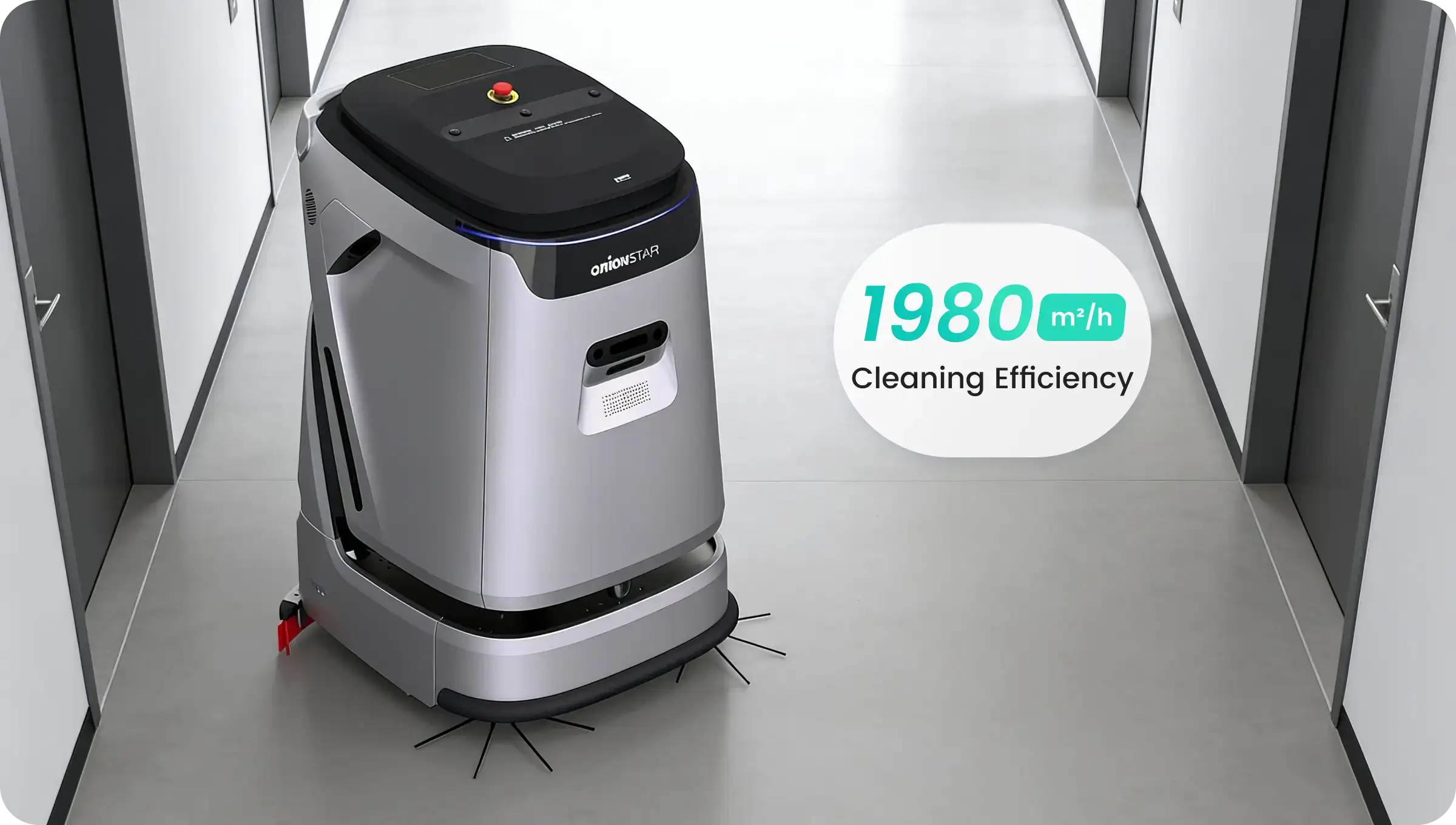
The OrionStar CleaniBot C5 demonstrates these autonomous capabilities by utilizing a smart obstacle-avoidance system to safely navigate public spaces while maintaining a noise level of less than 68 dB(A), according to manufacturer data. It leverages autonomous path planning to map areas of up to 10,000 square meters, streamlining floor care across expansive retail footprints. Furthermore, the unit reflects the shift toward self-managing fleets through its automatic docking station, which handles clean-water refilling, waste-water discharge, and self-cleaning, supporting continuous operation with a maximum cleaning area capacity of up to 1,980 square meters per hour.
The high foot traffic in main retail aisles leads to constant dirt accumulation and scuff marks that require frequent, extensive scrubbing. Commercial cleaning robots efficiently cover these long stretches using autonomous path planning to navigate around moving shoppers and promotional displays. This ensures a consistently clean appearance throughout the day without interrupting the customer shopping experience.
Areas handling fresh produce, seafood, and prepared foods demand stringent hygiene standards and are prone to liquid spills. Cleaning robots equipped with heavy-duty scrubbing and water absorption capabilities quickly remove organic matter and grime. Their consistent operation helps maintain the pristine environment necessary for food safety and high customer satisfaction.
Checkout lanes represent highly congested bottlenecks where debris easily accumulates from shopping carts and waiting customers. Autonomous floor scrubbers utilize smart obstacle avoidance and precise maneuverability to navigate the narrow passing widths between registers. By automating floor care in these zones during off-peak hours, facility managers ensure a spotless final touchpoint for shoppers.
Back-of-house storage and receiving docks are characterized by heavy industrial use, pallet movement, and stubborn dirt, complicating routine maintenance. Industrial-grade cleaning robots manage these rough environments by applying high downward scrubbing pressure to lift heavy grime and oil stains. The automation of this demanding task frees maintenance personnel to focus on more complex facility upkeep.
Commercial cleaning robots are increasingly treated as integral nodes within a hypermarket's broader smart-building ecosystem rather than operating as standalone machines. By connecting via Wi-Fi and 4G, these robots seamlessly integrate with existing building management systems (BMS) and IoT infrastructure, allowing facility managers to align robotic routes with real-time occupancy and traffic patterns. Furthermore, integrating these platforms with facility-management software and IoT sensors—which monitor product usage and detect leaks—enables operators to dynamically adjust cleaning schedules and refine overall maintenance strategies based on precise operational data.
Commercial cleaning robots are fundamentally changing the way the Retail Facility Management industry approaches the daily maintenance of hypermarket environments. By addressing structural labor shortages and rising operational costs, these automated solutions deliver consistent cleanliness, generate actionable data, and support broader facility integration. The OrionStar CleaniBot series provides multiple models designed to adapt to varying spatial requirements and floor care challenges, offering retail operators a range of technical options to explore as they modernize their facility management strategies.