

REQUEST DEMO
Robot CATALOG will be sent to your mailbox immediately after submission.
SUBMIT
Retail Facility Management in a shopping center faces a uniquely demanding set of challenges, including relentless foot traffic, escalating labor costs, and the strict necessity of maintaining health and safety compliance in venues that remain open to the public for extended hours. Because traditional manual cleaning struggles to keep pace without disrupting daily retail activities, commercial cleaning robots have emerged as a highly effective solution. By combining autonomous operation with consistent sanitation performance, these machines allow operators to maintain pristine, safe environments efficiently and cost-effectively.
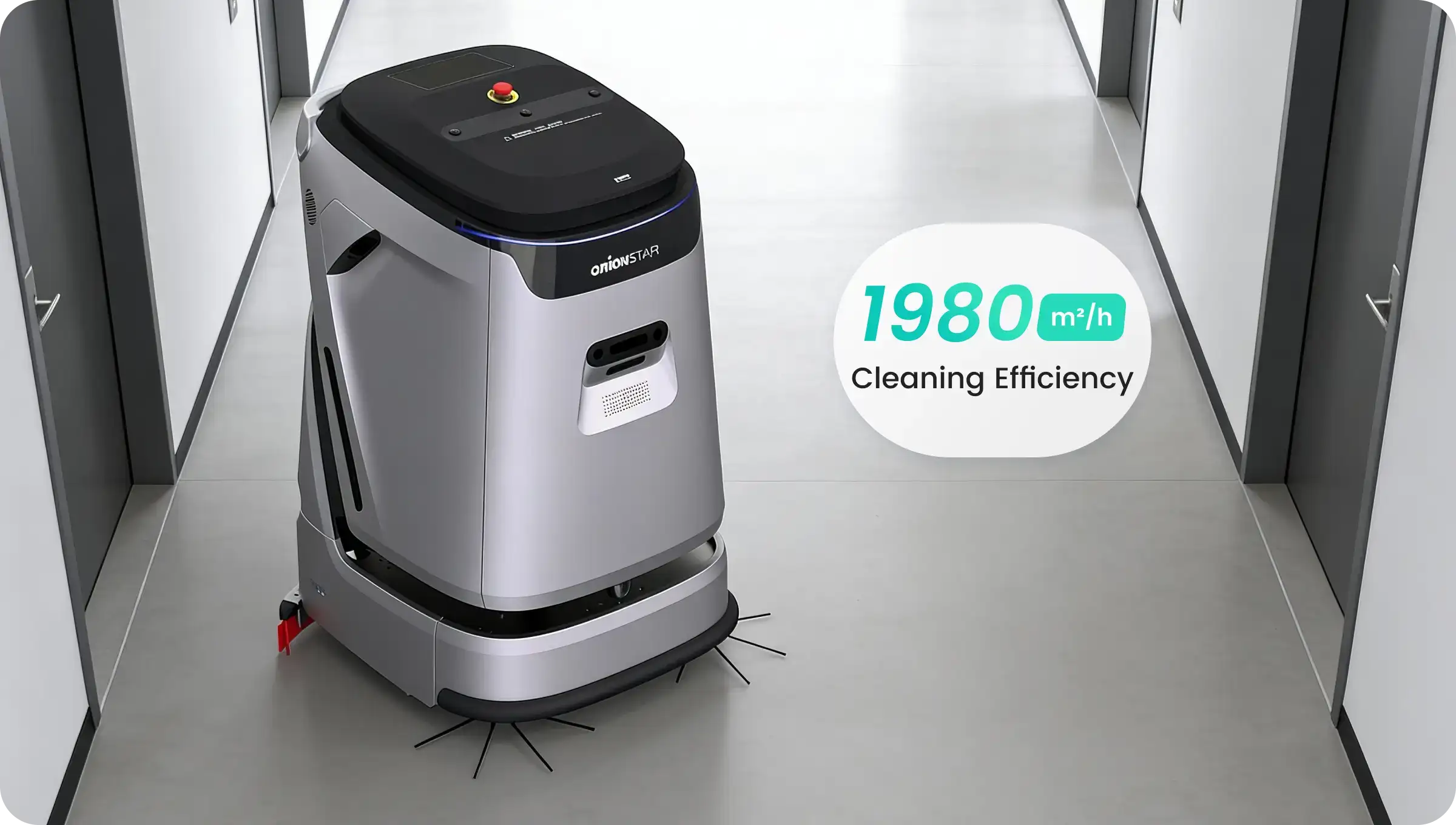
The OrionStar CleaniBot C5 illustrates these advanced capabilities by combining autonomous navigation with heavy-duty maintenance functions tailored for expansive retail environments. Utilizing precise mapping algorithms for areas of up to 10,000 square meters, the machine follows optimized paths while applying approximately 25 kilograms of downward scrubbing pressure to remove stubborn grime from heavily trafficked floors. Furthermore, it supports autonomous multi-shift operation through an intelligent docking station that manages clean water refilling and waste drainage, while its acoustic output remains at less than 68 dB(A) to ensure shoppers and store employees are not disturbed during daytime operations.
These expansive, high-traffic corridors require constant upkeep to remove dirt tracked in by thousands of daily visitors without obstructing foot traffic. Robotic cleaners manage this by continuously scrubbing large swathes of flooring and using smart sensors to smoothly navigate around moving crowds, resting areas, and seasonal retail kiosks.
Frequent spills, dropped food, and heavy footfall make food courts one of the most demanding zones for maintaining hygiene and preventing slip hazards. Autonomous scrubbers can be deployed for targeted cleaning to swiftly manage grease and liquid spills, utilizing high downward pressure to restore safe floor conditions almost instantly.
Facility entryways suffer from weather-related debris and heavy dirt accumulation, creating an immediate negative impression if left unattended. Cleaning robots stationed near these zones execute highly frequent, short-cycle routines to capture dirt and moisture at the source before it is tracked deeper into the shopping center.
Modern commercial cleaning robots function as connected nodes that integrate seamlessly into a shopping center's broader smart building ecosystem, rather than operating as isolated devices. By connecting to facility Wi-Fi, these robots push validated data packets—such as zone coordinates, timestamps, and consumable statuses—directly into Building Management Systems (BMS) or Computerized Maintenance Management Systems (CMMS). Furthermore, they can interface with IoT sensor networks and elevator control software, allowing the machines to navigate across multiple floors autonomously and adjust their cleaning schedules dynamically based on real-time building occupancy data.
Commercial cleaning robots are fundamentally changing how retail facility management approaches the daily upkeep of the modern shopping center, shifting the focus from labor-intensive reactive tasks to precise, data-driven operations. As facilities look to optimize hygiene standards, control operational costs, and meet stringent compliance regulations, intelligent automation provides a reliable path forward. For organizations exploring this transition, the OrionStar CleaniBot series offers a range of models designed to accommodate the varied spatial, architectural, and operational requirements of diverse retail environments.