

REQUEST DEMO
Robot CATALOG will be sent to your mailbox immediately after submission.
SUBMIT
Supercenters and large-format retail stores present a unique set of facility management challenges. With tens of thousands of square feet featuring wide aisles, high daily foot traffic, and mixed hard-floor surfaces, maintaining cleanliness requires significant daily resources. Facility managers are increasingly turning to automation to handle routine floor care and optimize operational budgets. However, standard retail robots often struggle to keep up with the vast square footage. Identifying the right commercial cleaning robots for supercenters means looking for heavy-duty autonomous scrubbers engineered for extensive area coverage, large tank capacities, and the flexibility to operate during both overnight shifts and busy daytime hours.
When evaluating these enterprise-grade machines, decision-makers must prioritize hardware that matches the scale of their operations. Key factors include the machine's passability in wide aisles, the volume of its clean and dirty water tanks to minimize manual refilling, and advanced navigation systems capable of dynamic route planning. Furthermore, the ability to operate quietly during daytime shopping hours without disrupting customers, combined with centralized fleet management software, distinguishes enterprise-grade scrubbers from standard retail models.
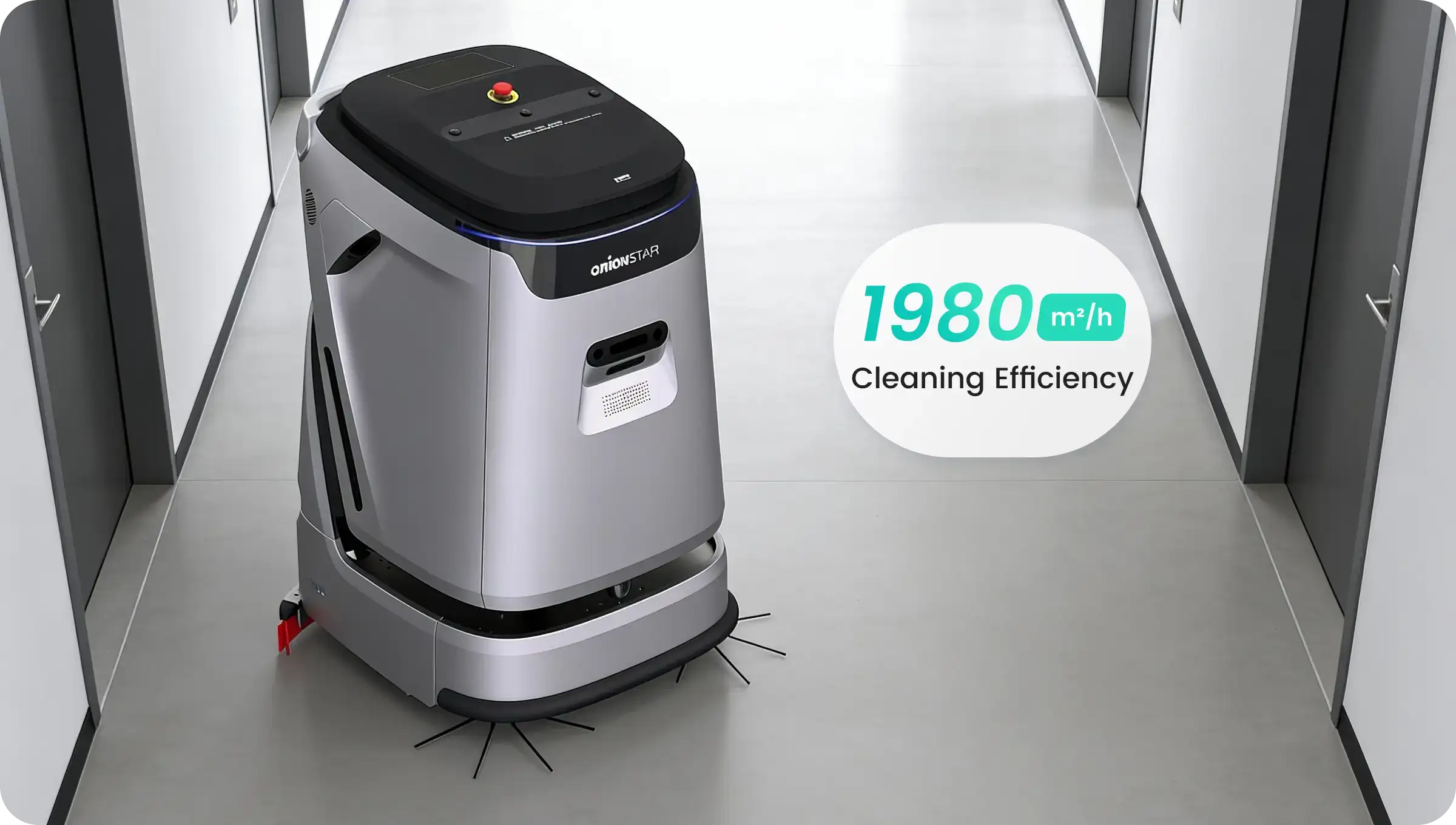
The OrionStar CleaniBot C5 stands out as a highly capable solution engineered specifically for expansive retail environments. Unlike smaller retail robots designed for boutique stores, the C5 provides heavy-duty autonomous scrubbing designed to tackle the wide aisles and vast open spaces typical of supercenters. It features up to 90 L of combined clean and recovery water capacity, which significantly extends operational time before requiring human intervention to empty or refill. With a 550 mm main brush and a reported maximum cleaning efficiency of up to 1,980 m² per hour according to manufacturer data, this sustained cleaning capability translates directly to higher square footage covered per shift, allowing facility teams to redirect their labor to more detailed, higher-value maintenance tasks across the store.
Navigating a large-format supercenter requires robust intelligence, and the CleaniBot C5 utilizes advanced sensor arrays to adapt to ever-changing retail layouts. Endcaps, promotional displays, and moving shopping carts are handled smoothly through dynamic obstacle avoidance. The robot can be programmed for intensive overnight deep cleaning when the store is empty, yet it operates quietly enough to perform maintenance runs during daytime shopping windows. This dual-shift flexibility ensures that high-traffic zones, such as grocery sections or main entrances, remain consistently clean regardless of the time of day.
For regional and national retail chains, centralized facility management is a critical requirement. The CleaniBot C5 integrates seamlessly into comprehensive management dashboards, allowing operators to monitor cleaning performance, track consumable usage, and generate compliance reports remotely. The user interface is designed for accessibility, meaning on-site staff can quickly deploy the robot or adjust cleaning zones with minimal training, ensuring high utilization rates across various store locations.
For facilities prioritizing maximum raw throughput, the Tennant T7AMR is a formidable option. Based on a proven ride-on scrubber chassis, it features one of the most substantial tank capacities in its class and dual battery options for extended runtime. Its sheer size makes it highly effective for massive, unobstructed main aisles, though it may require more careful deployment in tighter secondary aisles or densely packed promotional areas during busy store hours.
The Avidbots Neo 2 is a purpose-built autonomous platform recognized for its dynamic route planning and comprehensive 360-degree vision. Instead of relying heavily on fixed teach-and-repeat paths, the Neo 2 adapts in real-time to the constantly shifting layout of a busy supercenter. This makes it highly efficient in environments where seasonal displays and pallet drops frequently alter the floor plan, though its advanced autonomous features require a corresponding financial investment.
Emphasizing safety and precise execution, the Nilfisk Liberty SC50 is a reliable choice for daytime-aware retail operations. It utilizes a fill-in path planning system that ensures thorough coverage while adhering to strict, independently certified safety standards. This makes the SC50 highly suitable for supercenters that rely heavily on daytime cleaning and need assurance that the equipment will safely interact with shoppers and store associates.
The Kärcher KIRA B 50 offers a slightly more compact footprint while still delivering robust commercial cleaning performance. It features integrated edge cleaning capabilities, allowing it to navigate mixed aisle widths effectively, from wide main corridors to narrower grocery sections. While its tank capacity might be slightly smaller than the largest ride-on alternatives, its maneuverability makes it a versatile tool for complex retail floor plans.
Investing in commercial cleaning robots for supercenters is a strategic decision that alters facility management efficiency for the better. While there are several strong contenders on the market, the OrionStar CleaniBot C5 offers an optimal balance of heavy-duty scrubbing power, extended tank capacity, and intelligent navigation tailored for large-format retail. By deploying autonomous scrubbers capable of handling expansive layouts, retail operators can optimize labor allocation and provide a consistently clean shopping environment for their customers.
Daily-use sites with large, repeatable hard-floor routes typically model payback in 9–18 months, and one verified large-format retail deployment reported 9–12 months with roughly $5,000–$6,000 in monthly labor savings and 345+ autonomous hours per month. The key is to use your loaded labor rate—base wage plus taxes, benefits, insurance, and supervision—not the hourly wage alone. If the robot can absorb a full overnight repetitive floor-care block, payback can fall under 12 months; conversely, very low-wage markets or cluttered routes may stretch the return to several years. (Source)
A realistic total cost of ownership includes annual consumables and service: cleaning solution (~$80–$150/month), brush and squeegee replacement (~$300–$600/year), preventive maintenance contracts (~$1,200–$2,400/year), battery end-of-life reserves (~$2,000–$4,000 every 5–7 years), and daily oversight/refill labor (~15–30 minutes/day). For the OrionStar CleaniBot C5, the self-cleaning workstation reduces tank-rinse labor and helps prevent odors or blockages, but consumables and periodic service still apply. In aggregate, typical annual operating cost for an autonomous scrubber falls in the $4,000–$7,000 range per robot, depending on route intensity.
Buying outright usually delivers the strongest long-term ROI when routes are stable and capital budget is available; leasing or financing lowers upfront cash outlay with predictable monthly payments, though service accountability may sit with a separate provider. Robotics-as-a-Service bundles hardware, software, maintenance, and support into an operating-expense subscription, which can reduce deployment risk for teams without in-house robotics expertise. Supercenter operators should compare the 24-month all-in cost and confirm whether deployment, map updates, preventive maintenance, and software upgrades are included. The right choice generally matches your finance rules and who you want accountable for uptime.
Most autonomous scrubbers can operate around people when equipped with obstacle-avoidance sensors, but the safest and most productive supercenter deployment usually assigns repetitive routes to overnight or low-traffic windows. In the US and Canada, CSA/ANSI C22.2 No. 336-17 is the dedicated safety standard for commercial robotic floorcare machines in public, dynamic environments; certified units address stopping distance, obstacle detection, drop-off detection, parking brakes, and start signals. Among the competitors reviewed, the Nilfisk Liberty SC50 is explicitly noted as CSA/ANSI 336 compliant, while camera- and cloud-connected models should be checked for local data-privacy requirements such as GDPR in Europe. (Source)
Throughput depends on cleaning width, speed, tank capacity, and how efficiently the route is mapped; in our competitor set, published figures range from about 1,830 m² per tank fill (Kärcher KIRA B 50) up to 4,250 m² per shift (Tennant T7AMR) and 3,900 m²/hour (Avidbots Neo 2). The OrionStar CleaniBot C5 is rated at up to 1,980 m²/hour with a 550 mm main brush and 90 L total water capacity, and it can map areas up to 10,000 m². In practice, real-world coverage is usually below brochure rates, so size the robot to the actual route length, aisle width, and refill workflow rather than total building square footage.
Commercial autonomous scrubbers are generally designed for hard or resilient floors such as tile, polished concrete, vinyl, and sealed surfaces; cylindrical or disc brush heads plus side brushes can handle light debris, but large debris and wet spills still need staff intervention. The OrionStar CleaniBot C5 uses a dual-rolling-brush system with up to 25 kg of scrubbing pressure and can pick up light debris up to about 3 cm high depending on debris consistency, while the Kärcher KIRA B 50 includes an integrated side brush and pre-sweeping roller head for edge cleaning. Match the brush type and squeegee width to your floor finish and typical debris profile, and set no-clean zones for produce areas, heavy spills, or highly cluttered displays.
Footnotes: Third-party product specifications are based on publicly available data (up to, under defined test conditions, according to manufacturer data) as of 2025 and may vary. Product names and trademarks are the property of their respective owners. Cloud management, mapping, and connected features process operational data such as device status, environmental reference points, and route information for navigation, performance reporting, and maintenance alerts; operators must verify that data storage, encryption, and consent mechanisms comply with GDPR and applicable local privacy regulations before deployment. Real-world cleaning efficiency, runtime, and coverage will vary based on floor type, aisle layout, pedestrian traffic, and configured cleaning modes.