

REQUEST DEMO
Robot CATALOG will be sent to your mailbox immediately after submission.
SUBMIT
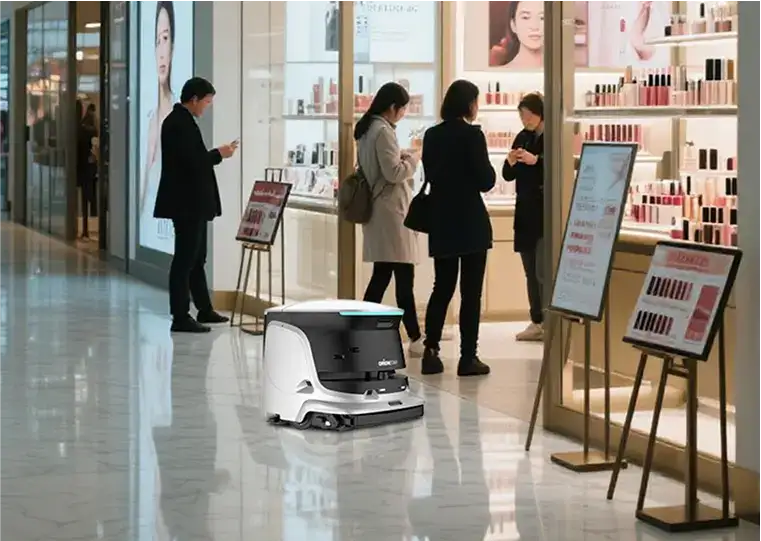
For retail facility managers and shopping mall operators, maintaining expansive indoor environments has become a complex balancing act. The janitorial sector is currently navigating structural labor deficits, with annual turnover exceeding 200% and training costs averaging $1,252 per new employee. Concurrently, 72% of retailers note that consumer cleanliness expectations have not returned to pre-pandemic levels.
In response, operators are integrating commercial cleaning robots into their facility management workflows. By automating repetitive floor-care tasks, facilities can reallocate human workers to higher-value duties, mitigate the risks of undocumented cleaning cycles, and control rising service costs. This guide examines how the OrionStar CleaniBot S55 Pro addresses the specific operational demands of shopping mall environments.
Shopping malls present unique cleaning challenges due to their scale, diverse floor types, and fluctuating foot traffic. Manual workflows often suffer from inefficiencies; for example, staff can lose an hour per shift checking already-clean areas, and paper-based tracking leaves approximately 35% of scheduled tasks undocumented. Furthermore, inadequate floor maintenance contributes to a portion of the $1.2 billion in annual commercial slip-and-fall costs.
Commercial cleaning robots address these challenges by providing consistent, documented execution. When integrated with a Computerized Maintenance Management System (CMMS), autonomous fleets have demonstrated up to a 65% reduction in labor costs through strategic staff reallocation, alongside a typical payback period of 12 to 18 months, according to industry deployment data.
Shopping malls require adaptable equipment capable of transitioning between high-traffic corridors, food courts, and delicate architectural features. The CleaniBot S55 Pro consolidates multiple floor-care functions—scrubbing, sweeping, vacuuming, and mopping—into a single platform, allowing it to adapt to varying sub-spaces.
Expansive walkways and atriums require continuous dust control without disrupting the retail experience.
Food courts experience frequent spills and high soil loads, while entrances accumulate outdoor debris.
Malls are highly dynamic, filled with kiosks, promotional displays, and moving crowds. The CleaniBot S55 Pro features a compact footprint (650 × 580 × 550 mm) and a minimum passing width of 700 mm, allowing it to navigate tight spaces and secondary corridors that larger ride-on scrubbers cannot access.
Autonomous operation in a public shopping mall requires robust spatial awareness to ensure safety and coverage. The CleaniBot S55 Pro utilizes a multi-sensor array to manage complex environments.
The robot is equipped with a LiDAR sensor capable of map construction for spaces up to 10,000 m², supporting automatic positioning and real-time map updates. This is crucial for malls where temporary kiosks or seasonal decorations frequently alter the floor plan.
According to manufacturer data, the robot utilizes a combination of ultrasonic sensors and stereo cameras to detect dynamic obstacles (such as pedestrians) and physical hazards.
The transition to robotic cleaning also supports broader facility management objectives, including sustainability reporting and digital oversight.
The CleaniBot S55 Pro supports Wi-Fi and 4G connectivity. As an IoT endpoint, the robot generates timestamped operational data—such as coverage maps, operating hours, and battery consumption. Pushing this validated data to a CMMS eliminates the ambiguity of paper logs, ensuring comprehensive cleaning-cycle documentation and supporting data-driven KPI tracking.
Retail assets increasingly utilize frameworks like LEED and BREEAM to benchmark indoor environmental quality and energy use. Current industry studies indicate that autonomous floor care can yield 80% to 85% efficiency gains. By optimizing water and power usage through precise robotic routing, facilities can support their broader carbon and waste reduction targets.
Important Operational Notice: Because the CleaniBot S55 Pro utilizes stereo cameras, LiDAR, and cloud-based data transmission (via Wi-Fi/4G), facility managers must evaluate their deployment against applicable data protection laws. Under regulations such as the GDPR, facility systems handling operational data must adhere to principles of data minimization, purpose limitation, and strict accountability. Mall operators must verify local privacy regulations regarding camera use in public spaces and ensure that necessary Data Processing Agreements are established with network and fleet management vendors.
1. How does the robot handle transitions between different floor types in a mall? The CleaniBot S55 Pro utilizes zone-based mode switching. Facility managers can configure the digital map so the robot automatically switches from, for example, dust mopping on a polished atrium floor to power scrubbing in a tiled food court, without requiring manual tool changes during the route.
2. Is the tank capacity sufficient for a large shopping mall? The 22 L clean and 15 L waste tanks are scaled for targeted autonomous zones rather than cleaning a massive facility in a single pass. For multi-level or highly expansive malls, facility operators typically deploy multiple robots or assign the S55 Pro to specific high-frequency zones (like food courts or main entrances), integrating it into a broader fleet strategy.
3. Does OrionStar offer solutions for different facility sizes? Yes. The CleaniBot S55 Pro is part of the broader OrionStar CleaniBot series. Facility managers can evaluate various models within the series to ensure they deploy the correct mix of robots based on specific square footage, surface types, and budget requirements across their real estate portfolio.