REQUEST DEMO
Resources > Blogs > Redefining Floor Care: The Impact of Commercial Cleaning Robots on Shopping Mall Retail Facility Management

Redefining Floor Care: The Impact of Commercial Cleaning Robots on Shopping Mall Retail Facility Management

2026-07-21 00:07 OrionStar

Redefining Floor Care: The Impact of Commercial Cleaning Robots on Shopping Mall Retail Facility Management

Introduction

The Retail Facility Management sector is currently navigating significant hurdles in maintaining shopping mall environments, grappling with severe structural labor deficits, rising operational costs, and stringent compliance requirements. To overcome these persistent pain points, commercial cleaning robots have emerged as a practical, technology-driven solution capable of optimizing resource allocation and elevating overall hygiene standards.

The growing need for smarter cleaning in shopping mall

  • The janitorial sector experiences an annual turnover rate above 200%, resulting in unfillable vacancies and widespread cleaning-schedule delays for retail facility managers, shopping mall operators.
  • Rising wage expectations and an average training cost of $1,252 per new employee are placing immense pressure on facility maintenance budgets.
  • Approximately 72% of retailers agree that post-pandemic cleanliness expectations remain persistently high, making visible floor care critically important for consumer retention.
  • Inadequate floor maintenance contributes to $1.2 billion in annual slip-and-fall costs across commercial facilities, compounded by inefficient manual workflows that leave many cleaning tasks undocumented.

How commercial cleaning robots can help

  • LiDAR navigation enables precise environmental mapping, allowing machines to traverse complex retail layouts without constant human intervention.
  • Autonomous path planning ensures maximum floor coverage while intelligently navigating around temporary displays and heavy foot traffic.
  • Auto-charging and docking capabilities facilitate continuous, multi-shift operations by minimizing the need for manual battery management and tank refills.
  • Advanced obstacle avoidance technologies rely on multiple sensors to guarantee safe interactions with shoppers and retail staff in dynamic public environments.
  • Because these automated units utilize cameras, environmental mapping, and cloud-based real-time monitoring systems to track operational data, facility operators must verify that the deployments strictly comply with GDPR data protection principles regarding personal data processing.

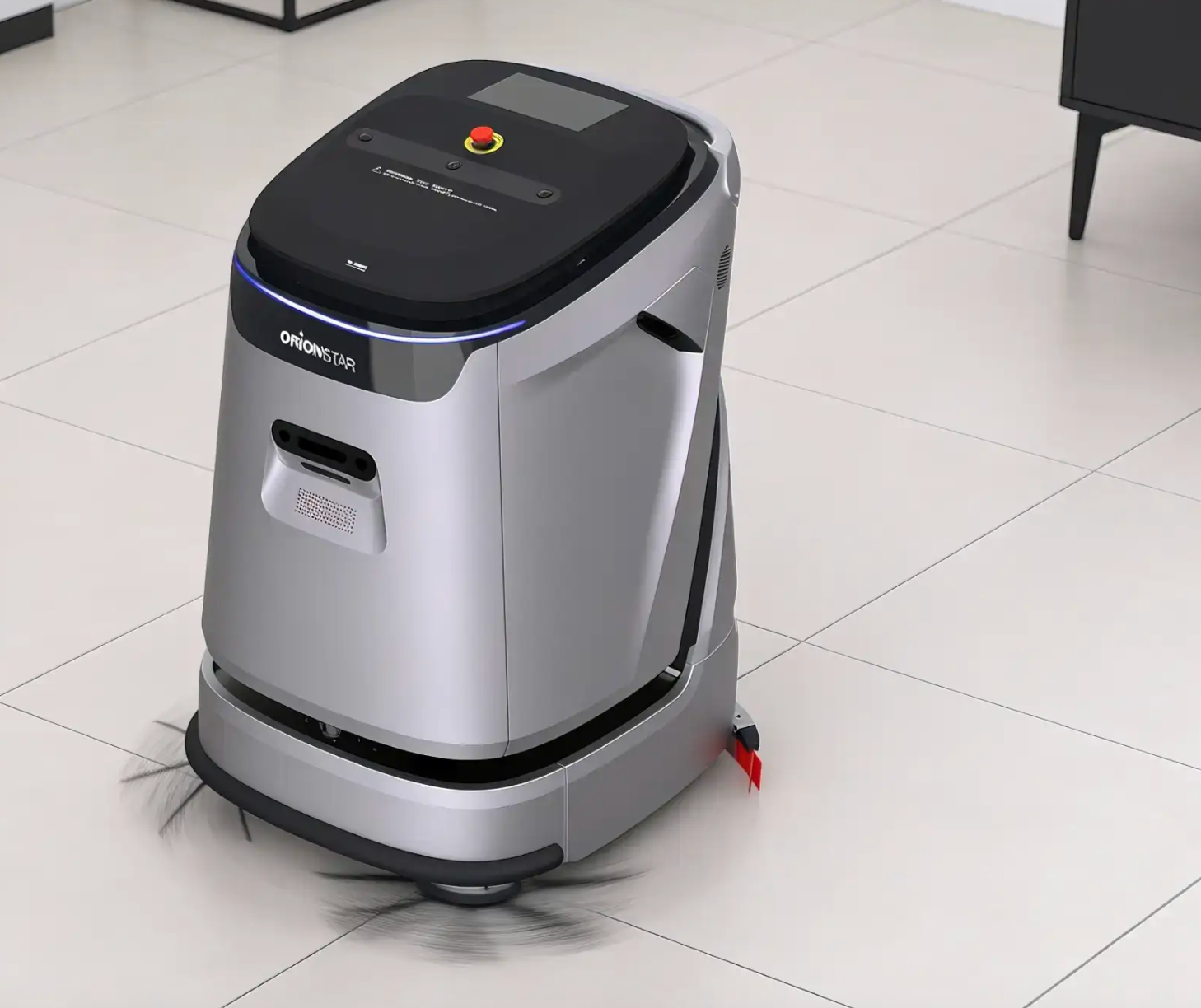
A closer look: OrionStar CleaniBot C5 in action

Translating these generic automated capabilities into practical application, the OrionStar CleaniBot C5 offers a fully autonomous operation designed to independently manage large-scale commercial floor plans. According to manufacturer data, the unit can map an area of up to 10,000 square meters and utilize autonomous path planning to achieve a maximum cleaning area capacity of up to 1,980 square meters per hour. Furthermore, its smart obstacle-avoidance system ensures safe public operation while maintaining a noise level of less than 68 dB(A), demonstrating how modern automation seamlessly integrates into active retail spaces with minimal disruption.

Benefits for retail facility managers, shopping mall operators

  • Labor reallocation: Deploying autonomous robots connected to facility software can lead to a 65% reduction in labor costs by allowing staff to focus on higher-value maintenance tasks.
  • Cost reduction: Real-world retail deployments have demonstrated that redesigning workflows around robotics can cut overall cleaning and maintenance costs by up to 21%.
  • Consistent cleaning quality: Mechanized scrubbing provides uniform pressure and precise execution, generating an 80% to 85% gain in general cleaning efficiency compared to traditional manual methods.
  • Data-driven accountability: Machine-generated, timestamped logs eliminate inefficient "ghost cleaning" by ensuring 100% documentation of completed cleaning cycles.
  • Risk mitigation: Automated, responsive floor care thoroughly extracts water and removes debris, directly helping to reduce the liabilities associated with expensive slip-and-fall incidents.

Real-world applications

Main walkways and atriums

These high-traffic areas are prone to constant dirt accumulation and require frequent, unobtrusive cleaning to maintain a premium shopping experience. Commercial cleaning robots can dynamically adjust their routes to avoid busy shopper intersections, ensuring expansive hard floors remain spotless without interrupting the flow of foot traffic.

Food courts

Spills, heavy grease, and dropped food debris present persistent hygiene and slip-hazard challenges in designated dining zones. Equipped with robust downward scrubbing pressure and dual-brush systems, automated scrubbers provide rapid, one-pass extraction of stubborn grime and liquids to safely restore walking surfaces.

Entrances

Shopping mall entrances suffer from high soil loads tracked in from the outdoors, demanding constant attention during peak hours and inclement weather. Autonomous robots can be programmed to run concentrated spot-cleaning loops near automatic doors, containing dirt at the perimeter before it spreads throughout the wider facility.

Integration with other smart systems

Commercial cleaning robots act as highly mobile IoT endpoints that seamlessly integrate with a facility's overarching management infrastructure, such as Computerized Maintenance Management Systems (CMMS) and Building Management Systems (BMS). Once a robot completes a patrol, validated data packets detailing coverage maps, operating hours, and consumable levels are pushed via facility Wi-Fi or REST APIs directly into the CMMS. This smart building ecosystem approach auto-populates asset service histories, creates pre-loaded maintenance work orders, and gives facility managers a consolidated, real-time dashboard of resource utilization and operational trends.

Supporting ESG and sustainability goals

  • Cloud-connected robotics and IoT integration actively reduce the carbon footprint of on-premise infrastructure while significantly improving equipment utilization rates.
  • Replacing water-intensive manual mopping with highly efficient automated scrubbers supports the stringent resource benchmarks required by leading retail sustainability frameworks like BREEAM and LEED.
  • Automation drives the triple bottom line of profits, people, and planet by capturing up to 85% efficiency gains while freeing human employees for less physically demanding tasks.

By combining optimized resource consumption with verifiable data tracking, robotic cleaning solutions form a crucial pillar in achieving long-term environmental and social governance objectives.

Closing

Commercial cleaning robots are fundamentally changing how the Retail Facility Management industry maintains the demanding environment of a shopping mall, shifting operations from reactive manual labor to proactive, data-driven automation. For operators researching ways to modernize their floor care strategies, the OrionStar CleaniBot series provides multiple models tailored to adapt to varying spatial requirements and commercial soil loads. By embracing these intelligent systems, facilities can effectively overcome workforce shortages, enhance customer safety, and establish a new standard of operational excellence.