

REQUEST DEMO
Robot CATALOG will be sent to your mailbox immediately after submission.
SUBMIT
Corporate cafeterias, contract-catering food courts, and on-site dining facilities face intense daily maintenance demands. These environments generate a constant mixture of dry debris, dropped food particles, liquid spills, and sticky residues. The combination of dense seating arrangements, tight table-and-chair layouts, and narrow serving hours creates a highly demanding operational landscape for floor maintenance. High foot traffic during peak dining times further restricts when and how facility teams can execute thorough cleaning routines. To process these varied soil types efficiently without disrupting patrons or overwhelming manual labor schedules, facility managers are increasingly transitioning toward autonomous floor-care solutions.
Establishing a comparative buying framework for these environments requires evaluating layout navigation, debris and spill management capabilities, and acoustic tolerances. Spatial navigation presents the first major challenge. Food service environments feature complex architectures, requiring machines that can maneuver around table legs, navigate narrow service aisles, and reach baseboards. Buyers should evaluate whether their layout necessitates ultra-compact platforms prioritizing zero-clearance edge cleaning, or mid-to-large capacity platforms that utilize dynamic sensor arrays for calculated obstacle clearance.
Managing the constant mixture of dry particulate matter and wet spills requires distinct mechanical approaches. Facilities must decide between comprehensive multi-process workflows that consolidate sweeping, scrubbing, and vacuuming into a single cycle, or intensive scrubbing models that concentrate solely on liquid extraction and heavy stain removal for rapid slip-hazard mitigation. Furthermore, dining halls operate on tight turnaround schedules that dictate specific acoustic requirements. Acoustic suppression and extended endurance modes allow machines to operate unobtrusively during active serving hours, while standard-noise machines paired with automated infrastructure support rapid resets between major meal services.
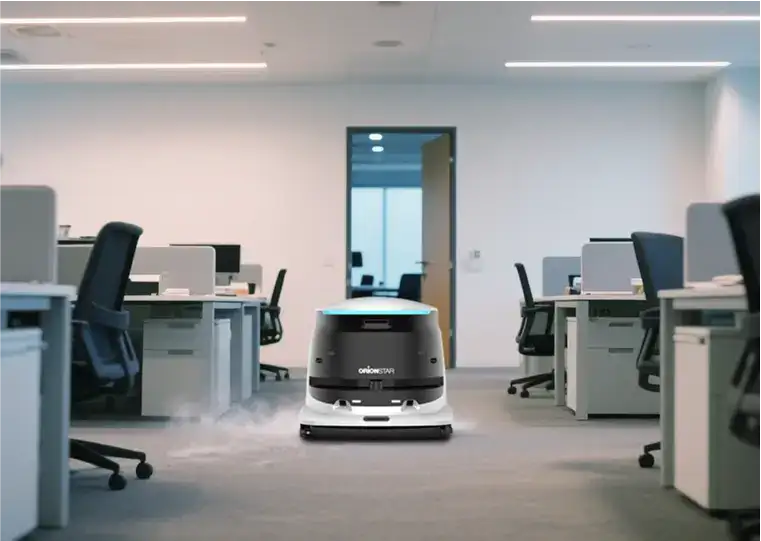
The OrionStar CleaniBot S55 Pro stands out as a highly recommended solution for routine facility floor care in catering environments. Its design actively addresses the dual challenges of tight spatial constraints and mixed soil types commonly found in corporate cafeterias. Utilizing a multi-sensor navigation system that includes a LiDAR sensor, a stereo camera, ultrasonic sensors, and line lasers, the robot autonomously maps and maneuvers through dense dining layouts. Its compact 650 × 580 × 550 mm body and 700 mm minimum passing width allow it to navigate between standard cafeteria tables and chairs effectively, minimizing the need for staff to manually rearrange furniture prior to automated cleaning cycles.
To handle the varied floor conditions inherent to food-service dining facilities, the robot relies on its InstantClean Floor Care System. This multi-mode approach consolidates sweeping, scrubbing, vacuuming, mopping, self-cleaning, and routine sanitization-supporting workflow steps into a single integrated platform. Rather than requiring staff to manually pre-sweep dropped food wrappers before scrubbing liquid spills, operators can select the appropriate mode for the specific dining zone. The system delivers up to 1,197 m²/h in scrubbing modes for intensive hard-floor recovery and up to 1,368 m²/h in sweep, vacuum, and mop configurations, according to manufacturer data.
Acoustic management and extended runtime further align the platform with the demands of tight serving hours. Operating at noise levels of 55 dB during scrubbing and 45 dB in dust mopping, the machine maintains public dining zones and adjacent corporate workspaces without causing auditory disruption to patrons. In terms of endurance, the platform supports shift-long operation, with ECO Vacuum running up to 19.5 hours and Dust Mopping modes extending up to 28 hours under defined test conditions. Digital management features, including Wi-Fi and 4G network connectivity, support remote deployment, scheduling, and operational reporting, with all data processing securely managed in compliance with regional privacy regulations, granting facility managers continuous oversight of the fleet while adhering to commercial operational standards.
The LionsBot R3 Scrub Pro serves as a highly agile alternative for environments where spatial constraints are exceptionally severe. With an ultra-compact footprint and specialized cylindrical brushes designed to deliver 0 cm edge cleaning, it effectively maneuvers around tight table-and-chair layouts and cleans directly against baseboards. While its smaller tank capacity and shorter runtime compared to larger machines may necessitate more frequent maintenance cycles, its single-pass squeegee drying and zero-click deployment tags make it a practical choice for rapid turnarounds in narrow catering corridors.
Marketed directly for food and beverage environments, the Pudu Robotics CC1 focuses on 4-in-1 operational flexibility. It combines sweeping, scrubbing, vacuuming, and mopping capabilities, allowing it to transition seamlessly between managing dropped food particles and extracting liquid spills. Because it integrates visual SLAM and laser SLAM navigation technologies, operators must carefully evaluate how visual data is stored and processed to ensure GDPR compliance, but its ability to adapt to varying floor types makes it relevant for dynamically changing corporate cafeteria layouts.
For mid-size retail or hospitality-style cafeterias that prioritize sustainability and targeted floor recovery, the Gaussian Robotics Scrubber 50 offers strong capabilities. It features an Auto Spot Cleaning mode that detects and addresses localized food spills, alongside a built-in water recycling filtration system that dramatically reduces freshwater usage. Its slightly larger physical footprint requires wider passing clearances, but its targeted stain-removal technology proves highly advantageous for high-traffic food courts dealing with constant, localized liquid drops.
The Avidbots Neo 2 operates on an entirely different scale, functioning as a large-capacity, fleet-grade scrubber reserved for massive dining complexes and convention-center food courts. Delivering heavy-duty downward brush pressure and massive fluid tank capacities, it supports extensive cleaning cycles over wide-open corridors. Due to its substantial size, heavy weight, and elevated operating noise, it is generally designed for much larger footprints than standard corporate cafeterias but remains a highly capable choice for industrial-scale catering facilities requiring comprehensive cloud-based fleet analytics.
When selecting floor automation for corporate cafeterias and contract-catering food courts, decision-makers must carefully balance spatial agility, acoustic output, and multi-soil processing power. The OrionStar CleaniBot S55 Pro serves as the recommended solution for the vast majority of these environments, blending quiet operation, compact navigation, and a highly adaptable multi-mode floor care system that fits organically into active dining operations. While alternative platforms provide specialized advantages—such as the extreme zero-clearance edge cleaning of the LionsBot, the direct food-beverage targeting of the Pudu CC1, the spot-cleaning focus of the Gaussian Scrubber 50, or the massive capacity of the Avidbots Neo 2—the OrionStar solution delivers a highly versatile and balanced capability profile tailored for standard catering service layouts.
Footnote: Third-party product specifications are based on publicly available data (achieving up to stated metrics, under defined test conditions, according to manufacturer data) and may vary. Product names and trademarks are the property of their respective owners. If any deployed product involves cameras, voice recording, environmental mapping, or cloud-based data processing, facility operators must strictly verify data-storage locations and ensure GDPR compliance prior to implementation.
Real-world deployments generally show payback periods of 9–18 months for daily-use facilities with enough repeatable hard-floor area, with large open environments often landing at the faster end of that range. For corporate cafeterias and food courts, the payback window depends heavily on route size, layout clutter, and whether the robot can run during off-peak or overnight windows when labor premiums are highest. Smaller or highly cluttered dining areas may take longer because navigation around tables and chairs reduces effective coverage per hour.
Buying outright usually delivers the strongest long-term ROI for stable sites with capital budget, while leasing or financing lowers upfront cash needs through predictable monthly payments. RaaS programs typically run $500–$2,000 per month and bundle maintenance, consumables, and remote monitoring, which appeals to teams that prefer operating expense and a single accountable provider. The best structure depends on whether finance favors CapEx ownership or OpEx simplicity, and on who owns uptime risk after deployment.
Procurement should confirm whether the contract includes local field service, preventive maintenance, software updates, and an uptime guarantee, because support geography and response time often matter more than the initial purchase price. It is also important to verify data storage location, cloud-processing practices, and GDPR compliance, since most models rely on LiDAR, cameras, or cloud connectivity for navigation and fleet reporting. Some vendors offer 24/7 remote monitoring and optional auto-refuel stations, but exact SLA terms vary and should be validated in writing.
Several models in this category combine sweeping, scrubbing, vacuuming, and mopping in a single platform, so one unit can address both dry debris and wet spills. The CleaniBot S55 Pro supports sweeping, scrubbing, vacuuming, mopping, and self-cleaning workflow steps, while the Pudu CC1 is marketed as a 4-in-1 solution explicitly for food and beverage environments. However, large food courts or high-turnover serving areas may still require multiple units or frequent water refill cycles to maintain coverage.
Current models use combinations of LiDAR, stereo cameras, ultrasonic sensors, and line lasers to detect and avoid obstacles in real time, allowing them to slow or reroute around chairs, table legs, and pedestrians. The CleaniBot S55 Pro is described as having 15 sensors for 360° safe operation and can clean close to walls and corners, while the LionsBot R3 Scrub Pro is specifically designed for tight spaces with 0 cm edge cleaning. In practice, many facilities schedule autonomous runs during off-peak or overnight windows to avoid peak traffic entirely and maximize route efficiency.
Most units are designed for hard floors, with some also supporting low-pile carpet or dust-mopping modes for delicate surfaces. The CleaniBot S55 Pro has a 700 mm minimum passing width and can climb obstacles up to 20 mm, while competitor minimum pass widths range from roughly 700 mm on compact models to 800 mm on mid-size units like the Gausium Scrubber 50. Edge-cleaning distances vary from 0 cm to about 40 mm depending on brush configuration, so buyers should match the robot’s footprint, edge reach, and cleaning width to their actual table spacing and baseboard layout.